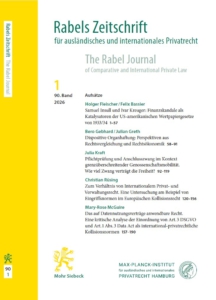
 Issue 1 of RabelsZ 90 (2026) has just been released. It contains the following articles which are all available Open Access: CC BY 4.0:
Holger Fleischer, Felix Bassier, Samuel Insull und Ivar Kreuger: Finanzskandale als Katalysatoren der US-amerikanischen Wertpapiergesetze von 1933/34 [Samuel Insull and Ivar Kreuger: Financial Scandals as Catalysts of US Securities Law from 1933 and 1934], pp. 1–57, https://doi.org/10.1628/rabelsZ-2026-0008
The US securities laws from 1933 and 1934 remain to this day the international benchmark for modern capital market regulation. Like many other regulations in this area, the legislation was preceded by major scandals. This article reconstructs the two leading scandals surrounding electricity magnate Samuel Insull and »Match King« Ivar Kreuger. After situating them within the spectrum of scandals occurring in the Roaring Twenties, the article considers these incidents in the larger context of research on corporate law scandals.
Bero Gebhard, Julian Greth, Dispositive Organhaftung: Perspektiven aus Rechtsvergleichung und Rechtsökonomik [Contracting Around Director Liability: Perspectives from Comparative Law and Law & Economics], pp. 58–91, https://doi.org/10.1628/rabelsz-2025-0070
The business judgment rule is intended to protect managers and board members from personal liability in connection with business decisions, thereby enabling risk-optimized decision-making. However, the requirements of an adequate information base and reasonableness preserve incentives for risk-averse behaviour, and the possibility of erroneous evaluations of business decisions by courts creates further incentives for board members to shy away from risk, yet such risk aversity is inefficient in a diversified shareholder structure. This article examines mechanisms for excluding the personal liability of board members in Delaware (USA) and Switzerland. The policy reference point is the ex ante dispositive liability regime under § 102(b)(7) Delaware General Corporation Law, whereas Swiss corporate law relies on less effective ex post mechanisms. The authors call for the implementation of an opt-out model for liability due to breaches of duty of care, similar – but not identical – to the legal framework in Delaware; such a model could be especially beneficial to high-growth companies. To this end, a policy proposal is developed that should also allow for exemption from liability for gross negligence.
Julia Kraft, Pflichtprüfung und Anschlusszwang im Kontext grenzüberschreitender Genossenschaftsmobilität. Wie viel Zwang verträgt die Freiheit? [Mandatory Audits, Membership in Umbrella Organizations, and the Cross-border Mobility of Cooperatives.
How Much Constraint Is Still Freedom?], pp. 92–119, https://doi.org/10.1628/rabelsZ-2026-0003
The cross-border mobility of companies is an expression of the freedom of establishment, which also applies to cooperatives, as emphasized in Art. 54(2) of the TFEU. But German cooperative law doubly constrains the freedom of establishment. First, every registered cooperative (eingetragene Genossenschaft, eG) under German law is subject to mandatory periodic audits. Second, cooperatives must belong to an umbrella organization that the state has authorized to perform the audits. Both obligations – core elements of the German act on cooperatives – may conflict with the freedom of establishment. Considering the German government’s 25 June 2025 draft of an act to »Strengthen the Legal Form of the Cooperative«, this article explores the tension between regulatory constraints and the freedom of establishment and assesses whether the requirements imposed by German cooperative law are compatible with it.
Christian Rüsing, Zum Verhältnis von Internationalem Privat- und Verwaltungsrecht.
Eine Untersuchung am Beispiel von Eingriffsnormen im Europäischen Kollisionsrecht [The Relationship between Private International Law and Administrative International Law. The Example of Overriding Mandatory Provisions in EU Conflict of Laws]m pp. 120–156, https://doi.org/10.1628/rabelsZ-2026-0005
The relationship between private international law and administrative international law is rarely examined in detail. Yet both areas would benefit from considering the other. In the context of private international law, this is particularly pertinent in relation to overriding mandatory provisions. In the HUK-Coburg II case, the CJEU recently established two unwritten requirements for the enforcement of these provisions: Courts may enforce such provisions only if, first, the legal situation in question has sufficiently close links with the Member State of the forum and, second, the public interest cannot be achieved through the application of the lex causae. This article demonstrates that the criterion of a sufficiently close link with the Member State of the forum is viewed differently when considered alongside the principles of administrative international law. The second requirement, the necessity test, has – among other things – a significant influence on approaches to coordinating administrative and private international law through the instrument of overriding mandatory provisions. The article therefore examines how both areas can be better coordinated, at least within the internal market.
Mary-Rose McGuire, Das auf Datennutzungsverträge anwendbare Recht.
Eine kritische Analyse der Einordnung von Art. 3 DSGVO und Art. 1 Abs. 3 Data Act als international-privatrechtliche Kollisionsnormen [The Law Applicable to Data Sharing Agreements. A Critical Analysis of the Classification of Article 3 GDPR and Article 1(3) Data Act as Conflict-of-law Rules under Private International Law], pp. 157–190, https://doi.org/10.1628/rabelsZ-2026-0007
The European legislature has issued a series of legal acts aimed at creating a European data space. Common to these instruments is that they establish a regulatory framework for this data space but leave it to be filled by the relevant actors through a network of contracts. The acts include only isolated requirements for these contracts, and their conclusion, validity, and termination is otherwise governed by national law. With regard to such data use contracts, harmonized private international law does not yet provide any specific rules. The two central legal acts – the GDPR and the Data Act – contain provisions only on the territorial scope of application. Against this background, it is subject to debate whether the general conflict-of-law rules of the Rome I and Rome II Regulations apply or are superseded by conflict-of-law rules “hidden” in the rule on the scope of application. Practical differences arise particularly with regard to the admissibility of choice of law and the applicability of European data law in relation to third countries. The analysis shows that a reliable determination of the applicable law requires distinguishing between the existence of rights to data, contracts relating to data, and breaches of obligations relating to data. The article advocates application of the Rome Regulations on determining the law applicable to contracts and torts with adaptation to the specific characteristics of the digital space.
BOOK REVIEWS
This issue also contains several reviews of literature in the fields of comparative private and private international law and on related topics (pp. 191–221).

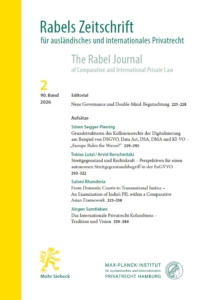 The latest issue of RabelsZ has just be released. It contains the following articles as well as an editorial with important information regarding the journal’s future governance structure and publication process. All content is Open Access: CC BY 4.0.
 Issue 2 of RabelsZ 89 (2025) is out. All content is
 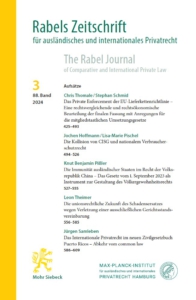 Issue 3 of RabelsZ 2024 has just been released. It contains the following articles:
 The latest issue of RabelsZ has just been released. In addition to the following articles it contains fantastic news (mentioned in an