
Revue Critique de droit international privé – issue 2023/4


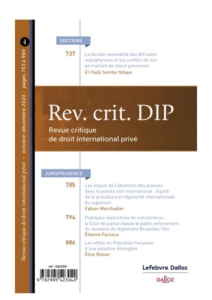 Written by Hadrien Pauchard (assistant researcher at Sciences Po Law School)
The fourth issue of the Revue critique de droit International privé of 2023 (available here) was released online some time ago. It features two articles and several case notes. The non-French speaker will be pleased to find that, for the first time, the articles have been made available in English on the editor’s website (for registered users and institutions).
By opening new horizons beyond French private international law, the doctrinal part of the volume sheds light on the role played by conflict of laws in a legal anthropology.
The first article authored by Dr. El Hadji Samba Ndiaye (Université de Cheikh Anta Diop de Dakar) is dedicated to La double nationalité des Africains subsahariens et les conflits de lois en matière de statut personnel (Dual nationality of sub-Saharan Africans and conflicts of law in matters of personal status). Its abstract reads as follows:
The principle of precedence of the nationality of the forum has an undeniable foundation in African private international law. Fortunately, however, it does not converge with the dynamics of migration of Africans towards the West and the contemporary diasporic realities. Dual nationality becoming more and more a reality in sub-Saharan Africa, it is urgent to review the treatment it receives in the field of conflicts of laws in matters of personal status when the African courts are the subject of direct referral to the proportion of dual Africans nationals who obtained a naturalization decree during their stay in the West. Taking advantage of the singularities shared between the conflict mobile and the positive conflict of nationalities, this analysis suggests applying to African dual nationals the law of their secondarily acquired nationality corrected, if possible, by the exception of dual nationality.
In the second article, Pr. Sabine Corneloup (Université Paris Panthéon-Assas) discusses L’appréhension des mariages d’enfants célébrés à l’étranger. Droit international privé et droits fondamentaux (Engaging with child marriages celebrated abroad. Private international law and fundamental rights). The abstract reads as follows:
While the fight against child marriages is a widely shared international objective, the choice of the best way to deal with such marriages, when they have been validly celebrated abroad, is a highly complex and controversial issue. On 1st February 2023, the German Federal Constitutional Court declared that article 13, paragraph 3, 1° of the EGBGB, relating to marriages of minors under the age of 16 celebrated abroad, was contrary to the freedom to marry guaranteed by the Basic Law of 1949. Adopted against a tense political backdrop, the provision stemmed from a 2017 law aimed specifically at combating child marriages. Its radical penalty – automatic nullity without any specific assessment of the situation of the spouses and without any substitute regime – attracted a great deal of criticism in Germany. The decision invites a more general reflection, beyond German constitutional law, on the questions of method and legal policy that the apprehension of these marriages gives rise to in private international law. The flexibility of the international public policy exception is problematic when the marriage has been contracted at a particularly early age. Public policy should then systematically oppose its validity in France. The benefit of putative marriage, as well as the possibility of celebrating the marriage again when majority has been reached, constitute sufficient guarantees to limit the effects of nullity in the legal order of the forum.
The issue also contains two case notes related to major transnational litigations on corporate responsibility. Written by Pr. Horatia Muir Watt (SciencesPo), they provide a critical comparative perspective on the contemporary developments and challenges of value chain disputes. The first note on Amici curiae : alerte à la vigilance ! (Amici curiae: vigilance alert!) scrutinizes the recent decision of the Tribunal judiciaire de Paris regarding the interim measures requested in the Total-Ouganda case under French law on corporate duty of care – “loi sur le devoir de vigilance” (TJ Paris, référé, 28 févr. 2023). The second note on Fuites de pétrole et fuite du temps: le point de départ de la prescription en cas de faits dommageables plurilocalisés à effets continus (Oil leaks and the passage of time: the starting point of the limitation period for plurilocal facts with continuous effects) then focuses on the judgement of the UK Supreme Court of May 10th, 2023 in the Jalla v Shell ([2023] UKSC 16) case.
The full table of contents is available here.
Previous issues of the Revue Critique (from 2010 to 2022) are available on Cairn.