Conflict of Laws
  • About
  • Editorial board
  • Subscription
  • Submission
  • Materials
  • Contact
  • Click to open the search input field Click to open the search input field Search
  • Menu Menu

Tag Archive for: revue critique de droit international privé

Revue critique de droit international privé – Issue 2026/2

July 21, 2026/0 Comments/in News/by Etienne Farnoux

Written by Hadrien Pauchard (assistant researcher and doctoral student at Sciences Po Law School)

The second issue of the Revue Critique de droit international privé of 2026 was just released and is accessible online. It contains two articles, eight case notes, as well as five book reviews. In line with the Revue Critique’s recent policy, the doctrinal part will soon be made available in English on the editor’s website (for registered users and institutions).

Read more

https://conflictoflaws.net/News/2020/08/CoL_Banner-1.png 0 0 Etienne Farnoux https://conflictoflaws.net/News/2020/08/CoL_Banner-1.png Etienne Farnoux2026-07-21 14:08:472026-07-21 14:08:47Revue critique de droit international privé – Issue 2026/2

Revue critique de droit international privé – Issue 2026/1

May 5, 2026/in News/by Etienne Farnoux

Written by Hadrien Pauchard (assistant researcher and doctoral student at Sciences Po Law School)

The first issue of the Revue Critique de droit international privé of 2026 has just come off the press and is available online. It contains three articles, nine case notes, and eight book reviews. In line with the Revue Critique’s recent policy, the doctrinal part will soon be made available in English on the editor’s website (for registered users and institutions).
Read more

https://conflictoflaws.net/News/2020/08/CoL_Banner-1.png 0 0 Etienne Farnoux https://conflictoflaws.net/News/2020/08/CoL_Banner-1.png Etienne Farnoux2026-05-05 06:23:302026-05-05 06:23:30Revue critique de droit international privé – Issue 2026/1

Revue critique de droit international privé – Issue 2025/4

February 2, 2026/in News/by Etienne Farnoux

Written by Hadrien Pauchard (assistant researcher and doctoral student at Sciences Po Law School)

The fourth and last issue of the Revue Critique de droit international privé of 2025 has just been released. It contains four articles, eight case notes, and six book reviews. In line with the Revue Critique’s policy, the doctrinal part will soon be made available in English on the editor’s website (for registered users and institutions). Read more

https://conflictoflaws.net/News/2020/08/CoL_Banner-1.png 0 0 Etienne Farnoux https://conflictoflaws.net/News/2020/08/CoL_Banner-1.png Etienne Farnoux2026-02-02 06:43:472026-02-02 06:43:47Revue critique de droit international privé – Issue 2025/4

Revue critique de droit international privé – Issue 2025/3

November 8, 2025/in News/by Etienne Farnoux

Written by Hadrien Pauchard (assistant researcher and doctoral student at Sciences Po Law School)

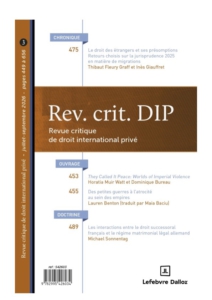
The third issue of the Revue critique de droit international privé of 2025 has been released last month. It gathers four articles, six case notes and seven book reviews. In line with the Revue Critique’s recent policy, the doctrinal part will soon be made available in English on the editor’s website (for registered users and institutions).

The issue opens with Prof. Thibaut Fleury Graff’s (Université Paris Panthéon-Assas) and Dr. Inès Giauffret’s (Université Paris-Saclay, UVSQ) survey of Le droit des étrangers et ses temporalités. Retours choisis sur la jurisprudence 2024 en matière de migrations (Immigration law and its temporalities. Selected reviews of 2024 case law on migration). A valuable addition to the dossier that the Revue critique recently devoted to the reform of French immigration law, its abstract reads as follows:

The adoption of the Law of 26 January 2024 “on controlling immigration and improving integration” marked the beginning of 2024 in the field of migration. Supplemented by its implementing decrees, the law has already given rise to initial litigation, discussed in this paper, alongside the more traditional case law interpreting the rules governing the rights and status of foreigners in France, as well as the conditions of their detention. These rulings reflect the current period, caught between legislative facilitation of detention and removal on the one hand, and judicial protection of the rights and freedoms of non-nationals on the other.

In the second article, Prof. Étienne Farnoux (Université de Strasbourg) elucidates the subtle connections between Les droits fondamentaux, l’exception d’ordre public et la prohibition de la révision au fond dans le système de Bruxelles I (Fundamental rights, public policy exception and the prohibition of review on the merits in the Brussels I system) from the Real Madrid case. At the crossroads of private international law and European integration, the contribution answers fundamental questions raised by this now notorious judicial saga. Its abstract reads as follows:

The case, which arose when recognition was sought in France of a Spanish court’s ruling against a French newspaper ordering it to pay heavy damages, highlights the conflict between the European objective of mutual trust and the protection of fundamental rights, particularly the freedom of the press. In a decision dated October 4, 2024, the Court of Justice (on a preliminary reference by the Cour de cassation) outlined the general methodology for controlling the proportionality of a financial penalty imposed abroad, on the basis of international public policy, a mechanism strongly influenced by European law. This control, which was subsequently implemented by the Court de cassation in a ruling dated May 28, 2025, is severely limited by the European principle of prohibition of the review on the merits.

In the third article, Prof. Fabienne Jault-Seseke (Université Paris-Saclay, UVSQ) points out Les non-dits du droit européen du numérique en matière de droit international privé : l’exemple du règlement sur les services numériques (DSA) (The unspoken private international law aspects of European digital law: the example of the Digital Services Act (DSA)). In light of cyberspace’s peculiarity, the study paves the way for a clearly articulated policy of private international law in the digital sphere. Its abstract reads as follows:

The Digital Services Act (DSA) addresses issues of private international law in a very limited way. It mainly defines its territorial scope using a unilateral rule : it applies to any intermediary service provider that targets users in the European Union, regardless of its place of establishment. It is largely silent on other aspects of the private international law, such as determining the law applicable to illegal content or to actions for injunctions and damages. In terms of jurisdiction, it refers to the Brussels I bis Regulation, whose provisions are poorly adapted to the specificities of the digital world. The preference that the DSA seems to give to public enforcement rather than private enforcement cannot justify its silence on most questions of PIL, which are essential if we are to ensure effective protection of rights in the digital environment, which is almost always cross-border.

The doctrinal part wraps up with Dr. Marcel Zernikow (Université d’Orléans) study of Le renouvellement des méthodes de la coopération judiciaire au service du droit au procès équitable : l’instrument du certificat et la numérisation (Renewing judicial cooperation methods to uphold the right to a fair trial: the instrument of the certificate and digitalisation). The growing importance of international cooperation in cross-border proceedings indeed requires a modernized approach, which the author proposes to pursue as follows:

Judicial cooperation is an object of study in private international law that is justified by the need to make the State’s jurisdictional activity effective in a foreign territory. Since it describes the connection between State or judicial authorities of two different States, it is governed by their respective territorial procedural laws. This field is nevertheless undergoing a renewal of its methods, which will be studied through the prism of the introduction of a new instrument: the certificate. The latter is gradually being used to accompany public documents or judicial decisions or for evidentiary purposes. How has this development become the basis for digitalization, which relies on the interconnection of legal systems and individuals via the internet? The renewal of methods is universal insofar as it is based on the guarantee of the right to a fair trial in international civil proceedings.

The full table of contents is available here.

Previous issues of the Revue critique (from 2010 to 2024) are available on Cairn.

https://conflictoflaws.net/News/2020/08/CoL_Banner-1.png 0 0 Etienne Farnoux https://conflictoflaws.net/News/2020/08/CoL_Banner-1.png Etienne Farnoux2025-11-08 14:49:352025-11-08 14:49:35Revue critique de droit international privé – Issue 2025/3

Revue Critique de droit international privé – Issue 2025/2

July 29, 2025/in News/by Etienne Farnoux

Written by Hadrien Pauchard (assistant researcher and doctoral student at Sciences Po Law School)
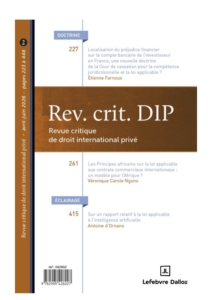
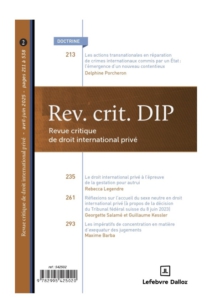
The second issue of the Revue Critique de droit international privé of 2025 has just been released. It contains four articles, seven case notes and numerous book reviews. In line with the Revue Critique’s recent policy, the doctrinal part will soon be made available in English on the editor’s website (for registered users and institutions). Read more

https://conflictoflaws.net/News/2020/08/CoL_Banner-1.png 0 0 Etienne Farnoux https://conflictoflaws.net/News/2020/08/CoL_Banner-1.png Etienne Farnoux2025-07-29 12:46:132025-07-29 13:17:36Revue Critique de droit international privé – Issue 2025/2

Revue Critique de droit international privé – issue 2025/1

June 24, 2025/2 Comments/in News/by Etienne Farnoux

Written by Hadrien Pauchard (assistant researcher and doctoral student at Sciences Po Law School)
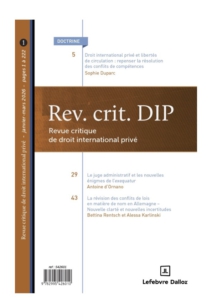
The first issue of the Revue Critique de droit international privé of 2025 has just been released. It gathers six contributions honouring Albert Armin Ehrenzweig and his legacy, as well as seven case notes and numerous book reviews.

The doctrinal part of the volume is devoted to the proceedings of the Albert Armin Ehrenzweig Conference organized in June 2024 at the University of Vienna, fifty years after the passing away of the great author. The contributions commemorate both the man and the scientist, testifying to the relevance of Albert A. Ehrenzweig’s scholarship to contemporary private international law. They are published in French in the printed version of the Revue (also available online here), and will be available shortly in English (here).

Read more

https://conflictoflaws.net/News/2020/08/CoL_Banner-1.png 0 0 Etienne Farnoux https://conflictoflaws.net/News/2020/08/CoL_Banner-1.png Etienne Farnoux2025-06-24 07:47:182025-06-24 07:47:18Revue Critique de droit international privé – issue 2025/1

Revue Critique de droit international privé – issue 2024/4

February 26, 2025/in News/by Etienne Farnoux

Written by Hadrien Pauchard (assistant researcher and doctoral student at Sciences Po Law School)
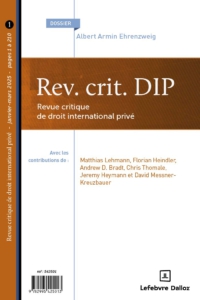
The fourth issue of the Revue Critique de droit international privé of 2024 will very shortly be released. It contains four articles, eight case notes and many book reviews. In line with the Revue Critique’s recent policy, the doctrinal part will shortly be made available in English on the editor’s website (for registered users and institutions). Read more

https://conflictoflaws.net/News/2020/08/CoL_Banner-1.png 0 0 Etienne Farnoux https://conflictoflaws.net/News/2020/08/CoL_Banner-1.png Etienne Farnoux2025-02-26 11:06:312025-02-27 14:17:54Revue Critique de droit international privé – issue 2024/4

Revue Critique de droit international privé – issue 2024/3

October 2, 2024/in News/by Etienne Farnoux

Written by Hadrien Pauchard (assistant researcher and doctoral student at Sciences Po Law School)
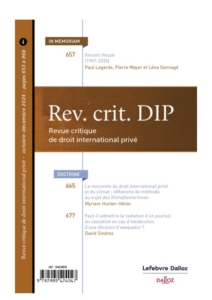
The third issue of the Revue Critique de droit international privé of 2024 was released on October 1st. It contains four articles and several case notes. In line with the Revue Critique’s recent policy, the doctrinal part will shortly be made available in English on the editor’s website (for registered users and institutions). Read more

https://conflictoflaws.net/News/2020/08/CoL_Banner-1.png 0 0 Etienne Farnoux https://conflictoflaws.net/News/2020/08/CoL_Banner-1.png Etienne Farnoux2024-10-02 16:16:402024-10-02 16:16:40Revue Critique de droit international privé – issue 2024/3

New Issue of Revue Critique de droit international privé (2024/2)

August 21, 2024/in News/by Etienne Farnoux

Written by Hadrien Pauchard (assistant researcher at Sciences Po Law School)

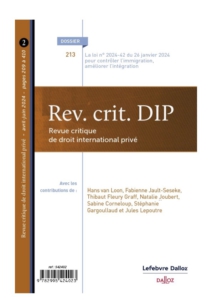
The second issue of the Revue Critique de droit international privé of 2024 was released a few weeks back. It contains a rich thematic dossier of seven articles and several case notes.

Under the direction of Prof. Sabine Corneloup (Université Paris-Panthéon-Assas), the doctrinal section of this issue is entirely devoted to an in-depth study of the latest French immigration law (Loi n° 2024-42 du 26 janvier 2024 pour contrôler l’immigration, améliorer l’intégration). In line with the Revue Critique’s recent policy, this doctrinal part has been made available in English on the editor’s website (for registered users and institutions). Against the backdrop of tightening migration controls at the global scale, this Act radically shifts administrative, procedural, and substantial aspects of the status of aliens in France.

Read more

https://conflictoflaws.net/News/2020/08/CoL_Banner-1.png 0 0 Etienne Farnoux https://conflictoflaws.net/News/2020/08/CoL_Banner-1.png Etienne Farnoux2024-08-21 15:13:582024-08-21 15:13:58New Issue of Revue Critique de droit international privé (2024/2)

Revue Critique de droit international privé – issue 2024/1

July 17, 2024/in News/by Etienne Farnoux

Written by Hadrien Pauchard (assistant researcher at Sciences Po Law School)

The first issue of the Revue Critique de droit international privé of 2024 was released a few months ago. It contains 2 articles and several case notes. Once again, the doctrinal part has been made available in English on the editor’s website (for registered users and institutions).

The opening article is authored by Dr. Nicolas Nord (Université de Strasbourg) and tackles the crucial yet often overlooked issue of L’officier d’état civil et le droit étranger. Analyse critique et prospective d’une défaillance française (Civil registrars and foreign law. A critical and prospective analysis of a French failure). Its abstract reads as follows:

In international situations, French civil registrars may frequently be confronted with the application of foreign law. However, by virtue of the General Instruction on Civil Status and other administrative texts, they are under no obligation to establish the content of foreign law and can be satisfied with the sole elements reported by requesting private individuals. This solution certainly has the advantage of simplifying the task of civil registrars, who are not legal professionals. However, it leads to inconsistencies within the French legal system. The article therefore recommends reversing the principle and creating a duty for the French authority in this area. However, the burden should be lightened by facilitating access to the content of foreign law. Concrete proposals are put forward to this end, both internally and through international cooperation.

In the second article, Prof. David Sindres (Université d’Angers) addresses the complex question of the scope of jurisdiction clauses, through the critical discussion of recent case law on whether Le « destinataire réel » des marchandises peut-il se voir opposer la clause attributive de compétence convenue entre le chargeur et le transporteur maritime ? (Can the “actual addressee” of the goods be submitted to the jurisdiction clause agreed between the shipper and the maritime carrier?). The abstract reads as follows:

In two notable decisions, the French Cour de cassation has ruled that the case law of the Court of Justice Tilly Russ/Coreck Maritime is strictly confined to the third-party bearer of a bill of lading or sea waybill, and cannot be applied to the “actual addressee” of the goods. Thus, unlike the third party bearer, the “actual addressee” cannot be submitted to the clause agreed between the shipper and the maritime carrier and inserted in a bill of lading or a sea waybill, even if he has succeeded to the rights and obligations of the shipper under the applicable national law, or has given his consent to the clause under the conditions laid down in article 25 of the Brussels I bis regulation. The distinction thus made by the Cour de cassation with regard to the enforceability against third parties of jurisdiction clauses agreed between shippers and carriers cannot be easily justified. Indeed, it is in no way required by the Tilly Russ and Coreck Maritime rulings and is even difficult to reconcile with them. Furthermore, insofar as it may lead to the non-application of a jurisdiction clause to an actual addressee who has nevertheless consented to it under the conditions of article 25 of the Brussels I bis regulation, it fails to meet the requirements of this text.

The full table of contents is available here.

The second issue of 2024 has been released and will be presented shortly on this blog.

Previous issues of the Revue Critique (from 2010 to 2022) are available on Cairn. 

https://conflictoflaws.net/News/2020/08/CoL_Banner-1.png 0 0 Etienne Farnoux https://conflictoflaws.net/News/2020/08/CoL_Banner-1.png Etienne Farnoux2024-07-17 13:09:512024-07-17 13:09:51Revue Critique de droit international privé – issue 2024/1
Page 1 of 212

Categories

  • Views
  • News

Most Recent Posts

  • Conflicts of jurisdiction in Senegal: lesson from the Senegalese Supreme Court on Lis Pendens and the Exequatur of foreign judgments July 27, 2026
  • Adoption in the proposal for a European Parenthood Regulation July 21, 2026
  • Copyright, Targeting and Geo-Blocking: The CJEU Stirs the Pot July 15, 2026
  • A Follow-Up: The German Judges Association’s Response to the HCCH Draft Text of a Future Convention on Parallel Proceedings and Related Actions July 15, 2026
  • Private International Law Dimensions of Singapore’s New Legislation to Combat Online Harms July 14, 2026
  • The 1961 HCCH Apostille Convention: Why All African Countries Should Ratify It? — Insights from Judicial Practice in Africa July 14, 2026
  • The enforcement of an advance on costs for substitute performance at the expense of a Russian debtor in German-French legal relations July 2, 2026
  • “Yes, in principle, but not quite there yet…” – Some Observations on the Public Consultation on the HCCH Draft Text of a Future Convention on Parallel Proceedings and Related Actions June 29, 2026
  • Judgment Mobility Rules in India’s Private International Law Regime: No place for a revision au fond? June 26, 2026
  • Nothing to See Here: The CJEU’s Decision in Case C-232/25 Idzinski June 18, 2026
  • Refusal to Enforce in Egypt of a Californian (U.S.) Judgment for Lack of Reciprocity: What Has Gotten into the Egyptian Supreme Court? June 15, 2026
  • PRC Double Interest neither Double nor Penal: Australian Courts Clear Its Name When Enforcing Chinese Judgments June 10, 2026
  • The AIFC Court, Gazprom v Naftogaz and the Emergence of a New Conduit Jurisdiction Debate June 6, 2026
  • Montana Supreme Court Decides International Child Custody Case June 3, 2026
  • China’s Countering Improper Foreign Extraterritorial Jurisdiction Regulation Blocked EU’s Extraterritorial Data Acquisition May 29, 2026
Scroll to top Scroll to top Scroll to top