
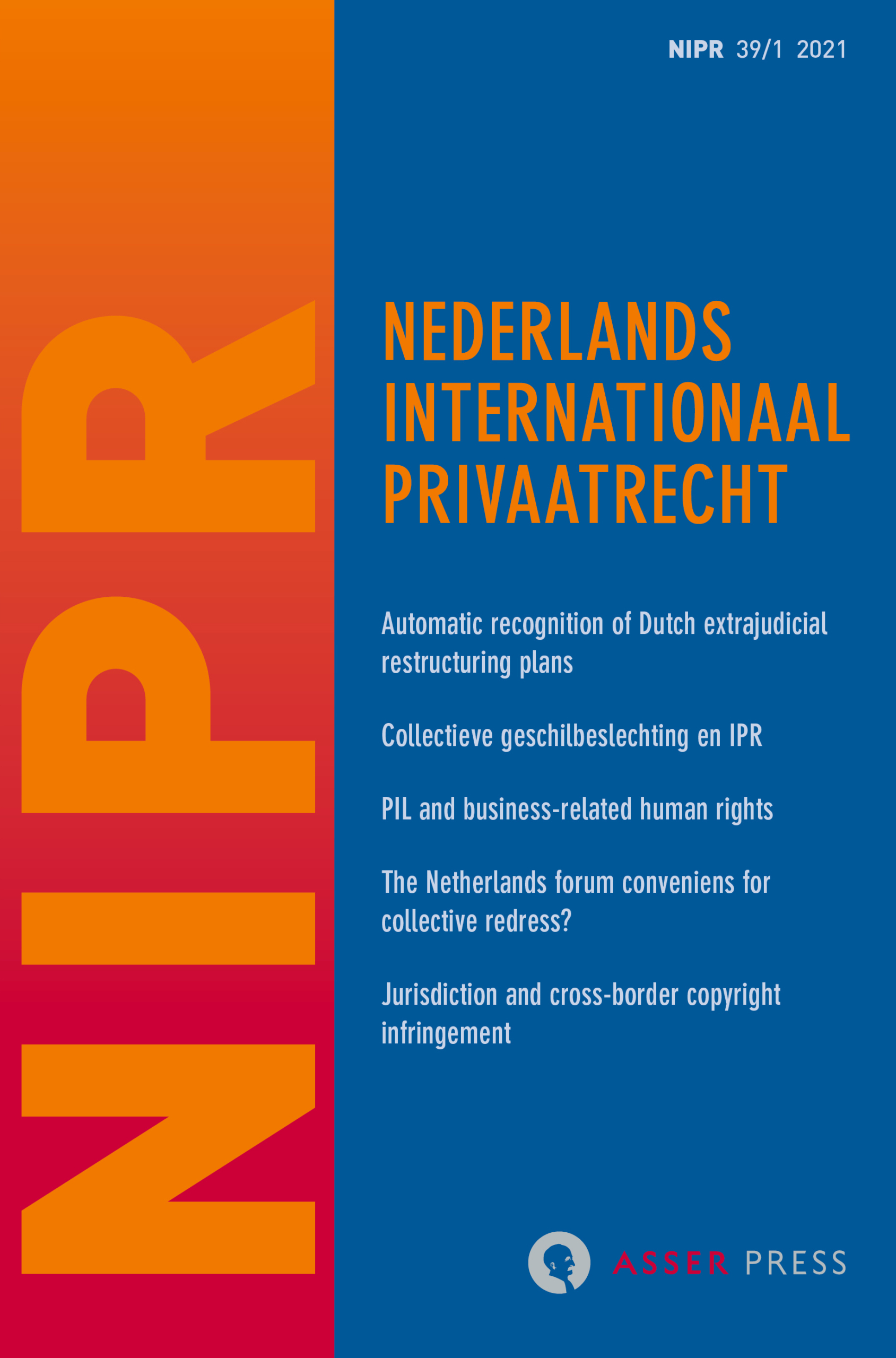
Latest issue Dutch PIL journal (NIPR)


The latest issue (21/1) of the Dutch journal Nederlands Internationaal Privaatrecht has been published. It includes the following articles.
Vriesendorp, W. van Kesteren, E. Vilarin-Seivane & S. Hinse, Automatic recognition of the Dutch undisclosed WHOA procedure in the European Union / p. 3-17
On 1 January 2021, the Act on Court Confirmation of Extrajudicial Restructuring Plans (‘WHOA’) was introduced into the Dutch legal framework. It allows for extrajudicial debt restructuring outside of insolvency proceedings, a novelty in the Netherlands. If certain requirements – mostly relating to due process and voting – are met, court confirmation of the restructuring plan can be requested. A court-confirmed restructuring plan is binding on all creditors and shareholders whose claims are part of that plan, regardless of their approval of the plan. WHOA is available in two distinct versions: one public and the other undisclosed. This article assesses on what basis a Dutch court may assume jurisdiction and if there is a basis for automatic recognition within the EU of a court order handed down in either a public or an undisclosed WHOA procedure.
Arons, Vaststelling van de internationale bevoegdheid en het toepasselijk recht in collectieve geschilbeslechting. In het bijzonder de ipr-aspecten van de Richtlijn representatieve vorderingen / p. 18-34
The application of international jurisdiction and applicable law rules in collective proceedings are topics of debate in legal literature and in case law. Collective proceedings distinguish in form between multiple individual claims brought in a single procedure and a collective claim instigated by a representative entity for the benefit of individual claimants. The ‘normal’ rules of private international law regarding jurisdiction (Brussel Ibis Regulation) and the applicable law (Rome I and Rome II Regulations) apply in collective proceedings. The recently adopted injunctions directive (2020/1828) does not affect this application.
Nonetheless, the particularities of collective proceedings require an application that differs from its application in individual two-party adversarial proceedings. This article focuses on collective redress proceedings in which an entity seeks to enforce the rights to compensation of a group of individual claimants.
Collective proceedings have different models. In the assignment model the individual rights of the damaged parties are transferred to a single entity. Courts have to establish its jurisdiction and the applicable law in regard of each assigned right individually.
In the case of a collective claim brought by an entity (under Dutch law, claims based on Art. 3:305a BW) the courts cannot judge on the legal relationships of the individual parties whose rights are affected towards the defendant. The legal questions common to the group are central. This requires jurisdiction and the applicable law to be judged at an abstract level.
Bright, M.C. Marullo & F.J. Zamora Cabot, Private international law aspects of the Second Revised Draft of the legally binding instrument on business and human rights / p. 35-52
Claimants filing civil claims on the basis of alleged business-related human rights harms are often unable to access justice and remedy in a prompt, adequate and effective way, in accordance with the rule of law. In their current form, private international law rules on jurisdiction and applicable law often constitute significant barriers which prevent access to effective remedy in concrete cases. Against this backdrop, the Second Revised Draft of the legally binding instrument to regulate, in international human rights law, the activities of transnational corporations and other business enterprises has adopted a number of provisions on private international law issues which seek to take into account the specificities of such claims and the need to redress the frequent imbalances of power between the parties. This article analyses the provisions on jurisdiction and applicable law and evaluate their potential to ensure effective access to remedy for the claimants.
Conference report
Touw, The Netherlands: a forum conveniens for collective redress? / p. 53-67
On the 5th of February 2021, the seminar ‘The Netherlands: a Forum Conveniens for Collective Redress?’ took place. The starting point of the seminar is a trend in which mass claims are finding their way into the Dutch judicial system. To what extent is the (changing) Dutch legal framework, i.e. the applicable European instruments on private international law and the adoption of the new Dutch law on collective redress, sufficiently equipped to handle these cases? And also, to what extent will the Dutch position change in light of international and European developments, i.e. the adoption of the European directive on collective redress for consumer matters, and Brexit? In the discussions that took place during the seminar, a consensus became apparent that the Netherlands will most likely remain a ‘soft power’ in collective redress, but that the developments do raise some thorny issues. Conclusive answers as to how the current situation will evolve are hard to provide, but a common ground to which the discussions seemed to return does shed light on the relevant considerations. When legal and policy decisions need to be made, only in the case of a fair balance, and a structural assessment thereof, between the prevention of abuse and sufficient access to justice, can the Netherlands indeed be a forum conveniens for collective redress.
Latest PhDs
Van Houtert, Jurisdiction in cross-border copyright infringement cases. Rethinking the approach of the Court of Justice of the European Union (dissertation, Maastricht University, 2020): A summary / p. 68-72
The dissertation demonstrates the need to rethink the CJEU’s approach to jurisdiction in cross-border copyright infringement cases. Considering the prevailing role of the EU courts as the ‘law finders’, chapter four argues that the CJEU’s interpretation must remain within the limits of the law. Based on common methods of interpretation, the dissertation therefore examines the leeway that the CJEU has regarding the interpretation of Article 7(2) Brussels Ibis in cross-border copyright infringement cases.
That’s really nice post. I appreciate your skills, Thanks for sharing.