AAPrIL’s November seminar: Mary Keyes on Jurisdiction Agreements in International Family Litigation

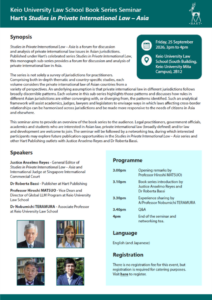
This week, the Australasian Association of Private International Law (AAPrIL) is co-hosting a free online seminar on ‘Jurisdiction Agreements in International Family Litigation’, to be presented by Professor Mary Keyes of Griffith University.

The seminar will be held online and in-person at UniSQ, Toowoomba, Queensland.  The details are:

Online (Zoom): Wednesday 26 November 2025, 12.30 to 1.30pm AEST.* 

In-person: Wednesday 26 November 2025, 12.30 to 1.30pm AEST, Wonderley & Hall Moot Court, Room Q420, Toowoomba Campus, University of Southern Queensland.

Please register by the details in the attached flyer:

Flyer_UniSQ and AAPrIL Seminar 2025-4

*Note the times given are in Australian Eastern Standard Time (UTC+10).

[Out Now!] Sooksripaisarnkit and Garimella on Legal Challenges of China’s One Belt One Road Initative: Private International Law Considerations

This note was kindly prepared by Dr. Poomintr Sooksripaisarnkit.


A new book Legal Challenges of China’s One Belt One Road Initative: Private International Law Considerations edited by Dr Poomintr Sooksripaisarnkit and Dr Sai Ramani Garimella has now been released by Routledge.

This book is a sequel to the book China’s One Belt One Road Initiative and Private International Law which was published by Routledge in 2018.

Here is the publisher’s blurb:

“This book covers new legal developments of the One Belt One Road (OBOR) project and assesses how litigation may be organised to enforce and compensate for defaults for its related initiatives.

This book is structured into five themes, consisting of essays which assess the decade of BRI’s existence in the context of international economic engagement and the rule of law, private international law, dispute resolution mechanisms – including mediation and judgment mobility. The chapters in the book strike new ground and cover recent developments such as the establishment of China’s International Commercial Court, engagements in multiple Belt and Road Initiative (BRI) construction and investment projects.

The book will be of interest to researchers, academics, policymakers and students interested in private international law issues pertaining to the OBOR routes as well as private international law in general, Asian studies and the politics of international trade”.


The table of contents and contributors include:


Poomintr Sooksripaisarnkit and Sai Ramani Garimella: Current Developments of the One Belt One Road Project and the Emerging Private International Law Issues

Dilini Pathirana: Sri Lanka’s Loan Agreements with China under the BRI: A Reflection of Selected Infrastructure Project-Related Loans

Atul Alexander: China and Foreign State Immunity Law: Legal Implications on State-Owned Entities

Mark McLaughlin: Global Standards, Local Realities: An Analysis of Singapore Convention on Mediation in the Context of Chinese State-Owned Enterprises

Zhengxin Huo: China’s International Commercial Court and Their Operation

Beligh Elbalti: Choice of Law in Contracts and Foreign Law before MENA Arab Courts from the Perspective of Belt and Road Initiative

Anna Wysocka-Bar: Circulation of Judgments Between EU Member States and China: A Path Through Complicated Framework Examined on the Example of Poland

Nobumichi Teramura: Recognition and Enforcement of Chinese judgments in Cambodia: Uncertain Foundations of the Rigid Reciprocity Standard in Cambodian Law

Jie (Jeanne) Huang: Recognition and Enforcement of Chinese Judicially Confirmed Mediation Decisions Abroad: The Challenges of Finality

Poomintr Sooksripaisarnkit: Private International Law Dimensions of Blockchain-Based Bills of Lading

Poomintr Sooksripaisarnkit and Sai Ramani Garimella: Conclusion and Reflection


The book can be ordered directly from Routledge: https://www.routledge.com/Legal-Challenges-of-Chinas-One-Belt-One-Road-Initiative-Private-International-Law-Considerations/Sooksripaisarnkit-Garimella/p/book/9781032805733


Anyone can use the below discount code to obtain 20% discount (available until 31st March 2026:

The editors are in the process of planning a book launch event (online). Currently, it is scheduled on 26th January 2026 between 8:00 -9:00 p.m (Australian Eastern Daylight Time). Further details will be announced once the full programme of event is available.

Crossroads in Private International Law Webinar with on ‘the EU Anti-SLAPP Directive’ at the University of Aberdeen

The Centre for Private International Law & Transnational Governance of the University of Aberdeen is continuing its Crossroads in Private International Law webinar series with a talk by Birgit van Houtert (Maastricht University) and Francesca Farrington (University of Liverpool) titled ‘The EU Anti-SLAPP Directive – Comparative Perspectives on Implementation’:

The Centre for Private International Law & Transnational Governance invites you to our next Crossroads in PIL webinar. This session brings together experts on Anti-SLAPP legislation from the UK and the Netherlands to discuss the Anti-SLAPP Directive. With 6 months to go before the Directive’s implementation deadline, this webinar will take stock of emerging best practices and challenges in implementing the directive and flesh out some unresolved questions.

Dr Francesca Farrington (University of Liverpool) will introduce the challenges posed by cross-border SLAPPs, before discussing how the Directive’s provisions on jurisdiction and recognition and enforcement of foreign judgments respond to these challenges. While these provisions represent a positive development, they also leave a number of issues unresolved and raise concerns about the fragmentation of European private international law.

Dr Birgit van Houtert (Maastricht University) will address the Dutch draft act regarding the transposition of the Anti SLAPP Directive. She will focus in particular on the challenges concerning the implementation of Articles 16 and 17 of the Directive. These core private international law provisions aim to provide protection for SLAPP targets against third country proceedings and judgments.

The webinar will be chaired by Prof Justin Borg-Barthet (University of Aberdeen).

Additional information and the link to register can be found here.

Launch of public consultation on a possible new HCCH convention

The Permanent Bureau of the HCCH is pleased to announce the launch of a public consultation on the Draft Text of a possible new convention on parallel proceedings and related actions, to be held from 18 November 2025 to 26 January 2026.

Experts, practitioners and judges from diverse legal traditions with experience in cross-border litigation and private international law more broadly are encouraged to participate in the consultation.

In 2021, the HCCH established a Working Group on matters related to jurisdiction in transnational civil or commercial litigation (WG), comprised of over 60 subject-matter experts from across the globe. The WG, after nine meetings, has developed a Draft Text containing provisions aimed at addressing parallel proceedings and related actions taking place in multiple States, acknowledging the primary roles of both jurisdictional rules and the doctrine of forum non conveniens. The objective of this future instrument would be to enhance legal certainty, predictability, and access to justice by reducing litigation costs and mitigating inconsistent judgments in transnational litigation in civil or commercial matters.

The public consultation seeks feedback on whether the Draft Text would, in practice, assist in addressing such matters and how the provisions in the Draft Text could be improved. The consultation is supported by a Consultation Paper comprising an Executive Summary, a detailed explanation of the key provisions and the operation of the Draft Text, and specific questions. Responses received from this consultation will be submitted to all HCCH Members for consideration in advance of the next meeting of the Council on General Affairs and Policy (CGAP), the governing body of the HCCH, in March 2026, at which the Members of the HCCH will decide on the next steps for the project.

For more information on the public consultation, please visit: https://www.hcch.net/en/projects/legislative-projects/jurisdiction/public-consultation


This post is published by the Permanent Bureau of the Hague Conference of Private International Law (HCCH).

LEX and FORUM VOLUME I /2025

The sweeping pace of technological advancement and the accelerated transition to the digital realm are generating novel and complex challenges for the law. Established legal frameworks are increasingly being tested within the digital environment, where cutting-edge technologies — such as digital platforms and artificial intelligence — have come to play a decisive role in both social and economic activity.

Although the European Union may not yet have attained its full technological maturity, it stands at the forefront of confronting the legal implications of the digital era. The Union’s legislative agenda seeks to maintain a delicate equilibrium between, on the one hand, promoting innovation and technological development, and, on the other, safeguarding the fundamental rights of individuals while ensuring transparency and accountability among digital service providers. Read more

Special Issue: Proceedings of the Bremen Conference on Informed Consent to Dispute Resolution Agreements

The German Law Journal has published a Special Issue featuring the proceedings of the international conference on Informed Consent to Dispute Resolution Agreements, held in Bremen on 20–21 June 2024 (see our earlier announcement here).

Edited by Gralf-Peter Calliess and Nicholas Mouttotos of the University of Bremen, the special issue brings together contributions from leading scholars in private international law, international civil procedure, and international arbitration. Contributors include: Symeon C. Symeonides, Nancy S. Kim, Gralf-Peter Calliess, Frederick Rieländer, Peter McColgan, Laura E. Little, Kermit Roosevelt III, Sören Segger-Piening, John F. Coyle, Hannah L. Buxbaum, Marta Pertegás Sender, Stephen Ware, Stefan F. Thönissen and Nicholas Mouttotos.

The collection addresses a central tension in modern dispute resolution: how to reconcile party autonomy in forum and choice-of-law agreements with the requirement of consent, and how informed should consent be, particularly where such agreements are embedded in standard-form contracts affecting weaker parties such as consumers and employees.

The issue encompasses perspectives from both the United States and the European Union, examining questions of constitutional fairness, access to justice, and the legitimacy of contractual self-determination. Contributions trace the historical development of party autonomy, critique the adequacy of existing consent models, examine their outward abandonment while also exploring comparative regulatory approaches to protecting vulnerable contracting parties.

The special issue is available in the German Law Journal, Volume 26, Special Issue 5, and the editorial can be found here. The German Law Journal is a pioneering (Gold) open-access, peer-reviewed forum for scholarship and commentary on comparative, European, and international law, offering free and unrestricted online access to its publications since 1999.

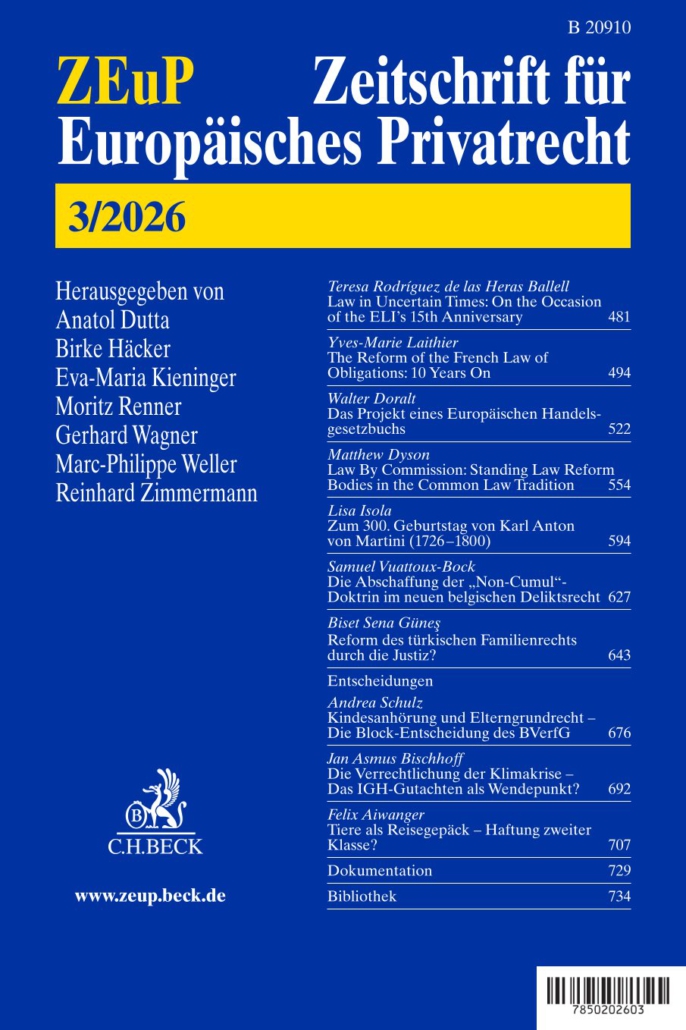
ZEuP – Zeitschrift für Europäisches Privatrecht 4/2025

A new issue of ZEuP – Zeitschrift für Europäisches Privatrecht is now available and includes contributions on EU private law, comparative law and legal history, legal unification, private international law, and individual European private law regimes. The full table of content can be accessed here: https://rsw.beck.de/zeitschriften/zeup.

Read more

Decoding the Language of Law in the post-Migration Crisis Period: the Informalisation of Migration

The Jean Monnet Chair in Legal Aspects of Migration Management in the EU and in Türkiye and Bilkent University Faculty of Law cordially invite you for the next Migration Talk by Professor Paul James Cardwell (King’s College London) on “Decoding the Language of Law in the post-Migration Crisis Period: the Informalisation of Migration”.

The talk shall be held online. For the Zoom link please contact migration@bilkent.edu.tr.


Rethinking Family Law Through a European Human Rights Lens: A New Collective Volume

What does it mean to respect family life in modern Europe? With families increasingly diverse and cross-border by nature, the concept of family law is undergoing profound legal, cultural, and institutional changes. A newly published academic volume — El Derecho de Familia a la Luz del Derecho Fundamental Europeo al Respeto a la Vida Familiar — offers a rich and timely exploration of this transformation.

Edited by María Victoria Cuartero Rubio and José Manuel Velasco Retamosa, this book brings together leading voices in European family law, private international law, and human rights to examine how the fundamental right to respect for family life (Article 8 ECHR, Article 7 EU Charter) is reshaping family law across jurisdictions. Read more

Revue critique de droit international privé – Issue 2025/3

Written by Hadrien Pauchard (assistant researcher and doctoral student at Sciences Po Law School)

The third issue of the Revue critique de droit international privé of 2025 has been released last month. It gathers four articles, six case notes and seven book reviews. In line with the Revue Critique’s recent policy, the doctrinal part will soon be made available in English on the editor’s website (for registered users and institutions).

The issue opens with Prof. Thibaut Fleury Graff’s (Université Paris Panthéon-Assas) and Dr. Inès Giauffret’s (Université Paris-Saclay, UVSQ) survey of Le droit des étrangers et ses temporalités. Retours choisis sur la jurisprudence 2024 en matière de migrations (Immigration law and its temporalities. Selected reviews of 2024 case law on migration). A valuable addition to the dossier that the Revue critique recently devoted to the reform of French immigration law, its abstract reads as follows:

The adoption of the Law of 26 January 2024 “on controlling immigration and improving integration” marked the beginning of 2024 in the field of migration. Supplemented by its implementing decrees, the law has already given rise to initial litigation, discussed in this paper, alongside the more traditional case law interpreting the rules governing the rights and status of foreigners in France, as well as the conditions of their detention. These rulings reflect the current period, caught between legislative facilitation of detention and removal on the one hand, and judicial protection of the rights and freedoms of non-nationals on the other.

In the second article, Prof. Étienne Farnoux (Université de Strasbourg) elucidates the subtle connections between Les droits fondamentaux, l’exception d’ordre public et la prohibition de la révision au fond dans le système de Bruxelles I (Fundamental rights, public policy exception and the prohibition of review on the merits in the Brussels I system) from the Real Madrid case. At the crossroads of private international law and European integration, the contribution answers fundamental questions raised by this now notorious judicial saga. Its abstract reads as follows:

The case, which arose when recognition was sought in France of a Spanish court’s ruling against a French newspaper ordering it to pay heavy damages, highlights the conflict between the European objective of mutual trust and the protection of fundamental rights, particularly the freedom of the press. In a decision dated October 4, 2024, the Court of Justice (on a preliminary reference by the Cour de cassation) outlined the general methodology for controlling the proportionality of a financial penalty imposed abroad, on the basis of international public policy, a mechanism strongly influenced by European law. This control, which was subsequently implemented by the Court de cassation in a ruling dated May 28, 2025, is severely limited by the European principle of prohibition of the review on the merits.

In the third article, Prof. Fabienne Jault-Seseke (Université Paris-Saclay, UVSQ) points out Les non-dits du droit européen du numérique en matière de droit international privé : l’exemple du règlement sur les services numériques (DSA) (The unspoken private international law aspects of European digital law: the example of the Digital Services Act (DSA)). In light of cyberspace’s peculiarity, the study paves the way for a clearly articulated policy of private international law in the digital sphere. Its abstract reads as follows:

The Digital Services Act (DSA) addresses issues of private international law in a very limited way. It mainly defines its territorial scope using a unilateral rule : it applies to any intermediary service provider that targets users in the European Union, regardless of its place of establishment. It is largely silent on other aspects of the private international law, such as determining the law applicable to illegal content or to actions for injunctions and damages. In terms of jurisdiction, it refers to the Brussels I bis Regulation, whose provisions are poorly adapted to the specificities of the digital world. The preference that the DSA seems to give to public enforcement rather than private enforcement cannot justify its silence on most questions of PIL, which are essential if we are to ensure effective protection of rights in the digital environment, which is almost always cross-border.

The doctrinal part wraps up with Dr. Marcel Zernikow (Université d’Orléans) study of Le renouvellement des méthodes de la coopération judiciaire au service du droit au procès équitable : l’instrument du certificat et la numérisation (Renewing judicial cooperation methods to uphold the right to a fair trial: the instrument of the certificate and digitalisation). The growing importance of international cooperation in cross-border proceedings indeed requires a modernized approach, which the author proposes to pursue as follows:

Judicial cooperation is an object of study in private international law that is justified by the need to make the State’s jurisdictional activity effective in a foreign territory. Since it describes the connection between State or judicial authorities of two different States, it is governed by their respective territorial procedural laws. This field is nevertheless undergoing a renewal of its methods, which will be studied through the prism of the introduction of a new instrument: the certificate. The latter is gradually being used to accompany public documents or judicial decisions or for evidentiary purposes. How has this development become the basis for digitalization, which relies on the interconnection of legal systems and individuals via the internet? The renewal of methods is universal insofar as it is based on the guarantee of the right to a fair trial in international civil proceedings.

The full table of contents is available here.

Previous issues of the Revue critique (from 2010 to 2024) are available on Cairn.