Conflict of Laws
  • About
  • Editorial board
  • Subscription
  • Submission
  • Materials
  • Contact
  • Click to open the search input field Click to open the search input field Search
  • Menu Menu

Tag Archive for: webinar

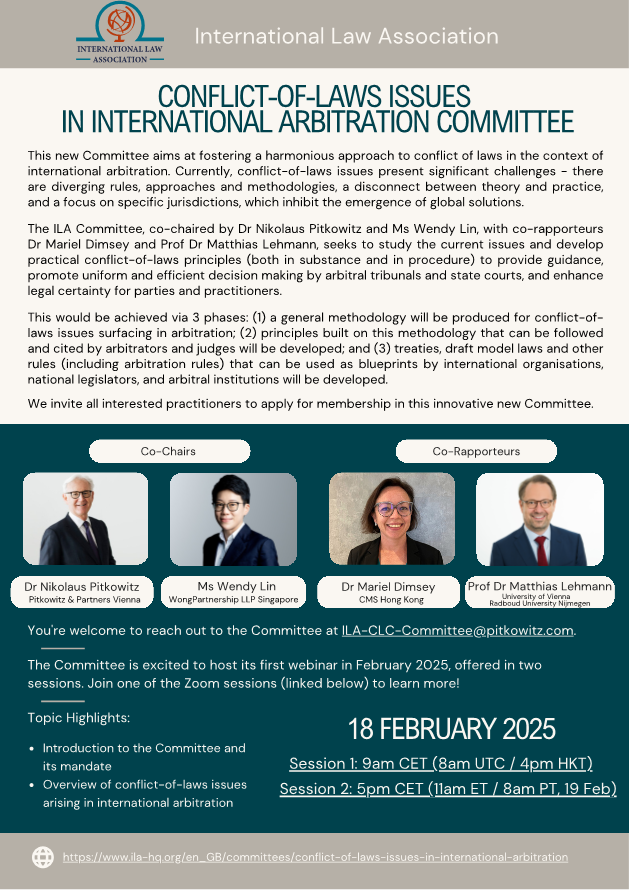
ILA Committee on Conflict-of-Laws Issues in International Arbitration: First Webinar on 18 February 2025

February 11, 2025/in News/by Matthias Weller

This post was written by Lukas Petschning, University of Vienna.

Conflict of laws is one of the most complex and disputed subject areas in international arbitration. An abundance of academic works has examined the issue and proposed widely diverging solutions. Yet, these studies frequently focus on isolated issues and lack overall consistency. Equally, they are often overly theoretical, lacking practical guidance useful to the average arbitrator or judge.

Forging a path toward more legal certainty, the International Law Association has established a new Committee on Conflict-of-Laws Issues in International Arbitration. It is chaired by Dr Nikolaus Pitkowitz and Ms Wendy Lin, with Professor Matthias Lehmann and Dr Mariel Dimsey acting as co-rapporteurs.

Read more

https://conflictoflaws.net/News/2020/08/CoL_Banner-1.png 0 0 Matthias Weller https://conflictoflaws.net/News/2020/08/CoL_Banner-1.png Matthias Weller2025-02-11 13:26:562025-02-11 13:26:56ILA Committee on Conflict-of-Laws Issues in International Arbitration: First Webinar on 18 February 2025

Research Methods in Private International Law – book and webinars

May 31, 2024/1 Comment/in News/by Xandra Kramer

As some readers will have seen through various other blogs and social media, this month the book Research Methods in Private International Law. A Handbook on Regulation, Research and Teaching, edited by Xandra Kramer (Erasmus University Rotterdam/Utrecht University) and Laura Carballo Piñeiro (University of Vigo) was published. The book is part of the Handbook in Research Methods of Law Series of Edward Elgar Publishing.

“The book seeks to provide insights into the different methodological approaches to private international law from both a regulatory approach and from a research and educational perspective. Established methodologies as well as evolving regulatory and empirical approaches that shape the future of private international law are discussed. To this end, the book is structured in three parts that correspond to three core debates, although they inevitably overlap: (I) the classification of private international law as private law and its interaction with international public law and regulation; (II) inter- and multidisciplinary approaches and research methods; and (III) how private international law helps to frame and address the critical debates of our time as well as the role of legal scholarship and education in shaping the future of private international law.” (Introductory Chapter, p. 1-2).

The book contains 18 chapters written by a team of authors spanning all continents discussing classical themes of private international law and new challenges in regulation, research, and teaching. It includes views from politics, human rights, legal theory, soft law and private regulation,  comparative law, empirical studies, economics, EU law making, technology, laymen, feminism, colonialism, as well as university teaching in Mexico, Nigeria and The Netherlands.

Contributors are (in alphabetical order): María Mercedes Albornoz, Adriani Dori, Diego P. Fernández Arroyo, Sai Ramani Garimella, Marco Giacalone, Paola Giacalone, Nuria González-Martin, Christoph A. Kern, Mary Keyes, Patrick Kinsch, Dulce Lopes, Cristina M. Mariottini, Ralf Michaels, Chukwuma Samuel Adesina Okoli, Marta Pertegás, Giesela Rühl, Veronica Ruiz Abou-Nigm, Carlota Ucín, Aukje van Hoek, Christopher Whytock, and Abubakri Yekini.

Further information is available on the publisher’s website here. The Prelims and the introductory chapter by the editors ‘Private international law in a global world: a revival of methodologies and research methods’ are freely accessible here. Critical acclaim by Geert Van Calster (KU Leuven), Yuko Nishitani (Kyoto University), Hans van Loon (former SG Hague Conference on Private International Law) and Symeon C. Symeonides (Willamette University College of Law).

Save the Date! Two launch webinars will take place on:

  • 10 September 2024, from 10-12am CET: Research Methods in Private International Law: Views from Regulation, Research and Education (confirmed speakers include Dulce Lopes, Diego Fernández Arroyo, Giesela Rühl, Adriani Dori and Mary Keyes)
  • 23 September 2024, from 10-11.30 CET: Research Methods in Private International Law: Educational Perspectives (co-organised by the University of Sydney, moderated by Jeanne Huang; confirmed speakers include Veronica Ruiz Abou-Nigm/Ralf Michaels, Ramani Garimella, Abubakri Yekeni & Chukwuma Okoli and Aukje van Hoek

More details and information on registration will follow soon.

For those interested, a report of an extensive online interview with the editors by Young-OGEMID can be downloaded from the website of Transnational Dispute Management.

 

https://conflictoflaws.net/News/2020/08/CoL_Banner-1.png 0 0 Xandra Kramer https://conflictoflaws.net/News/2020/08/CoL_Banner-1.png Xandra Kramer2024-05-31 13:46:372024-05-31 13:46:37Research Methods in Private International Law – book and webinars

Book and webinar Financing Collective Actions

May 29, 2024/in News/by Xandra Kramer

Collective actions and the financing of complex mass damage cases have been among the most debated and controversial topics in civil justice in Europe over the past decade. It doesn’t need much explanation that oftentimes these complex cases involving a multiplicity of parties and events or consequences taking place in different countries trigger private international law questions, as for instance the ongoing evaluation of the Brussels I-bis Regulation evidences (see among others the 2023 Study in support of the evaluation; a 2021 Working Paper by Burkhard Hess; a 2022 report by BEUC on PIL and Cross-border Collective Redress). Another key issue is the funding of these inherently costly litigations. The Representative Action Directive, applicable since June 2023, and the European Parliament Resolution on Responsible private funding of litigation, adopted in 2022, have proliferated discussions on the funding of collective actions. With the entry into force of the Dutch collective damages procedure (WAMCA) in 2020, enabling compensatory actions, the Netherlands has re-confirmed its reputation as one of the frontrunners in having a well-developed framework for collective actions and settlements in Europe. High stake cases involving privacy, environmental law, human rights and consumer law have found their way to the courts and have benefitted from third party funding.

These developments have triggered the Dutch Research and Documentation Centre of the Ministry of Justice and Security to commission a Study on the need for a procedural fund for collective actions, published in 2023 (in Dutch). The book Financing Collective Actions in the Netherlands: Towards a Litigation Fund?, based on this study and including updates, has just been published (Eleven International Publishing 2024) and is available open access. The book is authored by Xandra Kramer (Erasmus University Rotterdam/Utrecht University), Ianika Tzankova (Tilburg University), Jos Hoevenaars (Erasmus University Rotterdam, researcher Vici team) and Karlijn van Doorn (Tilburg University). It discusses developments in Dutch collective actions from a regulatory perspective, including the implementation of the RAD, and contains a quantitative and qualitative analysis of cases that have been brought under the WAMCA. It then examines funding aspects of collective actions from a regulatory, empirical and comparative perspective. It delves into different funding modes, including market developments in third party litigation funding, and  addresses the question of the necessity, feasibility, and design of a (revolving) litigation fund for collective actions.

The hardcover version of the book can be ordered from the publisher’s website, which also provides access to the free digital open access version through the publisher’s portal.

A launch event and webinar on ‘Financing Collective Actions: Current Debates in Europe and Beyond’ will take place on 3 July from 15-17.15 CET. Confirmed speakers include Jasminka Kalajdzic (University of Windsor) and Rachael Mulheron (Queen Mary University London). Registration for free here.

https://conflictoflaws.net/News/2020/08/CoL_Banner-1.png 0 0 Xandra Kramer https://conflictoflaws.net/News/2020/08/CoL_Banner-1.png Xandra Kramer2024-05-29 20:56:072024-05-29 20:57:05Book and webinar Financing Collective Actions

Principles of Treaty Interpretation – Does Vienna Wait for You?

November 30, 2020/in News/by Thomas John
Read more
https://conflictoflaws.net/News/2020/08/CoL_Banner-1.png 0 0 Thomas John https://conflictoflaws.net/News/2020/08/CoL_Banner-1.png Thomas John2020-11-30 09:03:392020-11-30 09:06:02Principles of Treaty Interpretation – Does Vienna Wait for You?
Page 2 of 212

Categories

  • Views
  • News

Most Recent Posts

  • The New Zealand Supreme Court’s judgment in Kea Investments Ltd v Wikeley on anti-enforcement relief August 3, 2026
  • Beyond Domicile: The BHP Litigation and the Functional Interconnection of Public and Private International Law August 3, 2026
  • Conflicts of jurisdiction in Senegal: lesson from the Senegalese Supreme Court on Lis Pendens and the Exequatur of foreign judgments July 27, 2026
  • Adoption in the proposal for a European Parenthood Regulation July 21, 2026
  • Copyright, Targeting and Geo-Blocking: The CJEU Stirs the Pot July 15, 2026
  • A Follow-Up: The German Judges Association’s Response to the HCCH Draft Text of a Future Convention on Parallel Proceedings and Related Actions July 15, 2026
  • Private International Law Dimensions of Singapore’s New Legislation to Combat Online Harms July 14, 2026
  • The 1961 HCCH Apostille Convention: Why All African Countries Should Ratify It? — Insights from Judicial Practice in Africa July 14, 2026
  • The enforcement of an advance on costs for substitute performance at the expense of a Russian debtor in German-French legal relations July 2, 2026
  • “Yes, in principle, but not quite there yet…” – Some Observations on the Public Consultation on the HCCH Draft Text of a Future Convention on Parallel Proceedings and Related Actions June 29, 2026
  • Judgment Mobility Rules in India’s Private International Law Regime: No place for a revision au fond? June 26, 2026
  • Nothing to See Here: The CJEU’s Decision in Case C-232/25 Idzinski June 18, 2026
  • Refusal to Enforce in Egypt of a Californian (U.S.) Judgment for Lack of Reciprocity: What Has Gotten into the Egyptian Supreme Court? June 15, 2026
  • PRC Double Interest neither Double nor Penal: Australian Courts Clear Its Name When Enforcing Chinese Judgments June 10, 2026
  • The AIFC Court, Gazprom v Naftogaz and the Emergence of a New Conduit Jurisdiction Debate June 6, 2026
Scroll to top Scroll to top Scroll to top