Conflict of Laws
  • About
  • Editorial board
  • Subscription
  • Submission
  • Materials
  • Contact
  • Click to open the search input field Click to open the search input field Search
  • Menu Menu

Tag Archive for: Tunisia

Bostanji on immunities and international jurisdiction in Tunisian private international law

October 13, 2024/in News/by Béligh Elbalti

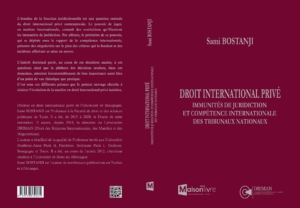
“Droit international privé – Immunités de juridiction et competence internationales des tribunaux tunisiens” (Private International Law – Jurisdictional Immunity and International Jurisdiction of Tunisian Courts) is the title of the long-awaited book recently published by Prof. Sami Bostanji, a distinguished Professor at the Faculté de droit et des sciences politiques de Tunis, Director of the DRIMAN research center, and one of the leading private international law scholars in Tunisia. Read more

https://conflictoflaws.net/News/2020/08/CoL_Banner-1.png 0 0 Béligh Elbalti https://conflictoflaws.net/News/2020/08/CoL_Banner-1.png Béligh Elbalti2024-10-13 02:34:512024-10-13 08:57:32Bostanji on immunities and international jurisdiction in Tunisian private international law

International Jurisdiction between Nationality and Domicile in Tunisian Private International Law – Has the Perennial Debate Finally been Resolved?

March 2, 2024/in Views/by Béligh Elbalti

I would like to thank Prof. Lotfi Chedly for providing me with the text of the decision on which this post is based.


I. Introduction

Scholars of private international law are well familiar with the classic debate on nationality and domicile as connecting factors in the choice of applicable law (see, for example, L. I. de Winter, “Nationality or Domicile? The Present State of Affairs” 128 Collected Courses III (1969) pp. 357 ff). In Tunisian private international law, this controversy has been particularly pronounced with regard to the role of nationality as a ground for the international jurisdiction of Tunisian courts. Since the enactment of the Tunisian Private International Law Code (“PILC”) in 1998 (for an English translation, see J. Basedow et al. (eds.) Encyclopedia of Private International Law – Vol. IV (Elgar Editions, 2017) 3895 and my own translation of the provisions dealing with international jurisdiction and the enforcement of foreign judgments in 8 Journal of Private International Law 2 (2012) pp. 221 ff)), the debate between opponents and proponents of nationality as a ground for international jurisdiction, especially in family law matters, has never ceased to be intense (for detailed analyses, see eg. Salma Triki, “La compétence internationale tunisienne et le critère de nationalité” in Ben Achour/Triki (eds.), Le Code de droit international privé – Vingt ans d’application (1998-2018) (Latrach edition, 2020) 119ff). This divergence in academic opinion is also reflected in the judicial practice of the courts, with the emergence of two opposing trends: one extends the international jurisdiction of the Tunisian courts when the dispute involves a Tunisian party, in particular as a defendant even when domiciled abroad. The other firmly rejects nationality as a ground for international jurisdiction.

Read more

https://conflictoflaws.net/News/2020/08/CoL_Banner-1.png 0 0 Béligh Elbalti https://conflictoflaws.net/News/2020/08/CoL_Banner-1.png Béligh Elbalti2024-03-02 03:53:312024-03-23 01:27:54International Jurisdiction between Nationality and Domicile in Tunisian Private International Law – Has the Perennial Debate Finally been Resolved?

Categories

  • Views
  • News

Most Recent Posts

  • The New Zealand Supreme Court’s judgment in Kea Investments Ltd v Wikeley on anti-enforcement relief August 3, 2026
  • Beyond Domicile: The BHP Litigation and the Functional Interconnection of Public and Private International Law August 3, 2026
  • Conflicts of jurisdiction in Senegal: lesson from the Senegalese Supreme Court on Lis Pendens and the Exequatur of foreign judgments July 27, 2026
  • Adoption in the proposal for a European Parenthood Regulation July 21, 2026
  • Copyright, Targeting and Geo-Blocking: The CJEU Stirs the Pot July 15, 2026
  • A Follow-Up: The German Judges Association’s Response to the HCCH Draft Text of a Future Convention on Parallel Proceedings and Related Actions July 15, 2026
  • Private International Law Dimensions of Singapore’s New Legislation to Combat Online Harms July 14, 2026
  • The 1961 HCCH Apostille Convention: Why All African Countries Should Ratify It? — Insights from Judicial Practice in Africa July 14, 2026
  • The enforcement of an advance on costs for substitute performance at the expense of a Russian debtor in German-French legal relations July 2, 2026
  • “Yes, in principle, but not quite there yet…” – Some Observations on the Public Consultation on the HCCH Draft Text of a Future Convention on Parallel Proceedings and Related Actions June 29, 2026
  • Judgment Mobility Rules in India’s Private International Law Regime: No place for a revision au fond? June 26, 2026
  • Nothing to See Here: The CJEU’s Decision in Case C-232/25 Idzinski June 18, 2026
  • Refusal to Enforce in Egypt of a Californian (U.S.) Judgment for Lack of Reciprocity: What Has Gotten into the Egyptian Supreme Court? June 15, 2026
  • PRC Double Interest neither Double nor Penal: Australian Courts Clear Its Name When Enforcing Chinese Judgments June 10, 2026
  • The AIFC Court, Gazprom v Naftogaz and the Emergence of a New Conduit Jurisdiction Debate June 6, 2026
Scroll to top Scroll to top Scroll to top