Conflict of Laws
  • About
  • Editorial board
  • Subscription
  • Submission
  • Materials
  • Contact
  • Click to open the search input field Click to open the search input field Search
  • Menu Menu

Tag Archive for: torts

Virtual Early-Career Conference: ‘Global Harm, Local Justice | The Future of Cross-Border Torts’ (University of Groningen, 6 Feb 2026)

September 10, 2025/in News/by Tobias Lutzi

We are delighted to share the Call for Papers for a virtual early-career conference on ‘Global Harm, Local Justice | The Future of Cross-Border Torts’, hosted by K.C. (Kirsten) Henckel and M.A.S. (Martin) Bulla from the University of Groningen on 6 February 2026.

Abstracts of 300–500 words must be submitted by 1 December 2025.

https://conflictoflaws.net/News/2020/08/CoL_Banner-1.png 0 0 Tobias Lutzi https://conflictoflaws.net/News/2020/08/CoL_Banner-1.png Tobias Lutzi2025-09-10 06:13:202025-09-10 06:13:20Virtual Early-Career Conference: ‘Global Harm, Local Justice | The Future of Cross-Border Torts’ (University of Groningen, 6 Feb 2026)

Who can bite the Apple? The CJEU can shape the future of online damages and collective actions

January 18, 2024/in Views/by Xandra Kramer

Written by Eduardo Silva de Freitas (Erasmus University Rotterdam), member of the Vici project Affordable Access to Justice, financed by the Dutch Research Council (NWO), www.euciviljustice.eu.  


Introduction

In the final weeks leading up to Christmas in 2023, the District Court of Amsterdam referred a set of questions to the CJEU (DC Amsterdam, 20 December 2023, ECLI:NL:RBAMS:2023:8330; in Dutch). These questions, if comprehensively addressed, have the potential to bring clarity to longstanding debates regarding jurisdictional conflicts in collective actions. Despite being rooted in competition law with its unique intricacies, the issues surrounding the determination of online damage locations hold the promise of illuminating pertinent questions. Moreover, the forthcoming judgment is expected to provide insights into the centralization of jurisdiction in collective actions within a specific Member State, an aspect currently unclear. Recalling our previous discussion on the Dutch class action under the WAMCA in this blog, it is crucial to emphasize that, under the WAMCA, only one representative action can be allowed to proceed for the same event. In instances where multiple representative foundations seek to bring proceedings for the same event without reaching a settlement up to a certain point during the proceedings, the court will appoint an exclusive representative. This procedural detail adds an additional layer of complexity to the dynamics of collective actions under the WAMCA.

Read more

https://conflictoflaws.net/News/2020/08/CoL_Banner-1.png 0 0 Xandra Kramer https://conflictoflaws.net/News/2020/08/CoL_Banner-1.png Xandra Kramer2024-01-18 08:09:512024-01-19 11:02:33Who can bite the Apple? The CJEU can shape the future of online damages and collective actions

Book: Marongiu Buonaiuti, Le obbligazioni non contrattuali nel diritto internazionale privato

November 12, 2013/in /by Giorgio Buono

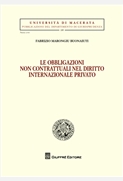
FMB-Le-obbligazioni-non-contrattuali__1338079.gifFabrizio Marongiu Buonaiuti (Univ. of Macerata) has recently published “Le obbligazioni non contrattuali nel diritto internazionale privato” (Non-contractual Obligations in Private International Law ) (Giuffrè, 2013). An abstract has been kindly provided by the author (the complete table of contents is available on the publisher’s website):

The volume deals with non-contractual obligations in private international law, addressing both issues related to jurisdiction and to conflict of laws.

As concerns jurisdiction, the volume discusses the problems posed by the application of the rules on jurisdiction in civil and commercial matters as contained in EC Regulation No. 44/2001 (s.c. “Brussels I”) to disputes concerning non-contractual obligations. Special attention is devoted to the specific rule of jurisdiction in matters of tort or delict under Article 5.3 of the said Regulation (to be replaced, without modifications as to the substance, by Article 7.2 of EU Regulation No. 1215/2012 providing for its recast) and to its coordination with the other rules of jurisdiction. The volume addresses also the more recent case law of the European Court of Justice concerning the application of the said rule to non-contractual obligations arising from activities performed through the Internet and implying violations either of privacy and personality rights or of intellectual property rights.

As concerns conflict of laws, the volume examines the rules contained in EC Regulation No. 864/2007 (s.c. “Rome II”) on the law applicable to non-contractual obligations, stressing parallelism and differences in respect of the solutions achieved as concerns jurisdiction under the Brussels I Regulation. Furthermore, the volume deals with the problems of coordination of the conflict of laws rules as contained in the Rome II Regulation with the rules contained in international conventions applicable in the field concerned, to which the Regulation grants priority. The volume finally addresses the domestic rules on conflict of laws as contained in Law No. 218 of 31 May 1995 providing for the reform of the Italian system of private international law, which apply residually to non-contractual obligations not governed by the Regulation.

Title: “Le obbligazioni non contrattuali nel diritto internazionale privato“, by Fabrizio Marongiu Buonaiuti, Giuffrè (series: Pubblicazioni del Dipartimento di Giurisprudenza dell’Università degli Studi di Macerata, Nuova serie, vol. 139), Milano, 2013, X – 254 pages.

ISBN: 9788814182419. Price: EUR 26. Available at Giuffrè.

https://conflictoflaws.net/News/2020/08/CoL_Banner-1.png 0 0 Giorgio Buono https://conflictoflaws.net/News/2020/08/CoL_Banner-1.png Giorgio Buono2013-11-12 08:00:432013-11-11 23:47:38Book: Marongiu Buonaiuti, Le obbligazioni non contrattuali nel diritto internazionale privato

Categories

  • Views
  • News

Most Recent Posts

  • Conflicts of jurisdiction in Senegal: lesson from the Senegalese Supreme Court on Lis Pendens and the Exequatur of foreign judgments July 27, 2026
  • Adoption in the proposal for a European Parenthood Regulation July 21, 2026
  • Copyright, Targeting and Geo-Blocking: The CJEU Stirs the Pot July 15, 2026
  • A Follow-Up: The German Judges Association’s Response to the HCCH Draft Text of a Future Convention on Parallel Proceedings and Related Actions July 15, 2026
  • Private International Law Dimensions of Singapore’s New Legislation to Combat Online Harms July 14, 2026
  • The 1961 HCCH Apostille Convention: Why All African Countries Should Ratify It? — Insights from Judicial Practice in Africa July 14, 2026
  • The enforcement of an advance on costs for substitute performance at the expense of a Russian debtor in German-French legal relations July 2, 2026
  • “Yes, in principle, but not quite there yet…” – Some Observations on the Public Consultation on the HCCH Draft Text of a Future Convention on Parallel Proceedings and Related Actions June 29, 2026
  • Judgment Mobility Rules in India’s Private International Law Regime: No place for a revision au fond? June 26, 2026
  • Nothing to See Here: The CJEU’s Decision in Case C-232/25 Idzinski June 18, 2026
  • Refusal to Enforce in Egypt of a Californian (U.S.) Judgment for Lack of Reciprocity: What Has Gotten into the Egyptian Supreme Court? June 15, 2026
  • PRC Double Interest neither Double nor Penal: Australian Courts Clear Its Name When Enforcing Chinese Judgments June 10, 2026
  • The AIFC Court, Gazprom v Naftogaz and the Emergence of a New Conduit Jurisdiction Debate June 6, 2026
  • Montana Supreme Court Decides International Child Custody Case June 3, 2026
  • China’s Countering Improper Foreign Extraterritorial Jurisdiction Regulation Blocked EU’s Extraterritorial Data Acquisition May 29, 2026
Scroll to top Scroll to top Scroll to top