Tag Archive for: migration

Stigma in the Lives of Refugees Living in Turkey

You are invited to the next Migration Talk organized by the Jean Monnet Chair in Legal Aspects of Migration Management in the European Union and in Türkiye.

Speakers: Dr. Hamed Abdollahpour Ranjbar (Istinye University), Khaled Elazab, MA (Clark University), Yomna Nassar, MA (Koç University), Farah Amayreh (Koç University), Dr. Ibrahim Yigit (Florida State University), Prof. Dr. Janet Molzan Turan (Koç University), and Prof. Dr. Bülent Turan (Koç University)

Title:Stigma in the Lives of Refugees Living in Turkey

Date and Time: Monday, May 4, 2026 – 12:30 PM – 1:20 PM (Turkish Time)
Event Location: via Zoom (The Zoom link shall be provided upon request: migration@bilkent.edu.tr)

The event will be held in English.

Abstract
The research is conducted with Syrian and Afghan refugees living in Istanbul, Turkiye to explore and examine effects of stigma and microaggressions in these populations.
It is based on 8 focus groups separately for men and women, four groups with Syrian refugees and four with Afghan refugees, with 4-10 participants in each group. Participants shared that stigma and microaggressions were central forces shaping every dimension of their daily life, well-being, and future plans. The intensity and ubiquity of these experiences appeared to exceed what is commonly documented in other stigmatized populations, owing in part to the visibility and politicization of refugee identity in the current sociopolitical climate in Türkiye, which allows and condones stigma and microaggressions against these populations. Refugees described that they and their children experienced mental and physical health problems not only due to trauma and difficulties faced before and during migration, but also due to post-displacement stigma and microaggressions that they experienced on a daily basis. Refugees employed a range of coping strategies to deal with these challenges, avoidance of interactions with Turks, forms of identity concealment (e.g., not revealing nationality, changing names, or not speaking their native language in public), avoidance of confrontation, and in some cases educating their neighbors to confront and correct stereotypes.

In the quantitative phase of the research, the research group developed the Refugee Stigma Scale (RSS) informed by the literature and qualitative and quantitative data. The scale includes four theoretical dimensions of stigma: perceived community stigma, experienced stigma, anticipated stigma, and internalized stigma. In a sample of 404 Syrian and 447 Afghan refugees in Türkiye, confirmatory factor analysis supported the hypothesized four-factor structure of the RSS. Results also supported convergent validity of the four subscales showing correlations with validated measures of depression, anxiety, post-traumatic stress disorder (PTSD), somatic symptoms, post-migration difficulties, and contact experiences.

The research group also developed a subscale assessing microaggressions (subtle/ambiguous discriminatory remarks or behaviors). Convergent validity of the Microaggression Scale for Refugees (MSR) was supported by high correlations between microaggressions and experienced stigma, somatic symptoms, post-migration difficulties, and contact experiences with the host country. Importantly, both experienced stigma and microaggressions contributed independently to explaining variance in psychological and somatic symptoms.

It is also explored the concept of identity denial in the context of refugee stigma using the new scales. Even after many years of immigrating, immigrants can have their new cultural identity (in this case, their Turkish identity) denied or unacknowledged. Based on a survey of 156 young Syrian adults living in Türkiye for many years, the research found that Turkish identity denial was associated with higher depressive symptoms and lower psychological well-being, mediated by perceived and anticipated stigma. Furthermore, a challenged sense of belonging was an independent parallel mediating mechanism by which identity denial was associated with psychological well-being and depressive symptoms.
Migration Talks: An Analysis of Free Movement Regimes Globally

You are invited to the next Migration Talk organized by the Jean Monnet Chair in Legal Aspects of Migration Management in the European Union and in Türkiye.

Speaker: Prof. Dr. Diego Acosta, University of Bristol

Title: An Analysis of Free Movement Regimes Globally

Date and Time: Monday, April 20, 2026 – 12:30 PM – 1:20 PM (Turkish Time)

Event Location: via Zoom (The Zoom link shall be provided upon request: migration@bilkent.edu.tr)

GE 250/251 will be given for full attendance.

The event will be held in English.

Read more

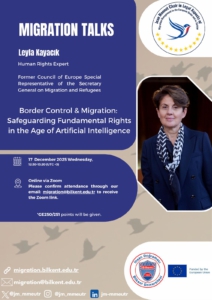
Border Control & Migration: Safeguarding Fundamental Rights in the Age of Artificial Intelligence

You are invited to the next Migration Talk organized by the Jean Monnet Chair in Legal Aspects of Migration Management in the European Union and in Türkiye by Leyla Kayac?k (Human Rights Expert/ Council of Europe Former Special Representative of the Secretary General on Migration and Refugees) on “Border Control & Migration: Safeguarding Fundamental Rights in the Age of Artificial Intelligence”.

Venue: Online via Zoom
Date: 17 December 2025, Wednesday
Time: 12:30 – 13:20 (UTC +3)
The Zoom link shall be provided upon request: migration@bilkent.edu.tr

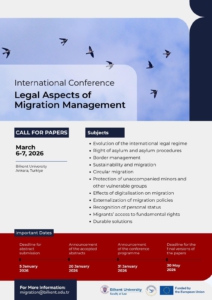
Call for Papers- International Conference on Legal Aspects of Migration Management

Bilkent University Faculty of Law and Jean Monnet Chair in Legal Aspects of Migration Management in the EU and in Türkiye cordially invite you to submit abstracts for the International Conference on Legal Aspects of Migration Management to be held at Bilkent University on 6-7 March 2026.

The Conference aims to give the opportunity to researchers who would like to present their theoretical or empirical research on the development of policy, legislative and administrative responses to key migration issues.

We particularly encourage submissions on the questions of evolution of the international legal regime relating to migration; the right of asylum and asylum procedures; border management; sustainability and migration; circular migration; protection of unaccompanied minors and other vulnerable groups; effects of digitalisation on migration; externalization of migration policies, recognition of personal status; migrants’ access to fundamental rights and durable solutions. Proposals involving comparative perspectives of international, European and national approaches are most welcome.

Abstracts (max. 500 words) (in English or in Turkish) should be sent to migration@bilkent.edu.tr by 5 January 2026.

Detailed information shall be provided upon request: migration@bilkent.edu.tr


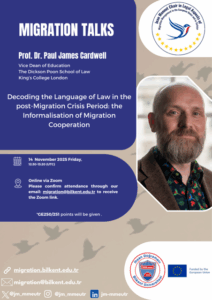
Decoding the Language of Law in the post-Migration Crisis Period: the Informalisation of Migration

The Jean Monnet Chair in Legal Aspects of Migration Management in the EU and in Türkiye and Bilkent University Faculty of Law cordially invite you for the next Migration Talk by Professor Paul James Cardwell (King’s College London) on “Decoding the Language of Law in the post-Migration Crisis Period: the Informalisation of Migration”.

The talk shall be held online. For the Zoom link please contact migration@bilkent.edu.tr.


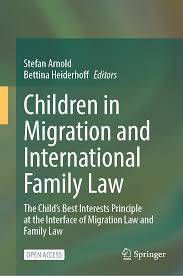
Out Now: New open Access book on Children in Migration and International Family Law (Springer, 2024) by Stefan Arnold & Bettina Heiderhoff

Stefan Arnold (Institute of International Business Law, Chair for Private Law, Philosophy of Law, and Private International Law, University of Münster, Münster, Germany) and Bettina Heiderhoff (Institute for German and International Family Law, Chair for Private International Law, International Civil Procedure Law and German Private Law, University of Münster, Münster, Germany) have recently published an edited book on Children in Migration and International Family Law (Springer, 2024).

The book is an open access title, so it is freely available to all. In the editors’ words, the book aims “to shed light on the often overlooked legal difficulties at the interface between international family law and migration law” (p. 3) with focus placed “on the principle of the best interests of the child and how this principle can be more effectively applied.” (p.4)


The book’s blurb reads as follows:

This open access book offers readers a better understanding of the legal situation of children and families migrating to the EU. Shedding light on the legal, practical, and political difficulties at the intersection of international family law and migration law, it demonstrates that enhanced coordination between these policy areas is crucial to improving the legal situation of families on the move. It not only raises awareness of these “interface” issues and the need for stakeholders in migration law and international family law to collaborate closely, but also identifies deficits in the statutory framework and suggests possible remedies in the form of interpretation and regulatory measures.
The book is part of the EU co-financed FAMIMOVE project and includes contributions from international experts, who cover topics such as guardianship, early marriage, age assessment, and kafala from a truly European perspective. The authors’ approach involves a rigorous analysis of the relevant statutory framework, case law, and academic literature, with particular attention given to the best interest of the child in all its facets. The book examines how this principle can be more effectively applied and suggests ways to foster a more fruitful understanding of its regulatory potential.

Given its scope and focus, the book will be of interest to researchers, scholars, and practitioners of Private International Law, Family Law, and Migration Law. It makes a valuable contribution to these fields, particularly at their often-overlooked intersections.


The content of the chapters is succinctly summarized in the introductory chapter of the book, authored by the editors (“Children in Migration and International Family Law: An Introduction,” pp. 11–16). This summary is referenced here as a sort of abstract for each chapter. Read more

Revue Critique de droit international privé – issue 2024/3

Written by Hadrien Pauchard (assistant researcher and doctoral student at Sciences Po Law School)

The third issue of the Revue Critique de droit international privé of 2024 was released on October 1st. It contains four articles and several case notes. In line with the Revue Critique’s recent policy, the doctrinal part will shortly be made available in English on the editor’s website (for registered users and institutions). Read more

New Issue of Revue Critique de droit international privé (2024/2)

Written by Hadrien Pauchard (assistant researcher at Sciences Po Law School)

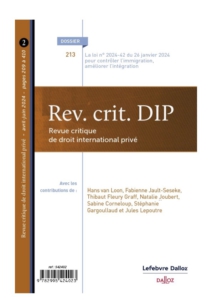
The second issue of the Revue Critique de droit international privé of 2024 was released a few weeks back. It contains a rich thematic dossier of seven articles and several case notes.

Under the direction of Prof. Sabine Corneloup (Université Paris-Panthéon-Assas), the doctrinal section of this issue is entirely devoted to an in-depth study of the latest French immigration law (Loi n° 2024-42 du 26 janvier 2024 pour contrôler l’immigration, améliorer l’intégration). In line with the Revue Critique’s recent policy, this doctrinal part has been made available in English on the editor’s website (for registered users and institutions). Against the backdrop of tightening migration controls at the global scale, this Act radically shifts administrative, procedural, and substantial aspects of the status of aliens in France.

Read more