Tag Archive for: Italy

Calls Open: Summer School and Workshop on Consumer Law and Green Rights in the EU

The University of Udine, together with its partners, has announced two exciting opportunities for students, researchers and practitioners interested in European consumer and market law, with a particular focus on sustainability and the circular economy.

The first call invites participants to register for the Summer School “Consumer and Market Law in the European Circular Economy” to be held at the University of Udine, from 8 to 17 July 2026. This programme offers a unique chance to engage with leading scholars and experts, explore the evolving legal framework surrounding sustainable markets and deepen understanding of how EU law is adapting to support the transition toward a circular economy. The Summer School promises an interdisciplinary and international learning environment, making it especially valuable for those looking to expand both their academic knowledge and professional networks. The organisers have provided the Call for applications – Udine Summer School 2026 and the Brochure – Udine Summer School 2026.

In parallel, a second call has been launched for abstracts for the Workshop “Judicial Protection and Enforcement of ‘Green’ Rights in the EU”. This workshop aims to bring together researchers and practitioners to discuss critical issues related to environmental rights enforcement, judicial protection mechanisms and the role of courts in advancing the EU’s green transition. Contributors are encouraged to submit abstracts that engage with current challenges and emerging developments in this rapidly evolving field. The workshop will be held at the University of Udine, on 14 July 2026. The organisers have provided the Call for Abstracts – Workshop Udine Summer School 2026.

Registration is now open for the Summer School, and interested participants are encouraged to apply promptly. At the same time, those wishing to present at the workshop can submit their abstracts for consideration.

Both initiatives reflect a growing commitment within the European academic and legal community to address sustainability challenges through legal innovation and collaboration. For more information on the programmes, application procedures and deadlines, please visit the official project website.

Activities are co-funded by the EU Erasmus+ Programme.

Protection of Forced Heirs and International Public Policy

Written by Matteo Mangone, PhD candidate in Private Law at the University of Turin

Protection of Forced Heirs and International Public Policy: A Comparative Analysis of Germany and Italy in Light of the Bundesgerichtshof Judgment of 29 June 2022

1. The German Approach

The Bundesgerichtshof (Federal Court of Justice), in its judgment of 29 June 2022, affirmed the following legal principle: the protection of mandatory heirs pertains to German public policy and, consequently, pursuant to Article 35 of EU Regulation No. 650/2012, it is possible to disregard the lex successionis designated under Article 22 of the same Regulation whenever its application does not concretely guarantee mandatory heirs a level of protection at least equivalent to that ensured by German inheritance law. Read more

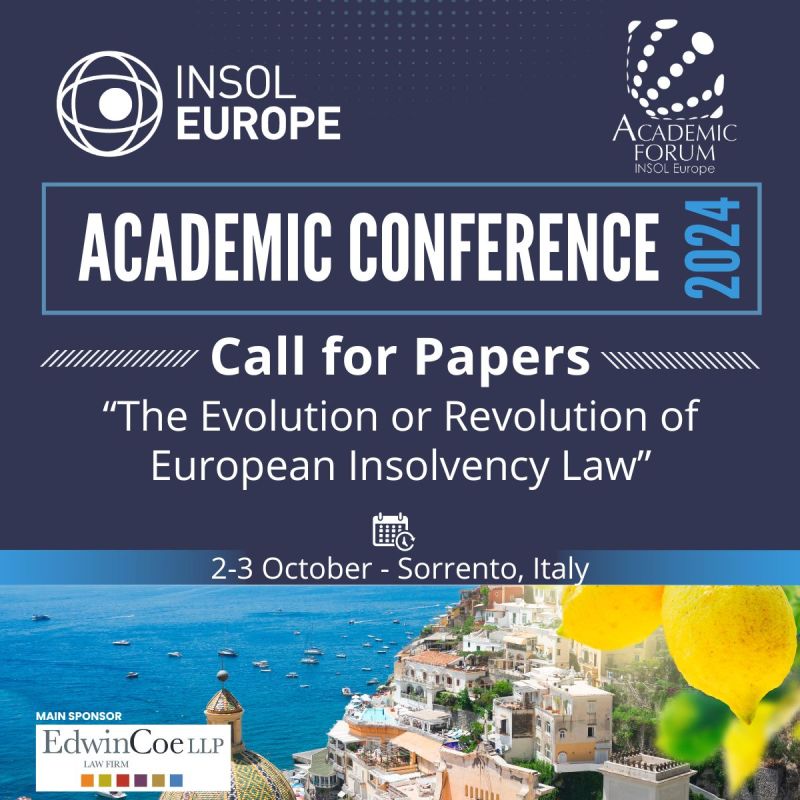
20th IEAF Call for Papers: Evolution or Revolution of European Insolvency Law


The organisers of the 2024 edition of the INSOL Europe Academic Forum kindly shared with us the following call for papers. Please note the deadline for submission is 1 March 2024:

Read more

Third Issue of 2017’s Rivista di diritto internazionale privato e processuale

(I am grateful to Prof. Francesca Villata – University of Milan – for the following presentation of the latest issue of the RDIPP)

The third issue of 2017 of the Rivista di diritto internazionale privato e processuale (RDIPP, published by CEDAM) was just released.

It features two articles and three comments. Read more

First and Second Issues of 2017’s Rivista di diritto internazionale privato e processuale

(I am grateful to Prof. Francesca Villata – University of Milan – for the following presentation of the latest issues of the RDIPP)

The first and second issues of 2017 of the Rivista di diritto internazionale privato e processuale (RDIPP, published by CEDAM) were just released.
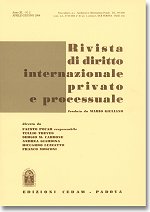
Rivista di diritto internazionale privato e processualeThe first issue features three articles, one comment, and two reports.

  • Franco Mosconi, Professor Emeritus at the University of Pavia, and Cristina Campiglio, Professor at the University of Pavia, ‘Richiami interni alla legge di diritto internazionale privato e regolamenti comunitari: il caso dei divorzi esteri’  (‘Effects of EU Regulations on Domestic Private International Law Provisions: The Case of Foreign Divorces’; in Italian).

This paper inquires whether Article 65 (Recognition of foreign rulings) and the underlying private international law reference are still applicable to foreign divorces after Regulations No 2201/2003 and No 1259/2010 replaced Article 31 of Law No 218/1995 and after the recent provision submitting the dissolution of same-sex partnerships to Regulation No 1259/2010.

  • Peter Kindler, Professor at the University of Munich, ‘La legge applicabile ai patti successori nel regolamento (UE) n. 650/2012’  (‘The Law Applicable to Agreements as to Successions According to Regulation (EU) No 650/2012’; in Italian).

Under Italian substantive law agreements as to succession are not admitted. The same is true, inter alia, for French and Spanish law. The idea behind this rule is deeply rooted in the dignity of the de cuius. The freedom to dispose of property upon death is protected until the last breath and any speculation on the death of the disponent should be avoided. Other jurisdictions such as German or Austrian law allow agreements as to succession in order to facilitate estate planning in complex family situations. This is why the Succession Regulation (650/2012/EU) could not ignore agreements as to succession. Article 25 of the Regulation deals with the law applicable to their admissibility, their substantive validity and their binding effects between the parties. The Regulation facilitates estate planning by introducing the freedom of the parties to such an agreement to choose the applicable law (Article 25(3)). The Author favours a wider concept of freedom of choice including (1) the law of the State whose nationality the person whose estate is involved possesses at the time of making the choice or at the time of death and (2) the law of the habitual residence of that person at the time of making the choice or at the time of death. As to the revocability of the choice of the lex successionis made in an agreement as to succession, the German legislator has enacted a national norm which allows the parties to an agreement as to succession to establish the irrevocability of the choice of law. This is, according to the Author, covered by Recital No 40 of the Succession Regulation. The Regulation has adopted a wide notion of agreements as to succession, including, inter alia, mutual wills and the Italian patto di famiglia. The Author welcomes that, by consequence, the advantages of Article 25, such as the application of the hypothetical lex successionis and the freedom of choice, are widely applicable.

The Regulation did not (and could not) introduce the agreement as to succession at a substantive law level. It does not interfere with the legislative competence of the Member States. According to the author this is why member states such as Italy are free to consider their restrictive rules on agreements as to succession as part of their public policy within the meaning of Articles 35 e 40 litt. a of the Regulation.

  • Cristina Campiglio, Professor at the University of Pavia, ‘La disciplina delle unioni civili transnazionali e dei matrimoni esteri tra persone dello stesso sesso’  (‘The Regulation of Cross-Border Registered Partnerships and Foreign Same-Sex Marriages’; in Italian).

With Law No 76/2016 two new types of pair bonds were regulated: civil unions between same-sex persons and cohabitation. As for transnational civil unions, the Law merely introduced two provisions delegating to the Government the amendment of Law No 218/1995 on Private International Law. The change is laid down in Legislative Decree 19 January 2017 No 7 which, however, has not solved all the problems. The discipline of civil unions established abroad is partial, being limited to unions between Italian citizens who reside in Italy. Some doubt remains moreover in regulating the access of foreigners to civil union in Italy as well as in identifying the law applicable to the constitution of the union, its effects and its dissolution; finally, totally unresolved – due to the limitations of the delegation – remains the question of the effect in Italy of civil unions established abroad between persons of opposite sex. With regard to same-sex marriages celebrated abroad the fate of Italian couples is eventually clarified but that of mixed couples remains uncertain; in addition, no information is provided as to the effects of marriages between foreigners.

In addition to the foregoing, the following comment is featured:

  • Domenico Damascelli, Associate Professor at the University of Salento, ‘Brevi note sull’efficacia probatoria del certificato successorio europeo riguardante la successione di un soggetto coniugato o legato da unione non matrimoniale’ (‘Brief Remarks on the Evidentiary Effects of the European Certificate of Succession in the Succession of a Spouse or a Partner in a Relationship Deemed to Have Comparable Effects to Marriage’; in Italian).

This article refutes the doctrinal view according to which the European Certificate of Succession (ECS) would not produce its effects with regard to the elements referred to therein that relate to questions excluded from the material scope of Regulation EU No 650/2012, such as questions relating to matrimonial property regimes and property regimes of relationships deemed by the law applicable to such relationships to have comparable effects to marriage. This view is rejected not only on the basis of its paradoxical practical results (namely to substantially depriving the ECS of any usefulness), but mainly because it ends up reserving the ECS a pejorative treatment compared to that afforded to the analogous certificates issued in accordance with the substantive law of the Member States (the effects of which, vice versa, have to be recognized without exceptions under Chapter IV of the Regulation). The rebuttal is strengthened considering the provisions contained in Chapter VI of the Regulation, from which it emerges that, apart from exceptional cases (related, for example, to the falsity or the manifest inaccuracy of the ECS), individuals to whom is presented cannot dispute the effects of ECS.

Finally, the first issue of 2017 of the Rivista di diritto internazionale privato e processuale features the following reports:

  • Katharina Raffelsieper, Attorney at Thewes & Reuter Avocats à la Cour, ‘Report on Recent German Case-Law Relating to Private International Law in Civil and Commercial Matters’ (in English).
  • Stefanie Spancken, Associate at Freshfields Bruckhaus Deringer LLP, Düsseldorf, ‘Report on Recent German Case-Law Relating to Private International Law in Family Law Matters’ (in English).

*****

The second issue of 2017 of the Rivista di diritto internazionale privato e processuale features three articles and one report.

  • Costanza Honorati, Professor at the University of Milan-Bicocca, ‘La proposta di revisione del regolamento Bruxelles II-bis: più tutela per i minori e più efficacia nell’esecuzione delle decisioni’ (‘The Proposal for a Recast of the Brussels IIa Regulation: More Protection for Children and More Effectiveness in the Enforcement of Decisions’; in Italian).

The present essay is a first assessment of the Proposal for a recast of the Brussels IIa Regulation (COM(2016)211). After a short explanation of the reasons for not touching on the highly controversial grounds for divorce, the essay develops on the proposed amendments in the field of parental responsibility and international abduction of children. It further analyses the amendments proposed to the general criterion of the child’s habitual residence and to prorogation of jurisdiction (par. 3) and the new provision on the hearing of the child (par. 4). Major attention is given to the new chapter on abduction of children, that is assessed into depth, also in regard of the confirmation of the much-discussed overriding mechanism (par. 5-7). Finally, the amendment aiming to the abolition of exequatur, counterbalanced by a new set of grounds for opposition, is assessed against the cornerstone of free circulation of decision’s principle. Indeed, new Article 40 will allow to refuse enforcement when the court of the state of enforcement considers this to be prejudicial to the best interest of the child, thus overriding basic EU principles (par. 8-9).

  • Lidia Sandrini, Researcher at the University of Milan, ‘Nuove prospettive per una più efficace cooperazione giudiziaria in materia civile: il regolamento (UE) n. 655/2014’ (‘New Perspectives for a More Effective Judicial Cooperation in Civil Matters: Regulation (EU) No 655/2014’; in Italian).

Regulation (EU) No 655/2014 – applicable from 18 January 2017 – established a European Account Preservation Order procedure (EAPO) to facilitate cross-border debt recovery in civil and commercial matters. In order to give a first assessment of the new instrument, the present contribution aims at identifying the peculiarity that could make the EAPO preferable to the creditor vis-à-vis equivalent measures under national law. It then scrutinizes the enactment of this new piece of European civil procedure law in light of the principles governing the exercise of the EU competence in the judicial cooperation in civil and commercial matters as well as its compliance with the standard of protection of the creditor’s and debtor’s rights resulting from both the EU Charter of Fundamental Rights and the ECHR. Finally, it analyses the rules on jurisdiction as well as on the applicable law, provided for by the Regulation, in order to identify hermeneutical solutions to some critical issues raised by the text and clarify its relationship with other EU instruments.

  • Fabrizio Vismara, Associate Professor at the University of Insubria, ‘Legge applicabile in mancanza di scelta e clausola di eccezione nel regolamento (UE) n. 2016/1103 in materia di regimi patrimoniali tra i coniugi’ (‘Applicable Law in the Absence of a Choice and Exception Clause Pursuant?to Regulation (EU) No 2016/1103 in Matters of Matrimonial Property Regimes’; in Italian).

This article analyzes the rules on the applicable law in the absence of an express choice pursuant to EU Regulation No 2016/1103 in matters of matrimonial property regimes. In his article, the Author first examines the connecting factors set forth under Article 26 of the Regulation, with particular regard to the spouses’ first common habitual residence or common nationality at the time of the conclusion of the marriage and the closest connection criteria, then he proceeds to identify the connecting factors that may come into play in order to establish such connection. The Author then focuses on the exception clause under Article 26(3) of the Regulation by highlighting the specific features of such clause as opposed to other exception clauses as applied in other sectors of private international law and by examining its functioning aspects. In his conclusions, the Author underlines some critical aspects of such exception clause as well as some limits to its application.

Finally, the second issue of 2017 of the Rivista di diritto internazionale privato e processuale features the following report:

  • Federica Favuzza, Research fellow at the University of Milan, ‘La risoluzione n. 2347 (2017) del Consiglio di Sicurezza e la protezione dei beni culturali nei conflitti armati e dall’azione di gruppi terroristici’ (‘Resolution No 2347 (2017) of the Security Council on the Destruction, Smuggling of Cultural Heritage by Terrorist Groups’; in Italian).

Indexes and archives of RDIPP since its establishment (1965) are available on the website of the Rivista di diritto internazionale privato e processuale.

Conference: Cross Border Family Litigation in Europe. The Brussels IIbis Recast (Milan, 14 october 2016)

The University of Milan (Department of International, Legal, Historical and Political Studies) will host on Friday 14 October 2016 (14h00) a conference on “Cross border family litigation in Europe. The Brussels IIbis recast“.

Here is the programme (the sessions will be held in English and Italian):

Welcoming addresses

  • Chiara Tonelli (Vice-Rector for Research, Univ. of Milan)
  • Laura Ammannati (Director of the Department of International, Legal, Historical and Political Studies)

Chair: Stefania Bariatti (Univ. of Milan)

The Brussels IIbis recast

  • Joanna Serdynska (Civil Justice Policy, DG Justice, European Commission): The Commission’s proposal
  • Anatol Dutta (Universität Regensburg – MPI Hamburg): A comment on the Commission’s Proposal from a member of the Commission’s Expert Group

Round Table – The Commission’s Proposal: exchange of views among judges, practitioners and academics

  • Giuseppe Buffone (Milan Court, Family Division)
  • Monica Velletti (Rome Court, Family Division)
  • Suzanne Todd (Whiters LPP, London)
  • Cinzia Calabrese (President of AIAF Lombardia)
  • Carlo Rimini (Univ. of Milan)
  • Ilaria Viarengo (Univ. of Milan)

Closing remarks: Stefania Bariatti (Univ. of Milan)

Venue: Sala Lauree, Facoltà di Scienze Politiche, Economiche e Sociali, University of Milan.

(Many thanks to Prof. Ilaria Viarengo for the tip-off)

Conference: “Le successioni internazionali in Europa” (International Successions in Europe) – Rome, 13 October 2016

The Faculty of Law of the University of Rome “La Sapienza” will host a German-Italian-Spanish conference on Thursday, 13th October 2016, on International Successions in Europe. The conference has been convened for the presentation of the volume “The EU Succession Regulation: a Commentary, edited by Alfonso-Luís Calvo Caravaca (University “Carlos III” of Madrid), Angelo Davì (University of Rome “La Sapienza”) and Heinz-Peter Mansel (University of Cologne), published by Cambridge University Press, 2016. The volume is the product of a research project on “The Europeanization of Private International Law of Successions” financed through the European Commission’s Civil Justice Programme.

Here is the programme (available as .pdf):

Welcome addresses: Prof. Enrico del Prato (Director, Department of Legal Sciences, University “La Sapienza”); Prof. Paolo Ridola (Dean, Faculty of Law, University “La Sapienza”); Prof. Angelo Davì (University “La Sapienza”).

First Session

Chair: Prof. Ugo Villani (University of Bari, President of SIDI-ISIL – Italian Society for International Law)

  • Prof. Javier Carrascosa González (University of Murcia): La residenza abituale e la clausola di eccezione (Habitual Residence and Exception Clause);
  • Prof. Cristina Campiglio (University of Pavia): La facoltà di scelta del diritto applicabile (Choice of the Applicable Law by the Testator);
  • Prof. Erik Jayme (University of Heidelberg): Metodi classici e nuove norme di conflitto: il regolamento relativo alle successioni (Traditional Methods and New Conflict Rules: the EU Regulation Concerning Succession);
  • Prof. Claudio Consolo (University “La Sapienza”): Il coordinamento tra le giurisdizioni (Coordination between Jurisdictions).

Second Session

Chair: Prof. Sergio Maria Carbone (University of Genova)

  • Prof. Peter Kindler (University of Munich): I patti successori (Agreements as to Succession);
  • Round Table: The European Certificate of Succession
    Introduction: Prof. Claudio Consolo (University “La Sapienza”);
    Participants: Dr. Ana Fernández Tresguerres (Notary in Madrid); Dr. Paolo Pasqualis (Notary in Portogruaro); Dr. Fabian Wall (Notary in Ludwigshafen).

Concluding remarks: Prof. Sergio Maria Carbone (University of Genova).

(Many thanks to Prof. Fabrizio Marongiu Buonaiuti, University of Macerata, for the tip-off)

Seminar: “New Trends in EU Private International Law” (Milan, 15 September 2016)

The University of Milan will host a very interesting seminar on 15 September 2016 (15h00) on “New Trends in EU Private International Law”. Here is the programme:

Welcome address: Prof. Laura Ammannati (Univ. of Milan);

Chair: Prof. Dr. h.c. mult. Fausto Pocar (Univ. of Milan);

  • Prof. Paul Lagarde (Univ. of Paris I Panthéon-Sorbonne): Les règlements en matière de régimes matrimoniaux et d’effets patrimoniaux des partenariats enregistrés;
  • Prof. Dr. Dr. h.c. mult. Jürgen Basedow (MPI, Hamburg): Damages claims for anticompetitive conduct and the competition of legal services;
  • Prof. Dr. Christian Kohler (Univ. des Saarlandes): Les dispositions de d.i.p. du règlement 2016/679 relatif à la protection des données à caractère personnel (et de la directive 2016/680);
  • Prof. Francisco Garcimartín Alférez (Univ. Autónoma de Madrid): The GEDIP proposal on the law applicable to companies;
  • Prof. Manlio Frigo (Univ. of Milan): Methods and techniques of dispute settlement in the international practice of restitution and return of cultural property;

Final remarks: Prof. Stefania Bariatti (Univ. of Milan).

Further information and the (mandatory) registration form can be found here.

(Many thanks to Prof. Francesca Villata for the tip-off)

Fourth Issue of 2015’s Rivista di diritto internazionale privato e processuale – Proceedings of the conference “For a New Private International Law” (Milan, 2014)

(I am grateful to Prof. Francesca Villata – University of Milan – for the following presentation of the latest issue of the RDIPP)

Rivista di diritto internazionale privato e processualeThe fourth issue of 2015 of the Rivista di diritto internazionale privato e processuale (RDIPP, published by CEDAM) was just released.

This issue of the Rivista features the texts – updated and integrated with a comprehensive bibliography – of the speeches delivered during the conference “For a New Private International Law” that was hosted at the University of Milan in 2014 to celebrate the Rivista’s fiftieth anniversary.

The speeches have been published in four sections, in the order in which they were delivered.

The first section, on “Fundamentals of Law No 218/1995 and General Questions of Private International Law”, features the following contributions:

Fausto Pocar, Professor Emeritus at the University of Milan, ‘La Rivista e l’evoluzione del diritto internazionale privato in Italia e in Europa’ (The Rivista and the Evolution of Private International Law in Italy and Europe; in Italian).

Fifty years after the foundation of the Rivista, this article portrays the reasons that led to the publication of this journal and its core features, in particular its unfettered nature and the breadth of its thought with respect to the definition of private international law. In this regard the Rivista – by promptly drawing attention to the significant contribution provided by the law of the European Union in the area of jurisdiction and conflict of laws – succeeded in anticipating the subsequent developments, which resulted in the impressive legislation of the European Union in the field of private international law since the entry into force of the Treaty of Amsterdam in 1999. These developments have significantly affected the Italian domestic legislation as laid down in Law No 218 of 1995. As a result of such impact, the Italian system of private international law shall undergo a further revision in order to harmonize it with the European legislative acts, as well as with recent international conventions adopted in the framework of the Hague Conference on Private International Law, to which the European Union – a Member of the Conference – is party.

Roberto Baratta, Professor at the Scuola Nazionale dell’Amministrazione, ‘Note sull’evoluzione del diritto internazionale privato in chiave europea’ (Remarks on the Evolution of Private International Law in a European Perspective; in Italian).

National sovereignties have been eroded in the last decades. Domestic systems of conflict of laws are no exceptions. While contributing with some remarks on certain evolving processes that are affecting the private international law systems, this paper notes that within the EU – however fragmentary its legislation in the field of civil justice may be – the erosion of national competences follows as a matter of course. It then argues that the EU points to setting up a common space in which inter alia fundamental rights and mutual recognition play a major role. Thus, a supranational system of private international law is gradually being forged with the aim to ensure the continuity of legal relationships duly created in a Member State. As a result, domestic systems of private international law are deemed to become complementary in character. Their conceptualization as a kind of inter-local rules, the application of which cannot raise obstacles to the continuity principle, appears logically conceivable.

Marc Fallon, Professor at the Catholic University of Louvain, ‘La révision de loi italienne de droit international privé au regard du droit comparé et européen des conflits de lois’ (The Recast of the Italian Private International Law with Regard to Comparative and European Conflict of Laws; in French). Read more

Conference: New Families – International Trends and Legal Recognition in Italy (Milan, 23 May 2016)

UniMIThe University of Milan will host on 23 May 2016 a conference on “New Families – International Trends and Legal Recognition in Italy“. The event will be structured in three parts: the first two sessions will look into changing family patterns in Europe and the US, respectively, while in the third one a round table will focus on legal recognition in Italy of new families.

Here’s the programme (available as a .pdf file):

9.00 Welcoming addresses

  • Gianluca Vago (Rector, University of Milan)
  • Maria Elisa D’Amico (University of Milan)
  • Ilaria Viarengo (University of Milan)

9.30: I Session –  Changing family patterns: European Trends

  • Chair: Stefania Bariatti (University of Milan)
  • Katharina Boele-Woelki (Bucerius Law School, Hamburg): New families: fundamental issues
  • Angelika Fuchs (ERA, Academy of European Law): Registered partnerships: crossing borders
  • Patrizia De Luca (DG Justice, Civil Justice Policy Unit): The EU proposal on the property consequences of registered partnerships

11.15: II Session – Changing family patterns: USA Trends

  • Suzanne Goldberg (Columbia University): Transforming Family Law in the United States: Multidimensional Advocacy and Social Change.
  • Yasmine Ergas (Columbia University): From marriage to gender: pathways to equality

14.30: III Session – Round table on “New families: Legal Recognition in Italy”

  • Monica Cirinnà (Italian Senate, Rapporteur of the proposed regulation of civil unions in Italy)
  • Ivan Scalfarotto (Italian Chamber of Deputies, Vice-minister of economic development)
  • Annibale Marini (President Emeritus of the Italian Constitutional Court)
  • Marilisa D’Amico (University of Milan)
  • Ilaria Viarengo (University of Milan)

17.30: Closing remarks

  • Stefania Bariatti (University of Milan)

(Many thanks to Prof Ilaria Viarengo for the tip-off)