
Conflict of Laws
  • About
  • Editorial board
  • Subscription
  • Submission
  • Materials
  • Contact
  • Click to open the search input field Click to open the search input field Search
  • Menu Menu

Tag Archive for: funding

New book and webinar Sustaining Access to Justice – 5 September
August 15, 2025/in News/by Xandra Kramer

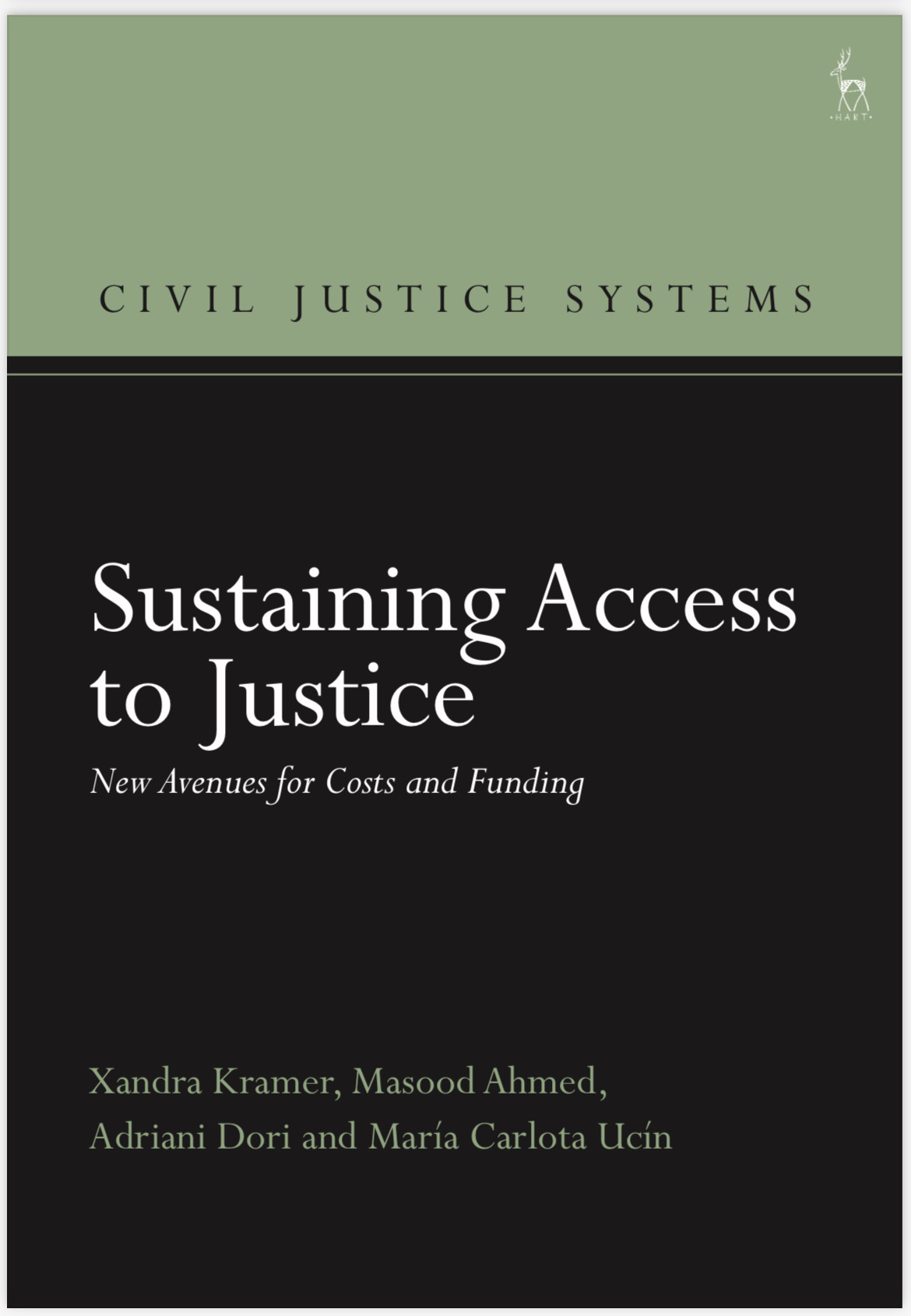
In June the volume “Sustaining Access to Justice: New Avenues for Costs and Funding” was published in the Civil Justice Systems series of Hart Publishing (2025).  The book is edited by Xandra Kramer, Masood Ahmed, Adriani Dori and Maria Carlota Ucín. This edited volume results from a conference held at Erasmus University Rotterdam, as part of the Vici project on Affordable Access to Justice funded by the Dutch Research Council (NWO).  It contains contributions on access to justice themes, in particular costs and funding of litigation, by key experts across Europe, Latin America and Asia. More information, including the table of contents is available at the Bloomsbury website here.

The book explores the dynamic landscape of legal costs and financing from three perspectives: regulatory frameworks in public and private funding; new trends and challenges in contemporary legal financing; and the transformative potential of alternative dispute resolution (ADR) and online dispute resolution (ODR) procedures to streamline civil justice processes and expand access to justice.

By addressing the intersectionality of legal, economic, political, market and social dynamics, the book aims to provide an encompassing understanding of the inherent complexity of costs and funding of litigation, and their implications for access to justice.

A seminar on the ocassion of launching the book will take place on 5 September 2025, from 10-12.15 CET.

Program

10.00 Introduction Xandra Kramer, Masood Ahmed, Carlota Ucin, Adriani Dori

10.15 Jacek Garstka (European Commission) – EC perspective on the access to justice and the role of litigation funding

10.25 Maria Jose Azar-Baud – Trends in Funding of Collective Litigation

10.35 Alexandre Biard – Enforcing Consumer Rights: Costs and Funding

10.50 Discussion

11.10 Eduardo Silva de Freitas – Justice for a Price: Funders, Fees and the RAD

11.20 Marcel Wegmüller – ESG and Litigation Funding: A Practitioner’s View

11.35 Adrian Cordina – Regulating Litigation Funding: A Law and Economics View

11.45 Stefaan Voet/Masood Ahmed – Beyond Litigation: Cost-Effective Strategies for ADR and ODR

12.00 Discussion and Conclusion

More information and (free) registration here.

https://conflictoflaws.net/News/2025/08/Cover-Sustaining-Access-to-Justice.jpg 1691 1170 Xandra Kramer https://conflictoflaws.net/News/2020/08/CoL_Banner-1.png Xandra Kramer2025-08-15 23:30:152025-08-15 20:31:04New book and webinar Sustaining Access to Justice – 5 September

Book and webinar Financing Collective Actions

May 29, 2024/in News/by Xandra Kramer

Collective actions and the financing of complex mass damage cases have been among the most debated and controversial topics in civil justice in Europe over the past decade. It doesn’t need much explanation that oftentimes these complex cases involving a multiplicity of parties and events or consequences taking place in different countries trigger private international law questions, as for instance the ongoing evaluation of the Brussels I-bis Regulation evidences (see among others the 2023 Study in support of the evaluation; a 2021 Working Paper by Burkhard Hess; a 2022 report by BEUC on PIL and Cross-border Collective Redress). Another key issue is the funding of these inherently costly litigations. The Representative Action Directive, applicable since June 2023, and the European Parliament Resolution on Responsible private funding of litigation, adopted in 2022, have proliferated discussions on the funding of collective actions. With the entry into force of the Dutch collective damages procedure (WAMCA) in 2020, enabling compensatory actions, the Netherlands has re-confirmed its reputation as one of the frontrunners in having a well-developed framework for collective actions and settlements in Europe. High stake cases involving privacy, environmental law, human rights and consumer law have found their way to the courts and have benefitted from third party funding.

These developments have triggered the Dutch Research and Documentation Centre of the Ministry of Justice and Security to commission a Study on the need for a procedural fund for collective actions, published in 2023 (in Dutch). The book Financing Collective Actions in the Netherlands: Towards a Litigation Fund?, based on this study and including updates, has just been published (Eleven International Publishing 2024) and is available open access. The book is authored by Xandra Kramer (Erasmus University Rotterdam/Utrecht University), Ianika Tzankova (Tilburg University), Jos Hoevenaars (Erasmus University Rotterdam, researcher Vici team) and Karlijn van Doorn (Tilburg University). It discusses developments in Dutch collective actions from a regulatory perspective, including the implementation of the RAD, and contains a quantitative and qualitative analysis of cases that have been brought under the WAMCA. It then examines funding aspects of collective actions from a regulatory, empirical and comparative perspective. It delves into different funding modes, including market developments in third party litigation funding, and  addresses the question of the necessity, feasibility, and design of a (revolving) litigation fund for collective actions.

The hardcover version of the book can be ordered from the publisher’s website, which also provides access to the free digital open access version through the publisher’s portal.

A launch event and webinar on ‘Financing Collective Actions: Current Debates in Europe and Beyond’ will take place on 3 July from 15-17.15 CET. Confirmed speakers include Jasminka Kalajdzic (University of Windsor) and Rachael Mulheron (Queen Mary University London). Registration for free here.

https://conflictoflaws.net/News/2020/08/CoL_Banner-1.png 0 0 Xandra Kramer https://conflictoflaws.net/News/2020/08/CoL_Banner-1.png Xandra Kramer2024-05-29 20:56:072024-05-29 20:57:05Book and webinar Financing Collective Actions

International tech litigation reaches the next level: collective actions against TikTok and Google

March 12, 2024/in Views/by Xandra Kramer

Written by Xandra Kramer (Erasmus University Rotterdam/Utrecht University) & Eduardo Silva de Freitas (Erasmus University Rotterdam), members of the Vici project Affordable Access to Justice, financed by the Dutch Research Council (NWO), www.euciviljustice.eu.

Introduction

We have reported on the Dutch WAMCA procedure for collective actions in a number of previous blogposts. This collective action procedure was introduced on 1 January 2020, enabling claims for damages, and has since resulted in a stream of (interim) judgments addressing different aspects in the preliminary stages of the procedure. This includes questions on the admissibility and funding requirements, some of which are also of importance as examples for the rolling out of the Representative Action Directive for consumers in other Member States. It also poses very interesting questions of private international law, as in particular the collective actions for damages against tech giants are usually international cases. We refer in particular to earlier blogposts on international jurisdiction in the privacy case against TikTok and the referral to the CJEU regarding international jurisdiction under the Brussels I-bis Regulation in the competition case against Apple.

Read more

https://conflictoflaws.net/News/2020/08/CoL_Banner-1.png 0 0 Xandra Kramer https://conflictoflaws.net/News/2020/08/CoL_Banner-1.png Xandra Kramer2024-03-12 21:25:482024-03-14 02:27:58International tech litigation reaches the next level: collective actions against TikTok and Google

Categories

  • Views
  • News

Most Recent Posts

  • Support in cross-border transactions by Adults: Contract law vs capacity law August 12, 2026
  • Recognition of Italian Extrajudicial Divorces in Tunisia — Between Methodological Uncertainty and the Need to Preserve Continuity of Personal Status Across Borders August 9, 2026
  • Private International Law and European Society August 4, 2026
  • The New Zealand Supreme Court’s judgment in Kea Investments Ltd v Wikeley on anti-enforcement relief August 3, 2026
  • Beyond Domicile: The BHP Litigation and the Functional Interconnection of Public and Private International Law August 3, 2026
  • Conflicts of jurisdiction in Senegal: lesson from the Senegalese Supreme Court on Lis Pendens and the Exequatur of foreign judgments July 27, 2026
  • Adoption in the proposal for a European Parenthood Regulation July 21, 2026
  • Copyright, Targeting and Geo-Blocking: The CJEU Stirs the Pot July 15, 2026
  • A Follow-Up: The German Judges Association’s Response to the HCCH Draft Text of a Future Convention on Parallel Proceedings and Related Actions July 15, 2026
  • Private International Law Dimensions of Singapore’s New Legislation to Combat Online Harms July 14, 2026
  • The 1961 HCCH Apostille Convention: Why All African Countries Should Ratify It? — Insights from Judicial Practice in Africa July 14, 2026
  • The enforcement of an advance on costs for substitute performance at the expense of a Russian debtor in German-French legal relations July 2, 2026
  • “Yes, in principle, but not quite there yet…” – Some Observations on the Public Consultation on the HCCH Draft Text of a Future Convention on Parallel Proceedings and Related Actions June 29, 2026
  • Judgment Mobility Rules in India’s Private International Law Regime: No place for a revision au fond? June 26, 2026
  • Nothing to See Here: The CJEU’s Decision in Case C-232/25 Idzinski June 18, 2026
Scroll to top Scroll to top Scroll to top