


Views
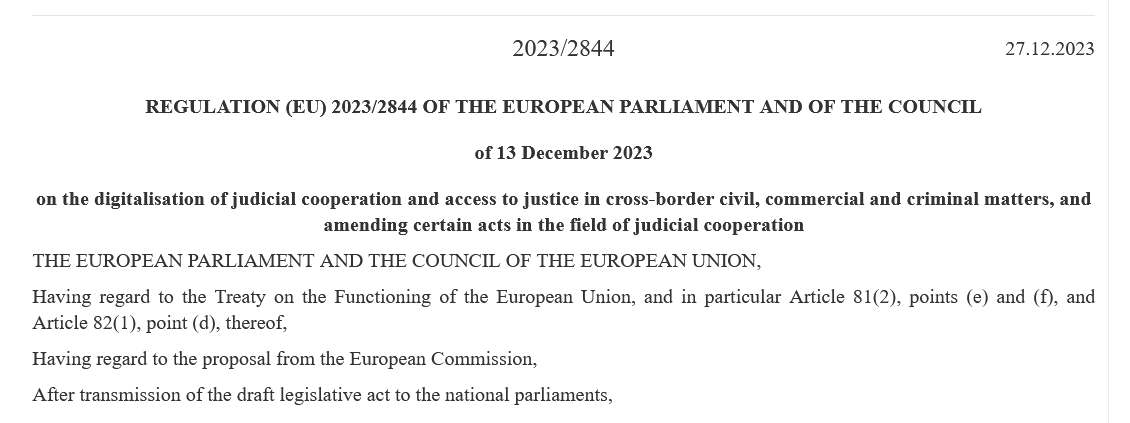
New EU Digitalisation Regulation: A Stepping Stone to Digitalised EU?
Author: Martina Ticic, assistant at the University of Rijeka, Faculty of Law and doctoral student funded by the Croatian Science Foundation (Hrvatska zaklada za znanost – HRZZ)
On 13 December 2023, two years after the first legislative proposal has been published, the new Regulation (EU) 2023/2844 of the European
Parliament and of the Council of 13 December 2023 on the digitalisation of judicial cooperation and access to justice in cross-border civil, commercial and criminal matters, and amending certain acts in the field of judicial cooperation (Digitalisation Regulation) has been adopted. While the process of digitalisation of judicial cooperation and cross-border procedures in the EU has been ongoing for some time already, the new Digitalisation Regulation represents a major step for advancing digitalisation practices in the EU.
Bahraini High Court on Choice of Court and Choice of Law Agreements
I. Introduction
It is widely recognized that choice of court and choice of law agreements are powerful tools for structuring and planning international dispute resolution. These agreements play an important role in “increasing legal certainty for the parties in cross-border transactions and reducing incentives for (the harmful version of) forum shopping.” (Alex Mills, Party Autonomy in Private International Law (CUP, 2018) p. 75). However, the realization of these objectives depends on the enforcement of the parties’ choice. Unfortunately, general practice in the MENA (North Africa and the Middle East) region shows that, with a few exceptions, the status quo is far from satisfactory. Choice-of-court agreements conferring jurisdiction on foreign courts are often disregarded or declared null and void. Similarly, the foreign law chosen as the governing law of a contract is often not applied because of the procedural status of foreign law as a matter of fact, the content of which must be ascertained by the party invoking its application. The recent judgment of the High Court of Bahrain (a first instance court in the Bahraini judicial system) in the Case No. 2/13276/2023/02 of 17 January 2024 is nothing but another example of this entrenched practice that can be observed in the vast majority of countries in the region.
U.S. Supreme Court Decides Great Lakes
On February 21, 2024, the U.S. Supreme Court handed down its decision in Great Lakes Insurance SE v. Raiders Retreat Realty Company, LLC.
The question presented was whether, under federal admiralty law, a choice-of-law clause in a maritime contract can be rendered unenforceable if enforcement is contrary to the “strong public policy” of the U.S. state whose law is displaced. In a unanimous opinion authored by Justice Kavanaugh, the Court concluded that the answer to this question was no. It held that choice-of-law provisions in maritime contracts are presumptively enforceable as a matter of federal maritime law. It further held that while there are narrow exceptions to this rule, state public policy is not one of them.
News
Virtual Workshop (in English) on November 4, 2025: Caroline Sophie Rapatz on “Fly Me to the Moon and Let Me Play Among the Laws?”

On Tuesday, November 4, 2025, the Hamburg Max Planck Institute will host its monthly virtual workshop Current Research in Private International Law at 10:30 a.m. – 12:00 p.m. (CEST). Professor Caroline Sophie Rapatz (Christian-Albrechts-Universität zu Kiel) will speak, in English, about the topic
“Fly Me to the Moon and Let Me Play Among the Laws?”
With the increasing privatisation and economisation of space activities, the need for private space law becomes urgent: Responsible exploration and exploitation necessitates suitable and reliable rules on jurisdiction and applicable law in Outer Space as well as substantive private law adapted specifically to space scenarios. The presentation will explore the options for developing a comprehensive body of such private (international) law rules within the framework established by the existing public international law treaties on space law. It will outline possible approaches to such an undertaking, using property law questions as the main example.
The presentation will be followed by open discussion. All are welcome. More information and sign-up here.
If you want to be invited to these events in the future, please write to veranstaltungen@mpipriv.de.
Inaugural event European Civil Justice Centre
In 2025, the European Civil Justice Centre (ECJC) was established at Erasmus School of Law in Rotterdam. This Centre was set up to facilitate the collaboration of scholars and other stakeholders across Europe and beyond in conducting research and related activities with a view to promoting access to justice. The Centre consolidates extensive work spearheaded by Erasmus School of Law civil justice scholars over the past fifteen years (see www.euciviljustice.eu), benefits in particular from support by the KU Leuven, and builds on collaborations with academics, practitioners and policy-makers around the globe. Read more
Crossroads in Private International Law Webinar with on ‘The Digital Afterlife: Digital succession and private international law’ at the University of Aberdeen
The Centre for Private International Law & Transnational Governance of the University of Aberdeen is continuing its Crossroads in Private International Law webinar series with a talk by Kirsten Henckel (Groningen University) titled ‘The Digital Afterlife: Digital succession and private international law’:
Over the past two decades, our daily lives have become ever more digital. This digitization has fundamentally reshaped the nature of property and inheritance. Digital assets ranging from social media accounts, emails and cloud-based archives to cryptocurrencies, NFTs and digital subscriptions now form an integral part of modern estates. These assets frequently lack clear legal classification and existing laws, largely designed for tangible property, struggle to accommodate their unique characteristics.
This webinar examines the emerging field of digital succession through the lens of private international law, highlighting issues that arise when digital estates span multiple jurisdictions. Key issues include determining jurisdiction and applicable law as well as enforcing rights across borders.
Additional information and the link to register can be found here.