


Views
Egyptian Supreme Court on the Enforcement of Foreign Judgments – Special Focus on the Service Requirement
I . Introduction
Egypt and its legal system occupy a unique position within the MENA region. Egyptian law and scholarship exert a significant influence on many countries in the region. Scholars, lawyers, and judges from Egypt are actively involved in teaching and practicing law in many countries in the region, particularly in the Gulf States. Consequently, it is no exaggeration to say that developments in Egyptian law are likely to have a profound impact on neighboring countries and beyond, and warrant special attention. Read more
International Jurisdiction between Nationality and Domicile in Tunisian Private International Law – Has the Perennial Debate Finally been Resolved?
I would like to thank Prof. Lotfi Chedly for providing me with the text of the decision on which this post is based.
I. Introduction
Scholars of private international law are well familiar with the classic debate on nationality and domicile as connecting factors in the choice of applicable law (see, for example, L. I. de Winter, “Nationality or Domicile? The Present State of Affairs” 128 Collected Courses III (1969) pp. 357 ff). In Tunisian private international law, this controversy has been particularly pronounced with regard to the role of nationality as a ground for the international jurisdiction of Tunisian courts. Since the enactment of the Tunisian Private International Law Code (“PILC”) in 1998 (for an English translation, see J. Basedow et al. (eds.) Encyclopedia of Private International Law – Vol. IV (Elgar Editions, 2017) 3895 and my own translation of the provisions dealing with international jurisdiction and the enforcement of foreign judgments in 8 Journal of Private International Law 2 (2012) pp. 221 ff)), the debate between opponents and proponents of nationality as a ground for international jurisdiction, especially in family law matters, has never ceased to be intense (for detailed analyses, see eg. Salma Triki, “La compétence internationale tunisienne et le critère de nationalité” in Ben Achour/Triki (eds.), Le Code de droit international privé – Vingt ans d’application (1998-2018) (Latrach edition, 2020) 119ff). This divergence in academic opinion is also reflected in the judicial practice of the courts, with the emergence of two opposing trends: one extends the international jurisdiction of the Tunisian courts when the dispute involves a Tunisian party, in particular as a defendant even when domiciled abroad. The other firmly rejects nationality as a ground for international jurisdiction.
An Answer to the Billion-Dollar Choice-of-Law Question
On February 20, 2024, the New York Court of Appeals handed down its opinion in Petróleos de Venezuela S.A. v. MUFG Union Bank, N.A. The issue presented—which I described in a previous post as the billion-dollar choice-of-law question—was whether a court sitting in New York should apply the law of New York or the law of Venezuela to determine the validity of certain bonds issued by a state-owned oil company in Venezuela. The bondholders, represented by MUFG Union Bank, argued for New York law. The oil company, Petróleos de Venezuela, S.A. (“PDVSA”), argued for Venezuelan law.
In a victory for PDVSA, the New York Court of Appeals unanimously held that the validity of the bonds was governed by the law of Venezuela. It then sent the case back to the federal courts to determine whether the bonds are, in fact, invalid under Venezuelan law.
Read more
News
Rivista di diritto internazionale privato e processuale (RDIPP) No 3/2025: Abstracts
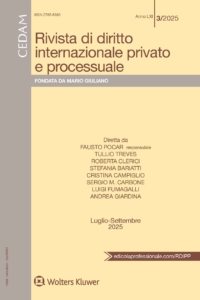 The third issue of 2025 of the Rivista di diritto internazionale privato e processuale (RDIPP, published by CEDAM) will be released shortly. It features:
Cristina Campiglio, Professor at the University of Pavia, Cittadinanza iure sanguinis e nazionalità: riflessioni internazionalprivatistiche [Citizenship by Birthright and Nationality: Private International Law Reflections; in Italian] Read more
Call for Chapters: Digitalisation of Justice
Dr. Benedikt Schmitz (University of Groningen), the editor of an upcoming edited volume called ‘Digitalisation of Justice: Perspectives from Germany and the Netherlands’, has kindly shared this Call for Chapters with us. The volume will be published by Springer.

Call for Abstracts for Emerging Scholars: Digitalisation of Justice, University of Groningen, 29 May 2026
Dr. Benedikt Schmitz (University of Groningen), the organiser of the upcoming symposium ‘Digitalisation of Justice: Perspectives from Germany and the Netherlands’, has kindly shared this Call for Abstracts for emerging scholars with us.