


Views
Colonialism and German PIL (4) – Exploiting Asymmetries Between Global North and South
This post is part of a series regarding Colonialism and the general structure of (German) Private International Law, based on a presentation I gave in spring 2023. See the introduction here.
As mentioned in the introduction, this series does not intent to automatically pass judgment on a norm or method influenced by colonialism as inherently negative. Instead, the aim is to reveal these influences and to initiate a first engagement with and awareness of this topic and to stimulate a discussion and reflection.
The first post (after the introduction) dealt with classic PIL and colonialism. This second considered structures and values inherent in German or European law, implicitly resonating within the PIL and, thus, expanding those values to people and cases from other parts of the world. The third category discusses an imagined hierarchy between the Global North and Global South that is sometimes inherent in private international law thinking. The fourth and for the moment last (but not least) category deals with PIL rules that allow or at least contribute to the exploitation of a power asymmetry between parties from the Global North and the Global South. For example, this power and negotiation asymmetry, in conjunction with generous rules on party autonomy, can lead to arbitration and choice of law clauses being (ab)used to effectively undermine rights of land use under traditional tribal law.
After the first post, in the comment section a discussion evolved regarding the (non-)application of tribal law. One question asked for an example. This post can also (hopefully) serve as such an example.
Colonialism and German PIL (3) – Imagined Hierachies
This post is part of a series regarding Colonialism and the general structure of (German) Private International Law, based on a presentation I gave in spring 2023. See the introduction here.
As mentioned in the introduction, this series does not intent to automatically pass judgment on a norm or method influenced by colonialism as inherently negative. Instead, the aim is to reveal these influences and to initiate a first engagement with and awareness of this topic and to stimulate a discussion and reflection.
The first post (after the introduction) dealt with classic PIL and colonialism and already sparked a vivid discussion in the comments section. This second considered structures and values inherent in German or European law, implicitly resonating within the PIL and, thus, expanding those values to people and cases from other parts of the world. The third category discusses an imagined hierarchy between the Global North and Global South that is sometimes inherent in private international law thinking, for instances where courts or legislators abstractly or paternalistically apply the public policy to “protect” individuals from foreign legal norms. This is especially evident in areas like underage marriages and unilateral divorce practices found inter alia in Islamic law.

US Ninth Circuit rules in favor of Spain in a decades-long case concerning a painting looted by the Nazis
This interesting case comment has been kindly provided to the blog by Nicolás Zambrana-Tévar, LLM, PhD, KIMEP University
The United States Court of Appeals for the Ninth Circuit has found in favor of Spain as defendant in a property case spanning several decades. A panel of three judges has unanimously ruled that, applying California conflict of law rules, Spain has a stronger interest than the claimants in the application of its own domestic law, including its own rules on prescriptive acquisition of property and the statute of limitations, thus confirming the ownership of a stolen painting, now owned by a Spanish museum.
News

New book and webinar Sustaining Access to Justice – 5 September
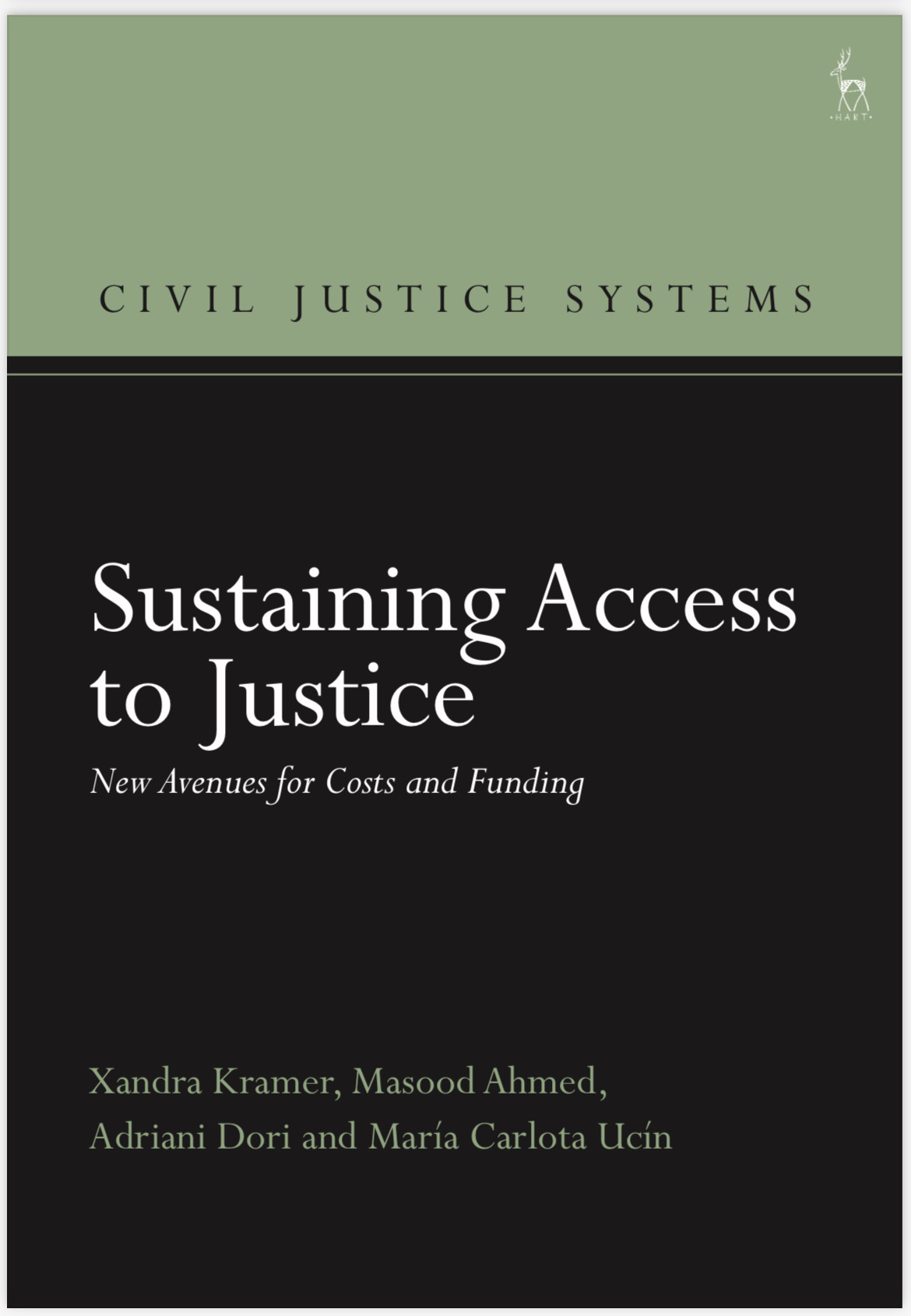 In June the volume “Sustaining Access to Justice: New Avenues for Costs and Funding” was published in the Civil Justice Systems series of Hart Publishing (2025). The book is edited by Xandra Kramer, Masood Ahmed, Adriani Dori and Maria Carlota Ucín. This edited volume results from a conference held at Erasmus University Rotterdam, as part of the Vici project on Affordable Access to Justice funded by the Dutch Research Council (NWO). It contains contributions on access to justice themes, in particular costs and funding of litigation, by key experts across Europe, Latin America and Asia. More information, including the table of contents is available at the Bloomsbury website here.
The book explores the dynamic landscape of legal costs and financing from three perspectives: regulatory frameworks in public and private funding; new trends and challenges in contemporary legal financing; and the transformative potential of alternative dispute resolution (ADR) and online dispute resolution (ODR) procedures to streamline civil justice processes and expand access to justice.
By addressing the intersectionality of legal, economic, political, market and social dynamics, the book aims to provide an encompassing understanding of the inherent complexity of costs and funding of litigation, and their implications for access to justice.
A seminar on the ocassion of launching the book will take place on 5 September 2025, from 10-12.15 CET.
Program
10.00 Introduction Xandra Kramer, Masood Ahmed, Carlota Ucin, Adriani Dori
10.15 Jacek Garstka (European Commission) – EC perspective on the access to justice and the role of litigation funding
10.25 Maria Jose Azar-Baud – Trends in Funding of Collective Litigation
10.35 Alexandre Biard – Enforcing Consumer Rights: Costs and Funding
10.50 Discussion
11.10 Eduardo Silva de Freitas – Justice for a Price: Funders, Fees and the RAD
11.20 Marcel Wegmüller – ESG and Litigation Funding: A Practitioner’s View
11.35 Adrian Cordina – Regulating Litigation Funding: A Law and Economics View
11.45 Stefaan Voet/Masood Ahmed – Beyond Litigation: Cost-Effective Strategies for ADR and ODR
12.00 Discussion and Conclusion
More information and (free) registration here.
Webinar: Beyond State Borders, Beyond the Situs Rule? Private International Law Issues of Resource Extraction in Antarctica, the Deep Seabed, and Outer Space
The Aberdeen Centre for Private International Law & Transnational Governance (CPILTG) will be hosting a webinar by Professor Caroline Rapatz (University of Kiel, Germany) on 20 August 2025, 11am – 12pm noon.
More information is available here.
ZEuP – Zeitschrift für Europäisches Privatrecht 3/2025
A new issue of ZEuP – Zeitschrift für Europäisches Privatrecht is now available and includes contributions on EU private law, comparative law and legal history, legal unification, private international law, and individual European private law regimes. The full table of content can be accessed here: https://rsw.beck.de/zeitschriften/zeup. 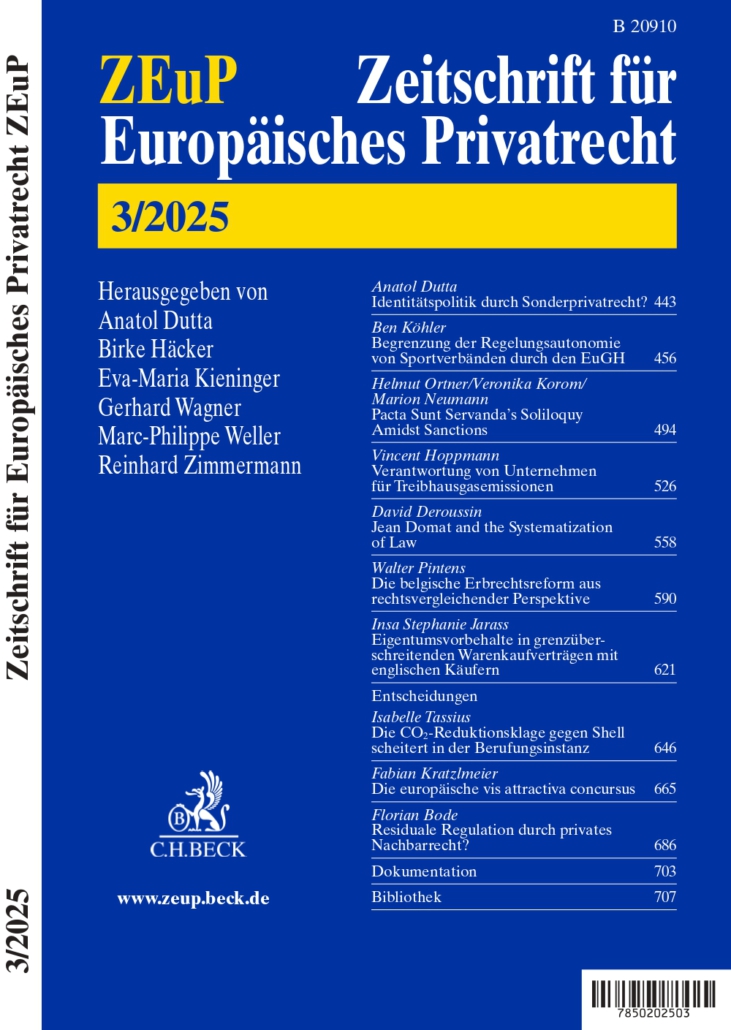
The following contributions might be of particular interest for the readers of this blog:
- Pacta Sunt Servanda’s Soliloquy Amidst Sanctions: The Impact of EU Sanctions on Contractual Performance in Arbitration Proceedings
Helmut Ortner, Veronika Korom and Marion on the Impact of EU Sanctions on Contractual Performance in Arbitration Proceedings: EU sanctions against Russia and Russia’s countermeasures have significantly disrupted trade, supply chains, and contractual relations, sparking disputes frequently resolved through arbitration. European legal systems provide a range of mechanisms—including force majeure, impossibility, frustration, and hardship—to address sanctions-related performance impediments. Despite doctrinal divergences, these frameworks tend to converge on practical outcomes. To mitigate risks and increase legal certainty, parties are well-advised to incorporate tailored clauses in their contracts. - Eigentumsvorbehalte in grenzüberschreitenden Warenkaufverträgen mit englischen Käufern
Insa Stephanie Jarass on retention of title clauses in contracts with English buyers: In PST Energy 7 Shipping LLC v OW Bunker Malta Ltd (The Res Cogitans) [2016] UKSC 23, the Supreme Court held that the Sale of Goods Act 1979 no longer applies to certain con-tracts containing retention of title clauses which had previously always been categorised as contracts for the sale of goods. This article analyses the legal implications of this decision for contracts for the supply of goods to Eng-land. In addition to the legal uncertainties that have always surrounded the validity in rem of retention of title clauses under English law, the decision adds a new level of complex-ity at the contractual level that requires par-ticular attention when drafting international contracts. - Die europäische vis attractiva concursus – Altbekanntes, Neues und Ungeklärtes zu Reichweite, Kompetenzkonflikten und materieller Sperrwirkung
Fabian Kratzlmeier comments on the decision by the ECJ in C-394/22, addressing the law applicable in the context of insolvency proceedings.