


Views
“Yes, in principle, but not quite there yet…” – Some Observations on the Public Consultation on the HCCH Draft Text of a Future Convention on Parallel Proceedings and Related Actions
This post was written by Matthias Weller and Achim Czubaiko-Güntgen, both at the University of Bonn, Germany. Matthias is a Director of the Institute for German and International Civil Procedural Law. Achim is a PhD Student there who works on the HCCH Conventions on judicial cooperation in civil and commercial matters.
Recently, the Hague Conference on Private International Law (HCCH) published the responses to the public consultation issued in November 2025 (all available on hcch.net here). Whilst each of the 72 reports is valuable in its own right, when viewed collectively they also provide an insight in the general perception of the HCCH’s Jurisdiction Project, as it is currently standing. We would like to take this opportunity to highlight certain aspects that are widely agreed upon, as well as others that still remain subject to further debate.
Judgment Mobility Rules in India’s Private International Law Regime: No place for a revision au fond?
This post was kindly prepared by Sai Ramani Garimella, Associate Professor, Faculty of Legal Studies, South Asian University.
A judgment-creditor is often concerned about the enforcement of foreign court orders, and that concern is not completely misplaced in India. The Supreme Court’s decision in Messer Griesheim v Goyal MG Gases is a useful illustration of the law governing the enforcement of foreign court orders and of the discussion of their finality and binding nature. Twenty-three years after the underlying loan transaction, and after much litigation, the Court has finally closed the chapter, refusing to enforce a 2006 English court’s summary judgment for roughly USD 5.8 million. Along the way, it has also clarified two recurring questions that often come up whenever a foreign money decree is sought to be executed in India:

Nothing to See Here: The CJEU’s Decision in Case C-232/25 Idzinski
Earlier today, the Court of Justice rendered its decision in Case C-232/25 Idzinski, essentially confirming its previous case law, combined with a restrictive reading of its infamous decision in Joint Cases C-509/09 and C-161/10 eDate.
The facts of the case (which was given the entirely fictitious name Idzinski) are eerily similar to those of the Court’s 2021 decision in Case C-800/19 Mittelbayrischer Verlag. Just like in that earlier case, they involved a claim by Polish claimants against a German media outlet regarding the correction of, and damages for, the publication of content that allegedly violated their personality rights, including their national dignity. Only two elements of the facts were different: first, the content complained of was broadcasted on television, in addition to being published online; second, the claimants were (1) a private person who was part of a Polish military unit during World War II, which the German broadcaster had allegedly portrayed as ‘anti-Semitic and nationalistic and as having collaborated with the Nazis in the Holocaust’, and (2) an association bringing together members of that unit.
After two decisions against the defendants (to varying degrees), the Polish Supreme Court had submitted two questions relating to the international jurisdiction of the Polish courts.
News
Revue critique de droit international privé – Issue 2026/2
 Written by Hadrien Pauchard (assistant researcher and doctoral student at Sciences Po Law School)
The second issue of the Revue Critique de droit international privé of 2026 was just released and is accessible online. It contains two articles, eight case notes, as well as five book reviews. In line with the Revue Critique’s recent policy, the doctrinal part will soon be made available in English on the editor’s website (for registered users and institutions).
RabelsZ: Issue 2/2026
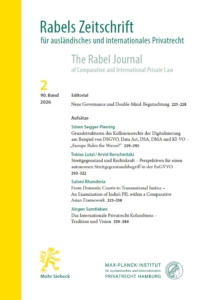 The latest issue of RabelsZ has just be released. It contains the following articles as well as an editorial with important information regarding the journal’s future governance structure and publication process. All content is Open Access: CC BY 4.0.