


Views
U.S. Court Issues Worldwide Anti-Enforcement Injunction
This post was written by Hannah Buxbaum, the John E. Schiller Chair in Legal Ethics and Professor of Law at the Indiana University Maurer School of Law in the United States.
Last month, Judge Edward Davila, a federal judge sitting in the Northern District of California in the United States, granted a motion by Google for a rare type of equitable relief: a worldwide anti-enforcement injunction. In Google v. Nao Tsargrad Media, a Russian media company obtained a judgment against Google in Russia and then began proceedings to enforce it in nine different countries. Arguing that the judgment was obtained in violation of an exclusive forum selection clause, Google petitioned the court in California for an order to block Tsargrad from enforcing it.
As Ralf Michaels and I found in a recent analysis, the anti-enforcement injunction is an unusual but important device in transnational litigation. There aren’t many U.S. cases involving these orders, and one of the leading decisions arose in the context of the wildly complicated and somewhat anomalous Chevron Ecuador litigation. As a result, there is little U.S. authority on a number of important questions, including the legal standard that applies to this form of relief and the mix of factors that courts should assess in considering its availability. Judge Davila’s decision in the Google case addresses some of these questions.
Read more
Tatlici v. Tatlici: Malta Rejects $740 Million U.S. Defamation Judgment as Turkish Case Looms
Written by Fikri Soral, Independant Lawyer, Turkey; and LL.M. student, Galatasaray University, Turkey
A Maltese court has refused to enforce a $740 million default judgment issued by the 15th Judicial Circuit Court of Florida (Palm Beach County) in a defamation suit brought by Applicant Mehmet Tatlici against his half-brother, Defendant Ugur Tatlici. [1] The Florida court’s award—issued on 8 January 2020 in a defamation suit filed by Mehmet Tatlici against his half-brother—was deemed procedurally deficient and substantively incompatible with Malta’s public policy, particularly due to its lack of reasoning and its chilling effect on free expression.[2] Read more
The Personal Status Regimes in the UAE — What’s New and What Are the Implications for Private International Law? A Brief Critical Appraisal
 Prologue
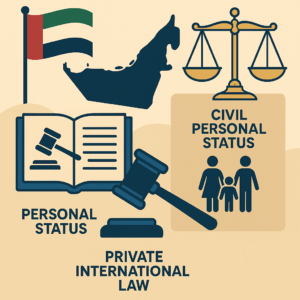
On 15 April 2025, the new federal UAE law on personal status (Federal Decree Law No 41 of 14 October 2024) officially entered into force ( “2024 PSL”). This law fully replaces the 2005 Federal Act on Personal Status (Federal Law No. 28 of 19 November 2005 as subsequently amended) (“2005 PSL”). The new law marks the latest step in the UAE remarkable wave of legal reforms, particularly regarding personal status matters. It follows a series of significant developments at both the federal and local levels. At the federal level, this includes the adoption of the law on Civil Personal Status (Federal Decree-Law No. 41 of 3 October 2022 on Civil Personal Status) (“2022 CPSL”) and its executive regulation. At the local level, specific legislations were adopted in the Emirate of Abu Dhabi, most notably the 2021 Law on Civil Marriages and its Effects (as subsequently amended) (“2021 ADCML”), and its Procedural Regulation. These legislative efforts collectively address what is commonly referred to as “civil family law” (for further details see previous posts on this blog here, here, here, and here). Together with the new 2024 PSL, these instruments will collectively be referred to as the “Family Law Regulations” (see Table below). Read more
News
Hybrid Lecture: Venezuela’s Oil, Between a Rock and a Hard (Arbitration) Place (UCL, 26 Feb 2026, 1pm)
EAPIL Conference in Geneva from 18-20 June 2026: Registration open!
 From 18 to 20 June 2026 the European Association of Private International Law (EAPIL) will host its third biannual conference. Following the Association’s conferences in Aarhus (Denmark) and Wroclaw (Poland) the conference promises to be a key event for scholars and practitioners interested in the present and future of European private international law.
Programme and Audience
Under the title “Shaping the Future of Private International Law in Europe – Putting Together the Pieces & Filling Gaps”, the conference will address structural developments, unresolved issues, and emerging challenges in European private international law. Special emphasis will be placed on 1) the consolidation of European private international law in a single instrument (EuPIL Act), 2) the unification of international property law (including the protection of cultural objects), and 3) the relationship of European Private International Law with third States.
All topics will be addressed from an analytical and a forward-looking perspective, combining doctrinal reflection with policy-oriented debate. Contributions will come from an internationally diverse group of speakers, reflecting EAPIL’s commitment to comparative and transnational perspectives.
The conference is open to academics, judges, practitioners, policymakers, and early-career researchers with an interest in (European) private international law.
Venue and Organisation
Hosted by the Faculty of Law of the University of Geneva, the conference will take place exclusively in person in Geneva. The choice of venue underscores the international outlook of the event and provides an ideal setting for scholarly exchange and networking.
Registration
Registration is available here. An early-bird rate applies until 15 March 2026, with standard registration available until 17 May 2026. Participation fees vary depending on registration date and include the option to attend the conference dinner. Further details on fees and registration can be found on the conference website.
Why Attend?
The EAPIL Conference 2026 offers a unique opportunity to:
- engage with cutting-edge research in private international law,
- discuss current reform projects and unresolved doctrinal questions,
- connect with leading scholars and practitioners from across jurisdictions, and
- contribute to shaping the future development of the field.
Further Information
More information on the programme, registration, and practical details is available on the conference website.
About EAPIL
The European Association of Private International Law was founded in 2019 to promote the study and development of Private International Law. It has today more than 600 members from more than 70 countries. For more information visit the EAPIL website and follow the EAPIL blog.
Crossroads in Private International Law Webinar with Tobias Lutzi on “Crossroads in Private International Law Seminar on the Reform of EU Private International Law” at the University of Aberdeen
The Centre for Private International Law & Transnational Governance of the University of Aberdeen is continuing its Crossroads in Private International Law webinar series with a talk by Tobias Lutzi (University of Augsburg) titled ‘Between Ambition and Realism – What to Expect from the Upcoming Reforms to the Rome II and Brussels Ia Regulation?’: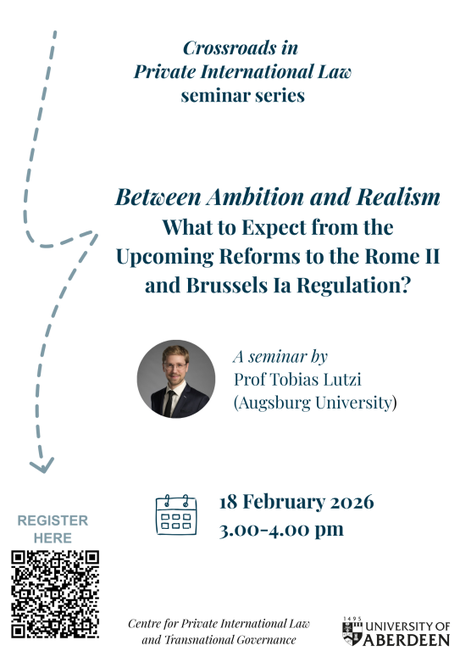
The Centre for Private International Law & Transnational Governance invites you to attend the next seminar in our Crossroads in Private International Law seminar series. You can find the link to register at the bottom of this page.
Prof Tobias Lutzi (Junior Professor for Private Law at Augsburg University) will give a seminar on the reforms to the Rome II and Brussels Ia Regulation. Prof Lutzi has kindly provided the following abstract:
Last year, the EU Commission formally kicked off the process of reforming two key instruments of EU Private International Law, identifying potential areas for reform and setting out some overarching policy goals. In 2026, the Commission will face the more difficult decision of which of those areas to actually focus on. This talk will discuss the respective merits of those areas of reform, highlighting the tension between ambition and realism that will shape the Commission’s work.
We are looking forward to welcoming you online or on campus!
Additional information and the link to register can be found here.