Views
South Africa Grapples with the Act of State Doctrine and Choice of Law in Delict
By Jason Mitchell, barrister at Maitland Chambers in London and at Group 621 in Johannesburg.
The Supreme Court of Appeal delivered judgment today in East Asian Consortium v MTN Group. The judgment is available here.
East Asian Consortium, a Dutch company, was part of the Turkcell consortium. The consortium bid on an Iranian telecommunications licence. The consortium won the bid. East Asian Consortium alleged that it was later ousted as a shareholder of the ultimate license holder, the Irancell Telecommunications Services Company. East Asian Consortium sued, amongst others, several subsidiaries of the MTN Group, a South African telecommunications company, in South Africa. East Asian Consortium alleged that the defendants unlawfully induced the Iranian government to replace East Asian Consortium with one of the MTN subsidiaries. Read more
U.S. Court Issues Worldwide Anti-Enforcement Injunction
This post was written by Hannah Buxbaum, the John E. Schiller Chair in Legal Ethics and Professor of Law at the Indiana University Maurer School of Law in the United States.
Last month, Judge Edward Davila, a federal judge sitting in the Northern District of California in the United States, granted a motion by Google for a rare type of equitable relief: a worldwide anti-enforcement injunction. In Google v. Nao Tsargrad Media, a Russian media company obtained a judgment against Google in Russia and then began proceedings to enforce it in nine different countries. Arguing that the judgment was obtained in violation of an exclusive forum selection clause, Google petitioned the court in California for an order to block Tsargrad from enforcing it.
As Ralf Michaels and I found in a recent analysis, the anti-enforcement injunction is an unusual but important device in transnational litigation. There aren’t many U.S. cases involving these orders, and one of the leading decisions arose in the context of the wildly complicated and somewhat anomalous Chevron Ecuador litigation. As a result, there is little U.S. authority on a number of important questions, including the legal standard that applies to this form of relief and the mix of factors that courts should assess in considering its availability. Judge Davila’s decision in the Google case addresses some of these questions.
Read more
Tatlici v. Tatlici: Malta Rejects $740 Million U.S. Defamation Judgment as Turkish Case Looms
Written by Fikri Soral, Independant Lawyer, Turkey; and LL.M. student, Galatasaray University, Turkey
A Maltese court has refused to enforce a $740 million default judgment issued by the 15th Judicial Circuit Court of Florida (Palm Beach County) in a defamation suit brought by Applicant Mehmet Tatlici against his half-brother, Defendant Ugur Tatlici. [1] The Florida court’s award—issued on 8 January 2020 in a defamation suit filed by Mehmet Tatlici against his half-brother—was deemed procedurally deficient and substantively incompatible with Malta’s public policy, particularly due to its lack of reasoning and its chilling effect on free expression.[2] Read more
News
New Book: La circolazione dello statuto personale / La circulation du statut personnel
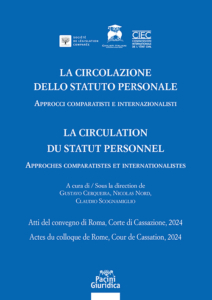 A new collective volume entitled “La circolazione dello statuto personale / La circulation du statut personnel” has recently been published by Pacini Giuridica. Edited by Gustavo Cerqueira (Nice), Nicolas Nord (Strasbourg) and Claudio Scognamiglio (Rome), the book brings together the proceedings of an international conference held on 19 January 2024 in Rome, in the prestigious Giallombardo Hall of the Italian Court of Cassation. Read more
Dutch Journal of PIL (NIPR) – issue 2025/3
The latest issue of the Dutch Journal on Private International Law (NIPR) has been published. It contains the following contributions.
NIPR 2025, Issue 3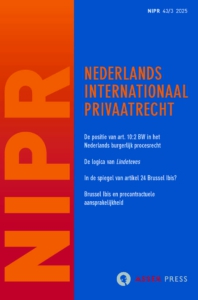
Editorial
Mathijs ten Wolde / p. 421
Articles
Steven Stuij, De positie van art. 10:2 BW in het Nederlands burgerlijk procesrecht / p. 423-444
Abstract
Article 10:2 of the Dutch Civil Code stipulates that the rules of private international law as well as the applicable law designated by those rules are to be applied ex officio. There has been a debate as to the positioning of this provision in relation to other rules of civil procedure on party autonomy as a result of two cases of the Dutch Supreme Court (‘Hoge Raad’). This contribution will address Read more
Public consultation on a possible new HCCH convention
Just 10 days left to participate in the public consultation on the Draft Text of a possible new HCCH convention on parallel proceedings and related actions!
The public consultation, launched on 18 November 2025, will close on 26 January 2026 at 9.00 a.m. CET. Experts, practitioners and judges from diverse legal traditions with experience in cross-border litigation and private international law more broadly are encouraged to participate in the consultation.
In 2021, the HCCH established a Working Group on matters related to jurisdiction in transnational civil or commercial litigation (WG), comprised of over 60 subject-matter experts from across the globe. The WG, after nine meetings, has developed a Draft Text containing provisions aimed at addressing parallel proceedings and related actions taking place in multiple States, acknowledging the primary roles of both jurisdictional rules and the doctrine of forum non conveniens. The objective of this future instrument would be to enhance legal certainty, predictability, and access to justice by reducing litigation costs and mitigating inconsistent judgments in transnational litigation in civil or commercial matters.
The public consultation seeks feedback on whether the Draft Text would, in practice, assist in addressing such matters and how the provisions in the Draft Text could be improved. The consultation is supported by a Consultation Paper comprising an Executive Summary, a detailed explanation of the key provisions and the operation of the Draft Text, and specific questions.
Responses received from this consultation will be submitted to all HCCH Members for consideration in advance of the next meeting of the Council on General Affairs and Policy (CGAP), the governing body of the HCCH, in March 2026, at which the Members of the HCCH will decide on the next steps for the project.
For more information on the public consultation, please visit: https://www.hcch.net/en/projects/legislative-projects/jurisdiction/public-consultation
This post is published by the Permanent Bureau of the Hague Conference of Private International Law (HCCH).