

Views
US Court Refused to Apply the Chosen Chinese Law due to Public Policy Concern
In Fu v. Fu, 2017 IL App (1st) 162958-U, a father brought a claim against his son to revoke an unconditional gift of $590,000 that he donated to his son for the later to pursue an EB-5 Visa to immigrate to the US. Both parties are Chinese citizens and the defendant is currently a resident of Massachusetts. The gift agreement was entered into in China, drafted in Chinese and contained a clause specifying PRC law should apply. The money was held by the International Bank of Chicago. The plaintiff brought the action in Illinois.
Under the US Law (Title 8 of the Code of Federal Regulations, § 204.6) a foreign national must invest at least $500,000 in the US to be considered for an EB-5 Visa, and must ‘show that he has invested his own capital obtained through lawful means.’ (Matter of Ho, 22 I&N Dec. 206, 210 (AAO 1998)) After a few denied EB-5 approval, the plaintiff sought to recover the money, by claiming that the defendant was estranged from his parents, including the donor and refused to support them, and the purpose of the gift contract was for the defendant to obtain an EB-5 Visa but the defendant failed to do so.
Under the Illinois law, a valid gift requires ‘delivery of the property by the donor to the donee, with the intent to pass the title to the donee absolutely and irrevocably, and the donor must relinquish all present and future dominion and power over the subject matter of the gift.” (Pocius v. Fleck, 13 Ill. 2d 420, 427 (1958)). Furthermore, the gift agreement between the parties also used the language that the gift was ‘unconditional’. However, the plaintiff argued that under the PRC law, gifts may be revocable after the transfer of ownership, if the donee ‘has the obligation to support the donor but does not fulfil it’, or a donnee ‘does not fulfill the obligations as stipulated in the gift agreement.’ (PRC Contract Law, Art 192)
The Appellate Court of Illinois First Judicial District affirmed the judgment of the circuit court of Cook County that the gift agreement was irrevocable. The plaintiff failed to successfully prove Chinese law. And even if the plaintiff properly pled PRC law, such interpretation was ‘oppressive, immoral, and impolitic’. Under the US law on EB-5 Visa application, the foreign citizen must prove ownership of those funds to be eligible for an EB-5 Visa. The signed agreement stating the gift ‘unconditional’ would help the defendant to prove he legally owned the funds to acquire an EB-5 visa. If the governing PRC law indeed allows a gift to be given unconditionally and revoked after delivery and acceptance, as argued by the plaintiff, it would facilitate a deception on the US Government and is against public policy.
The full judgment can be found here.
NIKI continued
Written by Lukas Schmidt, Research Fellow at the Center for Transnational Commercial Dispute Resolution (TCDR) of the EBS Law School, Wiesbaden, Germany
The Spanish airline Vueling Airlines S.A. is still intending to acquire large parts of the NIKI business. Vueling is part of the European aviation group IAG, which also includes British Airways, Iberia, Aer Lingus and LEVEL. The provisional insolvency administrator of NIKI Luftfahrt GmbH, therefore, will continue to drive forward the sales process. Vueling has provided interim financing of up to € 16.5 million to finance the NIKI business until the closing of the purchase agreement. This funding is only sufficient for a few weeks. Read more
NIKI, COMI, Air Berlin and Art. 5 EIR recast
Written by Lukas Schmidt, Research Fellow at the Center for Transnational Commercial Dispute Resolution (TCDR) of the EBS Law School, Wiesbaden, Germany.
The Regional Court of Berlin has, on the basis of the immediate appeal against the order of the provisional insolvency administration on the assets of NIKI Luftfahrt GmbH (under Austrian law), repealed the decision of the District Court of Charlottenburg (see here) as it finds that international jurisdiction lies with Austrian and not German courts. In its decision, the regional court has dealt with the definition of international jurisdiction, which is based on the debtor’s centre of main interests (‘COMI’). According to the provisions of the European Insolvency Regulation, that is the place where the debtor usually conducts the administration of its interests and that is ascertainable by third parties. Read more
News
Asian Private International Law Academy Conference 2023 on 9 and 10 December
The Asian Private International Law Academy (APILA) will be holding its second conference at Doshisha University, Kyoto, on 9 and 10 December 2023. The keynote addresses will be delivered by Professor Emerita Linda Silberman on 9 December and Professor Gerald Goldstein on 10 December. The first day of the conference will comprise presentation and discussion of works-in-progress. The conference will devote most of 10 December to discussion and finalisation of the Asian Principles on Private International Law (APPIL) on three topics: (1) recognition and enforcement of foreign judgments, (2) direct jurisdiction, and (3) general choice of law rules. Persons interested in attending or wishing further information should email reyes.anselmo@gmail.com to that effect. Please note that, while APILA can assist attendees by issuing letters of invitations in support of Japanese visa applications, APILA’s available funding is limited. In the normal course of events, APILA regrets that it will not be able to provide funding for travel and accommodation expenses.
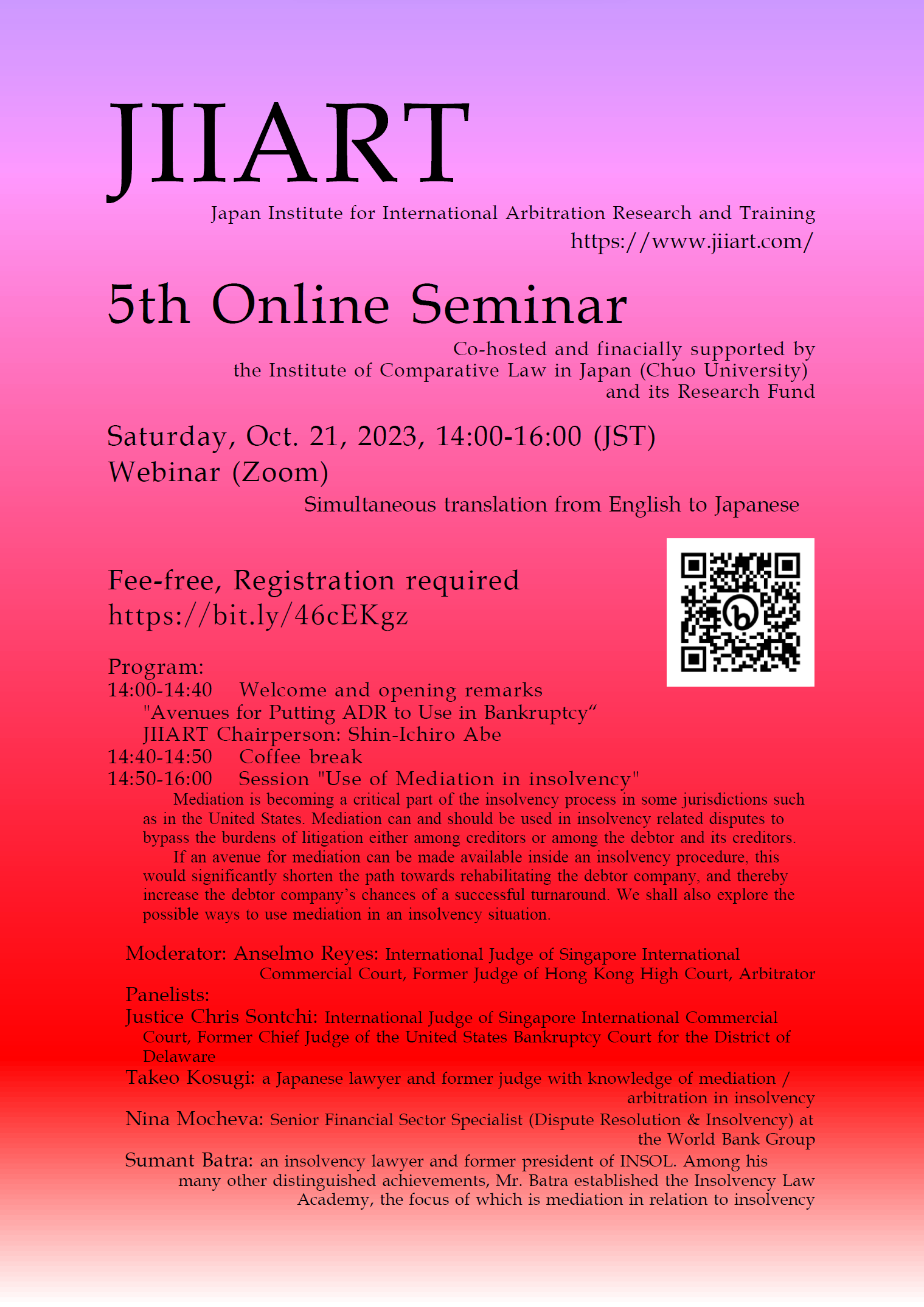
JIIART Online Seminar on Use of ADR in Insolvency: Saturday 21 October
The Japanese Institute for International Arbitration Research and Training (JIIART) will be holding an online seminar investigating use of alternative dispute resolution mechanisms in insolvency this Saturday 21 October 2023 at 14:00-16:00 Japan Standard Time. The event is free to attend but registration is required. You may register here. Details of the programme and speakers can be found in the event poster.