


Views
Child Abduction and Habitual Residence in the Supreme Court of Canada
The Supreme Court of Canada, in Office of the Children’s Lawyer v Balev (available here), has evolved the law in Canada on the meaning of a child’s habitual residence under Article 3 of the Hague Convention. The Convention deals with the return of children wrongfully removed from the jurisdiction of their habitual residence.
A majority of the court identifies [paras 4 and 39ff] three possible approaches to habitual residence: the parental intention approach, the child-centred approach, and the hybrid approach. The parental intention approach determines the habitual residence of a child by the intention of the parents with the right to determine where the child lives. This approach has been the dominant one in Canada. In contrast, the hybrid approach, instead of focusing primarily on either parental intention or the child’s acclimatization, looks to all relevant considerations arising from the facts of the case. A majority of the court, led by the (now retired) Chief Justice, holds that the law in Canada should be the hybrid approach [paras 5 and 48]. One of the main reasons for the change is that the hybrid approach is used in many other Hague Convention countries [paras 49-50].
The dissent (three of the nine judges) would maintain the parental intention approach [para 110]. One of its central concerns is the flexibility and ambiguity of the hybrid approach [para 111], which the judges worry will lead to less clarity and more litigation. Wrongful removal cases will become harder to resolve in a timely manner [paras 151-153].
The majority did not apply the law to the facts of the underlying case, it having become moot during the process of the litigation [para 6]. The court rendered its decision to provide guidance going forward. The dissent would have denied the appeal on the basis that the child’s habitual residence was in Germany (as the lower courts had held).
The court briefly addresses the exception to Article 3 in what is commonly known as “Article 13(2)” (since it is not numbered as such) – a child’s objection to return – setting out its understanding of how to apply it [paras 75-81 and 157-160].
The Supreme Court of Canada has recently adopted the practice of preparing summaries of its decisions (available here for this decision) to make them more accessible to the media and the public. These are called “Cases in Brief”.
The CJEU settles the issue of characterising the surviving spouse’s share of the estate in the context of the Succession Regulation
It has not been yet noted on this blog that the CJEU has recently settled a classic problem of characterisation that has plagued German courts and academics for decades (CJEU, 1 March 2018 – C-558/16, Mahnkopf, ECLI:EU:C:2018:138). The German statutory regime of matrimonial property is a community of accrued gains, i.e. that each spouse keeps its own property, but gains that have been made during the marriage are equalised when the marriage ends, i.e. by a divorce or by the death of one spouse. According to § 1371(1) of the German Civil Code (Bürgerliches Gesetzbuch – BGB), the equalisation of the accrued gains shall be effected by increasing the surviving spouse’s share of the estate on intestacy by one quarter of the estate if the property regime is ended by the death of a spouse; it is irrelevant in this regard whether the spouses have made accrued gains in the individual case. How is this claim to be characterized? Read more
Torture, Universal Civil Jurisdiction and Forum Necessitatis: Naït-Litman v. Switzerland before the ECtHR
On March 15 the ECtHR, sitting as the Grand Chamber,decided on the Naït-Litman v. Switzerland case (application no. 51357/07), against the applicant and his claim of violation of Article 6 ECHR. Independently on whether one agrees or not with the final outcome, for PIL lawyers and amateurs the judgment (for very busy people at least the press release) is certainly worth reading. Read more
News
Conference on Digital Justice for Cross-border Cases: University of Alicante, 23 November 2023 (in Spanish)
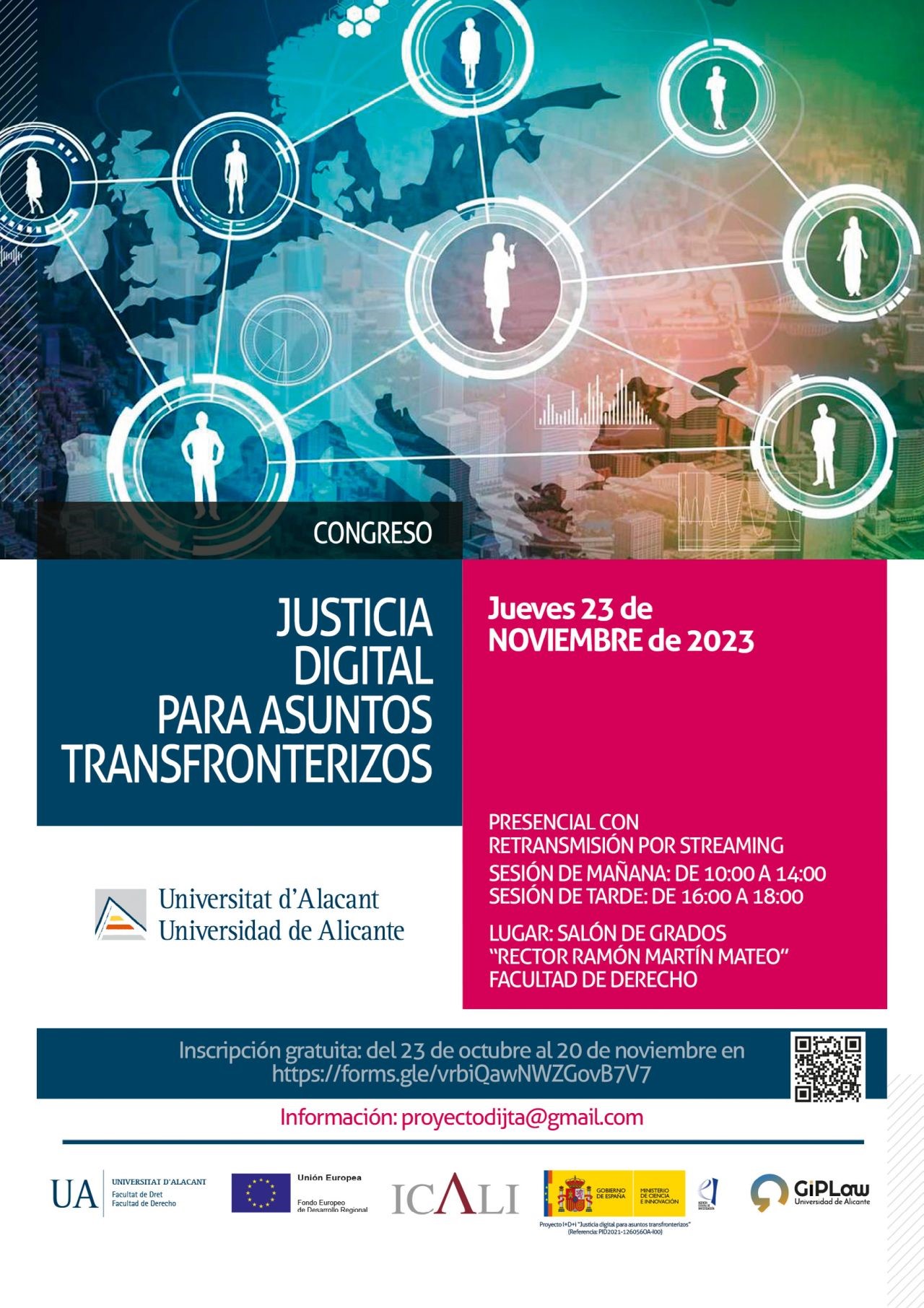
The Private International Law Department of the University of Alicante is organizing a conference entitled “Digital Justice for Cross-border Cases” (both onsite and online – in Spanish). The event will take place on 23 November 2023 at the Salón de Grados “Rector Ramón Martín Mateo” of the Faculty of Law at the University of Alicante.
Chinese Journal of Transnational Law Special Issue: Call for Papers
CHINESE JOURNAL OF TRANSNATIONAL LAW
Call for Papers
Special Issue: Private International Law and Sustainable Development in Asia
The United Nations Agenda 2030 with its 17 Sustainable Development Goals (SDGs) seems to have a blind spot for the role of private and private international law. That blind spot is beginning to be closed. A collective volume with global outlook published in 2021 addressed “the private side of transforming our world”: each of the 17 SDGs was discussed in one chapter of the book devoted to the specific relevance of private law and private international law. In 2022, the IACL-ASADIP conference in Asunción, Paraguay discussed sustainable private international law with regard to Latin America; the contributions published in 2023 in a special issue of the University of Brasilia Law Journal – Direito.UnB., V.7., N.3 (2023).
In this occasion the focus is on Asia. The Chinese Journal of Transnational Law invites submissions for its Vol. 2 Issue 2, to be published in 2025, engaging critically with the functions, methodologies and techniques of private international law in relation to sustainability from an Asian perspective, as well as in relation to the actual and potential contributions of private international law to the SDGs in Asia. Read more
Cycle de conférences: La refonte du règlement Bruxelles I Bis
Starting 30 November 2023, the French Cour de cassation is going to host a lecture series on the ongoing discussion of Brussels Ia reform under the direction of Marie-Elodie Ancel (Université Paris-Panthéon Assas) and Pascal de Vareilles-Sommières (Université Paris 1 Panthéon-Sorbonne).
The programme of the first session – and the video stream! – can be found here.