


Views
Doors open for First Hearing of International Chamber at Paris Court of Appeal
Written by Duncan Fairgrieve (BIICL;Université de Paris Dauphine) and Solenn Le Tutour (avocat, Barreau de Paris)
When the French Government announced in February this year plans to launch an “English” Commercial court in Paris, eyebrows were raised and, it is fair to say, an element of skepticism expressed in the common law world as to whether such a development would really prove to be a serious competitor to the Commercial Courts on Fetter Lane in London. Read more
The Belgian Government unveils its plan for the Brussels International Business Court (BIBC)
Written by Guillaume Croisant, Université Libre de Bruxelles
In October 2017, as already reported in a previous post, the Belgian Government announced its intention to set up a specialised English-speaking court with jurisdiction over international commercial disputes, the Brussels International Business Court (“BIBC”). An update version of the text has finally been submitted to Parliament on 15 May 2018, after the Government’s initial draft faced criticisms from the High Council of Justice (relating to the BIBC’s independence and impartiality, its source of funding and its impact on the ordinary courts) and was subject to the review of the Conseil d’Etat. Read more
Proving Chinese Law: Deference to the Submissions from Chinese Government?
Written by Dr. Jie (Jeanne) Huang, Senior Lecturer, University of New South Wales Faculty of Law
The recent U.S. Supreme Court case, Animal Science Products, Inc. v. Hebei Welcome Pharmaceutical Co. Ltd, concerns what weight should be given to the Chinese government’s submission of Chinese law. On Page 58 of the trial transcript, Justices Kagan and Ginsburg asked how about other countries dealing with formal submissions from the Chinese government. There are two examples.
One is Hong Kong. In TNB Fuel Services SDN BHD v China National Coal Group Corporation ([2017] HKCFI 1016), the issue is whether the defendant, a state-owned enterprise, is protected by Chinese absolute sovereignty immunity under Chinese law. The court deferred to an official letter provided by the Hong Kong and Macao Affairs Office of the State Department in Mainland China. The Office answers no absolute sovereignty immunity to Chinese state-owned enterprises carrying out commercial activities. The Court adopted this opinion without second inquiry (para 14 of the judgment). After considering a bunch of other factors, the court ruled against the defendant.
The other is Singapore. In Sanum v. Laos ([2016] SGCA 57), the issue is whether the China-Laos Bilateral Investment Treaty (BIT) shall be applied to Macao Special Administrative Region. Chinese embassy in Laos and China Ministry of Foreign Affairs provided diplomatic announcements indicating that the BIT shall not be applied to Macao. However, the Court of Appeal of Singapore held that China’s announcements were inadmissible and, even if admitted, they did not change the applicability of the BIT to Macau. This is partly because, before the dispute with Sanum crystalized, no evidence showed that China and Laos had agreed that the BIT should not be applied to Macau. Therefore, the China’s diplomatic announcements should not be retroactively applied to a previous dispute. For a more detailed discussion, please see pages 16-20 of my article.
TNB Fuel Services and Sanum share important similarities with Animal Science Products, because the key issues are all about the proving of Chinese law. In the three cases, Chinese government all provided formal submissions to explain the meaning and the applicability of Chinese law. However, TNB Fuel Services and Sanum can also be distinguished from Animal Science Products, because comity plays no role in the former two cases. TNB Fuel Services concerns sovereign immunity, which is an issue that Hong Kong courts must follow China’s practices. This is established by Democratic Republic of the Congo v. FG Hemisphere Associates (FACV Nos. 5, 6 & 7 of 2010). Sanum is a case to set aside an investment arbitration award, so the Court of Appeal of Singapore need not consider comity between Singapore and China. In contrast, in Animal Science Products, the U.S. Court of Appeals for the Second Circuit elaborated the importance of comity between the U.S. and China. Therefore, Animal Science Products should not be considered as a technical case of proving foreign laws. The U.S. Supreme Court may consider deferring to the submissions of Chinese government to a certain extent but allows judges to decide whether the Chinese government’s submission is temporally consistent with its position on the relevant issue of Chinese law.
News
Book on the African Principles on the Law Applicable to International Commercial Contracts now available
Posted by Marlene Wethmar-Lemmer
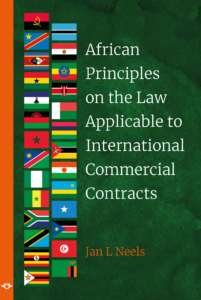
This booklet contains the first draft of the envisaged African Principles on the Law Applicable to International Commercial Contracts. The proposal could be used by national legislators on the continent and African economic integration organisations, particularly the African Union, in, respectively, domestic legislation and regional or supranational laws of a soft or binding nature. The existence of a reliable transnational legal infrastructure in respect of international commercial law, including commercial private international law, is a prerequisite for investor confidence, inclusive economic growth, sustainable development, and the ultimate alleviation of poverty on the African continent. The instrument may contribute to sustainable growth on a long-term basis. The regulation of private international law of contract is essential to the further development of the African Continental Free Trade Area.
Jan L Neels is professor of private international law and director of the Research Centre for Private International Law in Emerging Countries at the University of Johannesburg.
ISBNs
978-1-7764474-0-4 (Paperback)
978-1-7764474-1-1 (PDF)
978-1-7764474-2-8 (EPUB)
978-1-7764474-3-5 (XML)
DOI: https://doi.org/10.36615/9781776447411
PRICE: R125 (print), OA (ebook)
Elgar Companion to UNCITRAL: Virtual Book launch
Co-edited by Rishi Gulati, Thomas John and Ben Koehler, the Elgar Companion to UNCITRAL is now out. This is the second in the trilogy of books on the three key international institutions mandated to work on private international and international private law. The Elgar Companion to the HCCH has already been published in 2020, with the Elgar Companion to UNIDROIT out in 2024.
The Elgar Companion to UNCITRAL brings together a diverse selection of contributors from a variety of legal backgrounds to present the past, present and future prospects of UNCITRAL instruments. Split into four key thematic sections, this book starts by providing an institutional background to UNCITRAL, before moving on to discuss the topic of dispute resolution, including contributions on international arbitration, mediation, and online dispute resolution. Further chapters then explore key topics in international contract law, especially relating to the United Nations Convention on Contracts for the International Sale of Goods. The final section of the Companion consists of chapters on a variety of matters considered at UNCITRAL, namely, micro, small and medium-sized businesses; insolvency; secured transactions; negotiable instruments; public procurement; electronic commerce and transport law.
The book will be virtually launched by the Secretary of UNCITRAL, Ms Anna Joubin-Bret, on 14 December 2024 at 13:00 CET. The launch event will also include a highly informative panel discussion. To register, please click at the link below:
https://events.mpipriv.de/book_launch_elgar_companion_to_uncitral
Fundamental Rights and PIL after the German Federal Constitutional Court Decision on the Act to Combat Child Marriages

 In May, the Hamburg Max Planck Institute organized an online panel to discuss implications from the German Federal Constitutional Court Decision on the Act to Combat Child Marriages rendered just prior. The panelist were Henning Radtke (Judge at the Constitutional Court), Dagmar Coester-Waltjen (Professor emeritus for PIL at University of Göttingen), Susanne Gössl (Professor for PIL at University of Bonn) and Lars Viellechner (Professor for Constitutional Law at University of Bremen). Their contributions are now available, together with a short introduction, in open access via the “online first” section of Rabels Zeitschrift.
Ralf Michaels, Einleitung zum Symposium
Henning Radtke, Zu den Maßstäben der verfassungsrechtlichen Beurteilung von Regelungen des deutschen Internationalen Privatrechts
Susanne Lilian Gössl, Grundrechte und IPR: Vom beidseitigem Desinteresse zu höflicher Aufmerksamkeit – und zu angeregtem Austausch?
Lars Viellechner, Die Anwendbarkeit der Grundrechte im Internationalen Privatrecht: Zur Methodik der Entscheidung des Bundesverfassungsgerichts über die Kinderehe
Dagmar Coester-Waltjen, Die “Kinderehen”-Entscheidung des Bundesverfassungsgerichts: Welche Schlussfolgerungen ergeben sich für das internationale Eheschließungsrecht?