


Views
Mutual trust and judicial cooperation in the EU’s external relations – the blind spot in the EU’s Foreign Trade and Private International Law policy?
Further to the splendid conference How European is European Private International Law? at Berlin on 2 and 3 March 2018, I would like to add some thoughts on an issue that was briefly raised by our fellow editor Pietro Franzina in his truly excellent conference presentation on “The relationship between EU and international Private International Law instruments”. Pietro rightly observed an “increased activity on the external side”, meaning primarily the EU’s PIL activities on the level of the Hague Conference.
At the same time, there seems to be still a blind spot for the EU’s Private International Law policy when it comes to the design of the EU’s Free Trade Agreements (FTAs). Although there is an increasingly large number of such agreements and although “trade is no longer just about trade” (DG Trade) but additionally about exchange or even export of values such as “sustainability”, human rights, labour and environmental standards and the rule of law, there seems to be no policy by DG Trade to include in its many FTAs a Chapter on judicial cooperation with the EU’s respective external trade partners.
To my knowledge there are only the following recent exceptions: The Association Agreements with Georgia and Moldova. Both Agreements entered into force on 1 July 2016.
Article 21 (Georgia) and Article 20 (Moldova) provide:
“Legal cooperation: 1. The Parties agree to develop judicial cooperation in civil and commercial matters as regards the negotiation, ratification and implementation of multilateral conventions on civil judicial cooperation and, in particular, the conventions of the Hague Conference on Private International Law in the field of international legal cooperation and litigation as well as the protection of children.”
Article 24 of the Association Agreement of 29 May 2014 with the Ukraine reads slightly differently:
“Legal cooperation: 1. The Parties agree to further develop judicial cooperation in civil and criminal matters, making full use of the relevant international and bilateral instruments and based on the principles of legal certainty and the right to a fair trial.2. The Parties agree to facilitate further EU-Ukraine judicial cooperation in civil matters on the basis of the applicable multilateral legal instruments, especially the Conventions of the Hague Conference on Private International Law in the field of international Legal Cooperation and Litigation as well as the Protection of Children.”
All other FTAs, even those currently under (re-) negotiation, do not take into account the need for the management of trust in the judicial cooperation of the trade partners in their deepened and integrated trade relations. Rather, foreign trade law and PIL seem to have remained separate worlds, although the business transactions that are to take place and increase within these trade relations obviously rely heavily on both areas of the law.
Some thoughts on why there is no integrated approach to foreign trade and PIL in the EU, why this is a deficiency that should be taken care of and how this could possibly be done are offered here.
How European is European Private International Law? – Impressions from Berlin
Written by Tobias Lutzi, DPhil Candidate and Stipendiary Lecturer at the University of Oxford
 Last weekend, more than a hundred scholars of private international law followed the invitation of Jürgen Basedow, Jan von Hein, Eva-Maria Kieninger, and Giesela Rühl to discuss the ‘Europeanness’ of European private international law. Despite the adverse weather conditions, only a small number of participants from the UK – whose presence was missed all the more dearly – were unable to make it to Berlin. Thus, the Goethe-Saal of the Max Planck Society’s Harnack House was packed, and so was the conference programme, which spanned over two full days. Read more
This one is next: the Netherlands Commercial Court!
By Georgia Antonopoulou, Erlis Themeli, and Xandra Kramer, Erasmus University Rotterdam (PhD candidate, postdoc researcher and PI ERC project Building EU Civil Justice)
Following up on our previous post, asking which international commercial court would be established next, the adoption of the proposal for the Netherlands Commercial Court by the House of Representatives (Tweede Kamer) today answers the question. It will still have to pass the Senate (Eerste Kamer), but this should only be a matter of time. The Netherlands Commercial Court (NCC) is expected to open its doors on 1 July 2018 or shortly after. Read more
News
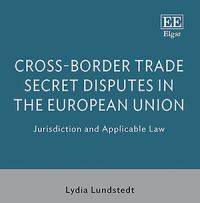
Book by Lydia Lundstedt on trade secrets in PIL
Fresh from the print comes the book titled Cross-Border Trade Secret Disputes in the European Union: Jurisdiction and Applicable Law authored by Lydia Lundstedt, Senior Lecturer in Private International Law at the Stockholm University and Senior Lecturer in Intellectual Property Law at the Linköping University.
The book is offering an EU perspective on one of the important ways the companies are protecting their intellectual property and information in general. This book examines different approaches to trade secret protection in the EU Member States, and focuses on the jurisdiction and applicable law under Brussels I bis, Rome I and Rome II.
The book is available here, and code LUND35 will secure a 35% discount on the book price.
Revue Critique de droit international privé – issue 2023/2
The second issue of the Revue critique de droit International privé of 2023 was released in August. It contains four articles and several case notes.
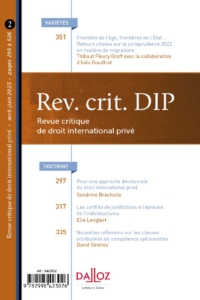 The first part of the issue features the doctrinal work of two young authors, who confront PIL techniques with contemporary developments in social sciences.
The first article Pour une approche décoloniale du droit international privé (A Decolonial Approach to Private International Law) is authored by Dr Sandrine Brachotte (Université Saint-Louis & Université de Lille). Following her doctoral work on The Conflict of Laws and Non-secular Worldviews: A Proposal for Inclusion (see presentation over at EAPIL), Dr Brachotte discusses colonial studies’ implications for PIL scholarship. She examines how plural normativities challenge the traditional conception of conflict of laws and then outlines the potential form of a decolonial PIL. An English translation of the article is available on the website of the editor. Its abstract reads as follows:
Call for Paper: Private International Law and Business Compliance in Asia Pacific
This national conference will be held on 21 February 2024 at The University of Sydney Law School in Australia.
Business compliance in international transactions across the Asia-Pacific region holds immense importance for organizations seeking to expand their activities within this dynamic and evolving landscape. Multinational corporations operating in Asia Pacific often confront unique compliance challenges due to the swiftly changing regulatory and geopolitical environment in the region.