


Views
Grounds for Refusal of Recognition of (Quasi-) Annex Judgements in the Recast European Insolvency Regulation
Written by Zoltán Fabók, Fellow of INSOL International, Counsel at DLA Piper (Hungary) and PhD Candidate at Nottingham Trent University
Insolvency-related (annex) actions and judgements fall within the scope of the Recast European Insolvency Regulation (‘Recast EIR’). That instrument both determines international jurisdiction regarding annex actions and sets up a simplified recognition system for annex judgements. However, tension between the Recast EIR’s provisions on jurisdiction and recognition arises when a court of a state different from the state of insolvency erroneously assumes jurisdiction for annex actions. Such ‘quasi-annex’ judgements rendered by foreign courts erroneously assuming jurisdiction threaten the integrity of the insolvency proceedings. Besides, the quasi-annex judgements may violate the effectiveness and efficiency of the insolvency proceedings as well as the principle of legal certainty.
In my paper, it is argued that even the current legal framework may offer some ways to avoid the recognition of such quasi-annex judgements. First, the scope of the public policy exception may be extended in order to protect the integrity of the insolvency proceedings from the quasi-annex judgements rendered by foreign courts erroneously assuming jurisdiction. Second, it may be argued that quasi-annex judgements do not equal real annex judgements and therefore do not enjoy the automatic recognition system provided by the Recast EIR. At the same time, their close connection to the insolvency proceedings – disregarded by the forum erroneously assuming jurisdiction – may exclude quasi-annex judgements from the scope of the Brussels Ibis Regulation, as well. As a consequence, those quasi-annex judgements may fall within the gap between the two regulations, meaning that no European instrument instructs the courts of the member state addressed to recognise quasi-annex judgements.
My research article has been accepted for publication by International Insolvency Review. The paper can be accessed in the Early View section at http://onlinelibrary.wiley.com/doi/10.1002/iir.1284/full.
Egyptian Court of Cassation on the application of the Hague Service Convention
[The author wishes to thank Justice Hossam Hesham Sadek, Vice President of the Civil and Commercial Chamber of the Court of Cassation, and reporting judge in the case at hand, for granting access to the Supreme Court’s ruling].
1. Introduction
In a recent ruling (22/05/2017), the Egyptian Court of Cassation tackled with the issue of service of process abroad. The facts of the case were the following: The claimant (and appellant) was an Egyptian Medical Equipment company, situated in Cairo. The respondents and appellees were a Chinese company, with its seat in Nanshan district, Shenzen, the Egyptian General Organization for Import and Export Control, and an Egyptian company, with its seat in Heliopolis, Cairo.
2. Facts and instance ruling
The Appellant filed a lawsuit against the Chinese Company and the Second Appellee at Cairo Court of Appeal, requesting a judgment obliging the First Appellee to pay the amount of ten million Egyptian pounds as monetary and moral compensation resulting from the contract’s termination. The Appellant asserted that it had been assigned as the sole agent of the First Appellee in Egypt, for selling ultrasonic wave devices, and that it was unexpectedly notified by the First Appellee that the contract was terminated.
The first instance court ordered that the lawsuit be dismissed for lack of proper service to the Chinese company. The Appellant claimed that service had been effected through the Public Prosecution Office, following all necessary procedures through diplomatic channels in China, pursuant to article 13 (9) of the Egyptian Civil and Commercial Code of Procedure (CCCP), and by notification of the claim to the first Appellee’s legal representative (Commercial Agent) pursuant to article 13 (5) CCCP.
Article 13 (9) CCCP states that, if no international treaty or a specific provision of law is applicable, service shall be made by delivering the documents to the public prosecutor, who then forwards them to the Minister of Foreign Affairs, to be delivered through diplomatic channels to the country of destination. Art. 13 (5) CCCP stipulates that, if service is addressed to a foreign company that has a branch or agent in Egypt, domestic service shall be effected (i.e. to the branch or agent located in Egypt).
3. The Supreme Court ruling
The Court of Cassation referred initially to Art. 13 (5) & (9) CCCP. It then mentioned Articles 3 & 14 of the Judicial Cooperation Treaty on Civil, Commercial and Criminal Matters between the Arab Republic of Egypt and The People’s Republic of China, signed on 21/4/1994, which stipulates that: “For the purposes of requesting and providing judicial assistance, parties shall communicate through their central authorities unless otherwise provided for in this Treaty. Central authorities of both parties are represented by the Ministries of Justice. Both parties shall serve judicial documents in civil and commercial matters pursuant to Hague Convention on the service Abroad of Judicial and Extrajudicial Documents in civil or Commercial Matters concluded on 15/11/1965’’.
Based on the above, the Court of Cassation decided as follows: The Hague Convention exclusively stipulates methods, means and conditions for serving judicial documents unless agreed between the Parties on other methods pursuant to Article 11 of the same Convention, and obliges the judge to stay proceedings, save when a document was served by a method prescribed by the internal law of the State addressed, or when the document was actually served to the defendant in its residence under one of the methods prescribed in the Convention in sufficient time to enable him to arrange for his defence.
Since the legislator has permitted in Article 13(5) CCCP that foreign companies may be served by delivering a copy to its branch or agent in Egypt, their existence is considered a question of fact under the exclusive competence of the court. Accordingly, the Court of Cassation confirmed the instance decision, which ruled that service made to the first Appellee through the third appellee (Trade And Importing Company in Heliopolis), ostensibly being its commercial agent and representative, was improper, since the representative of the latter denied its relation with the first Appellee.
Finally, delivering the document to the Public Prosecution in order to take necessary actions towards service by diplomatic channels is not sufficient, because notice was not delivered / served to the first Appellee.
4. Conclusion
The judgment offers a valuable insight into the practice of Egyptian courts in regards to notification of documents abroad. It is noteworthy that the Court of Cassation examined carefully all legal regimes related to the subject matter: It referred to domestic law (CCCP), the Egyptian – Chinese bilateral treaty, and the multilateral convention, to which the bilateral convention refers. The question whether service of process abroad was necessary or not was decided on a substantive level: Given that the appellant failed to demonstrate that the third appellee was the representative of the Chinese company, the court rightfully considered that service solely to the local Transmission Authority through the Prosecutor’s Office does not suffice. Hence, whenever the Hague Service Convention applies, the Court of Cassation dismisses fictitious service (remise au parquet).
The Justice Initiative Frankfurt am Main 2017
Written by Prof. Dr. Dres. h.c. Burkhard Hess, Executive Director Max Planck Institute Luxembourg for Procedural Law
Against the backdrop of Brexit, an initiative has been launched to strengthen Frankfurt as a hot spot for commercial litigation in the European Judicial Area. On March 30, 2017, the Minister of Justice of the Federal State Hessen, Ms Kühne-Hörmann, organized a conference at which the Justice Initiative was presented. More than 120 stakeholders (lawyers, judges, businesses) attended the conference. The original paper was elaborated by Professors Burkhard Hess (Luxembourg), Thomas Pfeiffer (Heidelberg), Christian Duve (Heidelberg) and Roman Poseck (President of the Frankfurt Court of Appeal). Here, we are pleased to provide an English translation of the position paper with some additional information on German procedural law for an international audience. The proposal has, as a matter of principle, been endorsed by the Minister of Justice. Its proposals are now being discussed and shall be implemented in the next months to come. The paper reads as follows: Read more
News
Book launch: Brooke Marshall, ‘Asymmetric Jurisdiction Clauses’
On behalf of our former editor Brooke Marshall, we are happy to share the invitation to the UNSW Law & Justice Book Forum, which will host the launch of her book on Asymmetric Jurisdiction Clauses.
The event will feature the following speakers:
- Professor Mary Keyes, Director of the Law Futures Centre; Professor, Griffith Law School, Griffith University
- Professor Caroline Kleiner, Professor, Centre for Business Law and Management (CEDAG), Faculty of Law, Université Paris Cité, Paris, France
- Chaired by Professor Justine Nolan, Director, Australian Human Rights Institute; Professor, UNSW Faculty of Law & Justice
It will take place in a hybrid setting on Wednesday, 5 July, at 4:30pm AEST = 8:30am CEST = 7:30am BST. You may register using this link.
Praxis des Internationalen Privat- und Verfahrensrechts (IPRax) 4/2023: Abstracts
The latest issue of the „Praxis des Internationalen Privat- und Verfahrensrechts (IPRax)“ features the following articles:
(These abstracts can also be found at the IPRax-website under the following link: https://www.iprax.de/en/contents/)
Rivista di diritto internazionale privato e processuale (RDIPP) No 1/2023: Abstracts
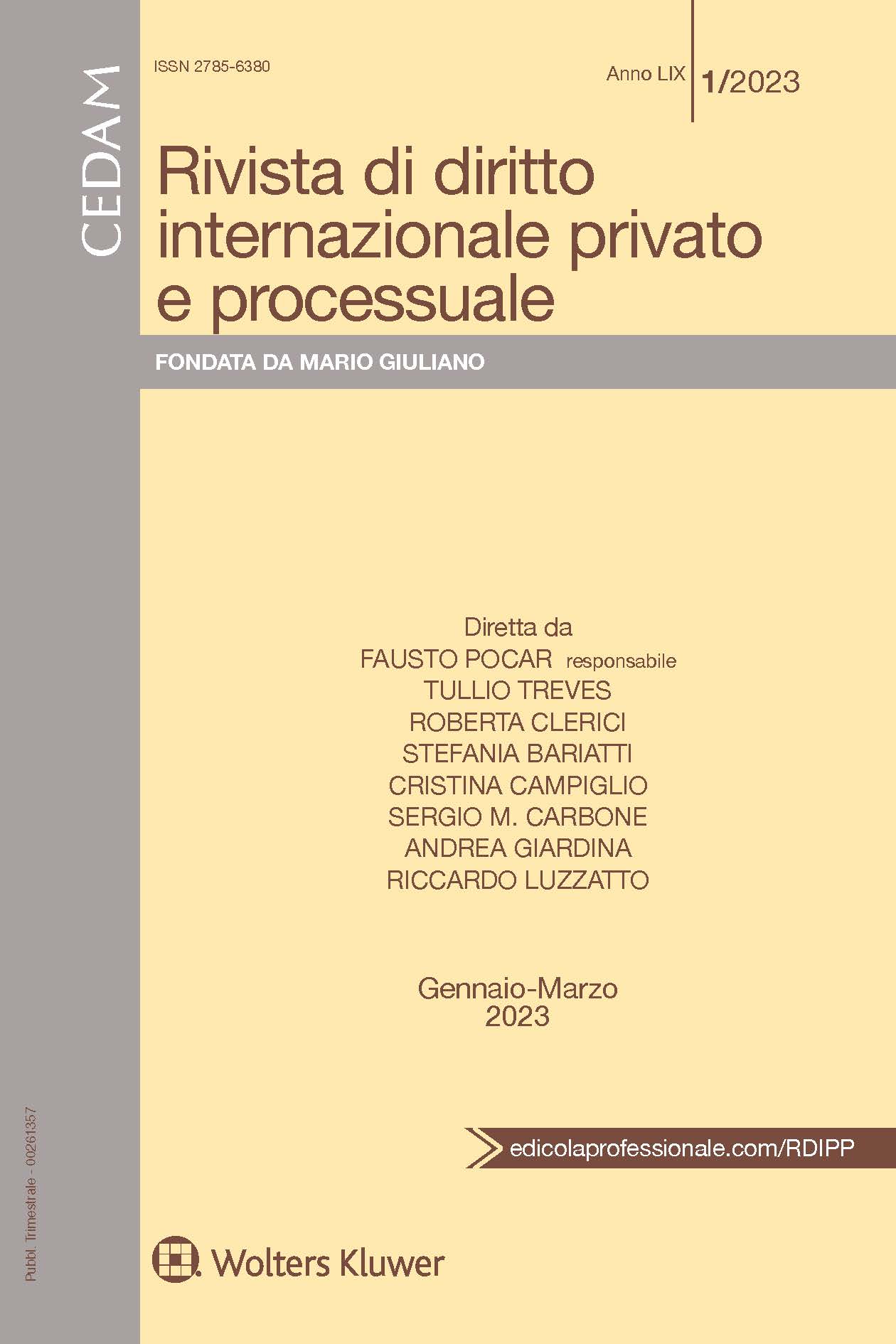 The first issue of 2023 of the Rivista di diritto internazionale privato e processuale (RDIPP, published by CEDAM) was just released. It features:
Francesco Salerno, (formerly) Professor at the University of Ferrara, L’impatto della procedura di interpretazione pregiudiziale sul diritto internazionale privato nazionale (The Impact of the Preliminary Rulings of the Court of Justice on National Private International Law; in Italian)
The European Court of Justice’s uniform interpretation of private international law concerns mainly – albeit not only – the EU Regulations adopted pursuant to Article 81 TFEU: in the context of this activity, the Court also takes into account the distinctive features of EU Member States. The increasing number of autonomous notions developed by the Court greatly enhanced the consistency and the effectiveness of the European rules. Against this background, the Italian judicial authorities implemented such a case-law even when it ran counter well-established domestic legal principles. Moreover, the European institutions rarely questioned the case-law of the Court of Justice, but when they did so, they adopted new rules of private international law in order to “correct” a well-settled jurisprudential trend of the Court.