


Views
‘Salami-slicing’ and Issue Estoppel: Foreign Decisions on the Governing Law
One of the requirements for issue estoppel is identity of issue. However, the process of ‘refining down’ or ‘salami-slicing’[1] is not always clear. The argument that the issue is different because the two courts would arrive at different conclusions on the governing law is increasingly being utilised as a litigation strategy. If the first court applied its choice of law rules to determine that the governing law of the claim is Utopian law, would an issue estoppel arise over this decision in the second court if under the second court’s choice of law rules, Ruritanian law is the governing law? The answer depends on whether the ‘slice’ is thick or thin. Is the relevant issue ‘What law governs the dispute or issue?’ or ‘What law is identified by our (forum) choice of law rules to govern the dispute or issue?’ Read more
The Conflict-of-Law Rules in the UAE’s New Civil Transactions Act: Yet Another Missed Opportunity!

I. Introduction
On 1 January 2026, the Legislative Decree No. 25/2025 promulgating a new Civil Transactions Act (hereafter ‘NCTA’) entered into force. The NCTA repeals and replaces the former Federal Civil Transactions Act of 1985 (hereafter ‘the 1985 Act’). The adoption of the NCTA forms part of the State’s broader and ongoing effort to comprehensively update and modernize its legal system, an effort that has already touched major legislative instruments, including, among many others, the 2022 Civil Procedure Act, the 2024 Personal Status Act, the 2023 Competition Act, and the 2022 Commercial Transactions Act.
Since the 1985 Act contained a codified set of conflict-of-laws rules, its replacement necessarily entails a re-examination of the UAE’s private international law framework and, at least in principle, the introduction of new or revised choice-of-law provisions. Against this background, this note offers a preliminary and necessarily tentative assessment of the modifications introduced by the NCTA. It focuses on the main features of the new law in relation to choice-of-law regulation, highlighting both the changes introduced and the limits of the reform. Read more
Enforceability of foreign judgments for punitive damages under English law and South African law
This post is posted on behalf of Jason Mitchell, barrister at Maitland Chambers in London and Group 621 in Johannesburg.
In Motorola Solutions v Hytera Communications Corporation, the Court of Appeal held that a judgment that includes a punitive damages component is unenforceable in its entirety (the judgment is available here). The punitive component cannot be severed so that the judgment creditor can enforce non-punitive components.
Motorola sued Hytera in the U.S. One of its causes of action was under the Defend Trade Secrets Act, a federal statute that allows for punitive damages of up to double any compensatory damages. On that cause of action, the U.S. court awarded Motorola compensatory damages of $135 million and punitive damages of $270 million. Motorola tried to enforce the U.S. judgment in England. Read more
News
Perspectives contentieuses internationales (PCI), Volume 5
The following announcement was kindly shared with us by Fabienne Jault-Seseke

It is a special issue devoted to a dossier entitled “The Exploitation of Natural Resources in the Face of the Energy Transition,” prepared under the direction of RebeccaLegendre and Denys-Sacha Robin. It provides an opportunity to reflect on the transformations that the extractive sector as a whole is facing as a result of sustainable development policies, as well as on the multiple disputes likely to arise from the difficult reconciliation of competing considerations. Read more
Revue critique de droit international privé – Issue 2026/1
Written by Hadrien Pauchard (assistant researcher and doctoral student at Sciences Po Law School)
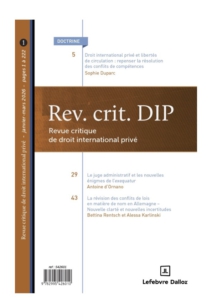 The first issue of the Revue Critique de droit international privé of 2026 has just come off the press and is available online. It contains three articles, nine case notes, and eight book reviews. In line with the Revue Critique’s recent policy, the doctrinal part will soon be made available in English on the editor’s website (for registered users and institutions).
Read more