


Views
Policy discussions on ADR/ODR in France: towards greater regulation for the Legaltech?
Current policy discussions on ADR/ODR in France: towards greater regulation for the Legaltech?
By Alexandre Biard, Erasmus University Rotterdam (postdoc researcher ERC project Building EU Civil Justice)
In April 2018, the French government published a new draft legislation aimed at reforming and modernizing the French Justice system (Projet de loi de programmation 2018-2022 et de réforme pour la Justice). Among other things, the proposal is likely to trigger some significant changes in the French ADR/ODR landscape, and may have important consequences for the future development of the legaltech. The proposal is currently discussed before the French Parliament and Senate. The following elements should be noted: Read more
Netherlands Commercial Court: English proceedings in The Netherlands
By Friederike Henke, Advocaat & Rechtsanwältin at Buren in Amsterdam
The international demand for English language dispute resolution is increasing as the English language is commonly used in international trade and contracts as well as correspondence, not only between the trading partners themselves, but also by international parties, their legal departments and their advisors. Use of the English language in legal proceedings is expected to save time and money for translations and language barriers in general. Read more
Alexander Vik v Deutsche Bank AG: the powers of the English court outside of the jurisdiction in contempt of court proceedings
By Diana Kostina
The recent Court of Appeal judgment in Alexander Vik and Deutsche Bank AG [2018] EWCA Civ 2011confirmedthat contempt of court applications for alleged non-compliance with a court order can be served on a party outside the jurisdiction of England and Wales. The Court of Appeal’s judgment also contains a useful reminder of the key principles governing the powers of English courts to serve defendants outside of the jurisdiction.
Background
This Court of Appeal’s judgment is the latest development in the litigation saga which has been ongoing between Deutsche Bank (‘the Bank’) and Alexander Vik, the Norwegian billionaire residing in Monaco (‘Mr Vik’) and his company, Sebastian Holdings Inc (‘the Company’). The Bank has been trying to enforce a 2013 judgment debt, which is now estimated to be around US $ 320 million.
Within the enforcement proceedings, the English court made an order under CPR 71.2 requiring Mr Vik to appear before the court to provide relevant information and documents regarding the assets of the Company. This information would have assisted the Bank in its efforts to enforce the judgment against him. Although Mr Vik did appear in court, the Bank argued that he had deliberately failed to disclose important documents and lied under oath. Accordingly, the Bank argued that Mr Vik should be held in contempt of court by way of a committal order.
To obtain a committal order, the Bank could have applied under either CPR 71.8 or CPR 81.4. The difference is that the former rule provides for a simple and streamlined committal procedure, while the latter is more rigorous, slow, and — as accepted by courts — possibly extra-territorial. The Bank filed an application under CPR 81.4, and the court granted a suspended committal order. The Bank then sought to serve the order on Mr Vik in Monaco.
High Court decision
The Judge at first instance, Teare J, carefully considered the multi-faceted arguments. Teare J concluded that permission should not be required to serve the committal order on Mr Vik, because the debtor was already subject to the incidental jurisdiction of the English courts to enforce CPR 71 order. A similar conclusion could be reached by relying on Article 24(5) of the Brussels Recast Regulation (which provides that in proceedings concerned with the enforcement of judgments, the courts of the member state shall have exclusive jurisdiction regardless of the domicile of the parties). However, if the Bank had needed permission to serve the committal order outside the jurisdiction, then his Lordship concluded that the Bank could not rely on the gateway set out in PD 6B 3.1(10) (which provides that a claim may be served out of the jurisdiction with the permission of the court where such claim is made to enforce a judgment or an arbitral award). Both parties appealed against this judgment.
Court of Appeal decision
The Court of Appeal, largely agreeing with Teare J, made five principal findings.
(1) The court found it ironic that Mr Vik argued that CPR 71.8 (specific ground), rather CPR 81.4 (generic ground) applied to the alleged breach of CPR 71.2, since CPR 81.4 offered greater protections to the alleged contemnor. The likely reason for this “counter-intuitive” step was that the latter provision was extra-territorial. The Court of Appeal confirmed that CPR 71.8 is not a mandatory lex specialis for committal applications relating to a breach of CPR 71.2, and that the Bank was perfectly entitled to rely on CPR 81.4.
(2) The Court of Appeal agreed with the findings of Teare J that the court’s power to commit contemnors to prison is derived from its inherent jurisdiction. The CPR rules only provide the technical steps to be followed when this common law power is to be exercised. It followed that it did not make much difference which rule to apply – either the broader CPR 81.4 or the narrower CPR 71.8. Thus, if the Bank had made the committal application under CPR 71.8, the application would have had an extra-territorial effect.
(3) Mr Vik sought to challenge Teare J’s finding that he should be deemed to be within the jurisdiction in the contempt of court proceedings, because they are incidental to the CPR 71.2 order in which he participated. Instead, he argued, such proceedings were distinguishably “new”, and would require permission to serve outside the jurisdiction. The Court of Appeal disagreed and confirmed that the committal order was incidental as the means to enforce the CPR 71.2 order. Therefore, in the light of the strong public interest in the enforcement of English court orders, it was not necessary for the Bank to obtain permission to serve the committal order outside the jurisdiction.
(4) Teare J observed that Article 24(5) of the Brussels Recast Regulation meant that that permission to serve Mr Vik outside of the jurisdiction was not required. Article 24(5) confers exclusive jurisdiction on the courts of the Member State in which the judgment was made and to be enforced by, regardless of the domicile of the parties. The Court of Appeal (in obiter) was generally supportive of this approach, opining that the committal application in the case at hand was likely to fall within Article 24(5) of the Brussels Recast Regulation. However, the careful and subtle wording of Article 24(5) implied that this conclusion might be subject to further consideration on a future occasion.
(5) Under CPR 6.36, a claimant may serve a claim form out of the jurisdiction with the permission of the court where the claim comes within one of the “gateways” contained in PD 6B. The relevant gateway in the Mr Vik’s case was to be found at PD 6B, para 3.1(1), as a claim made to enforce a judgment. Teare J was of the view that the Bank could not rely on this gateway to enforce the committal order. The Court of Appeal was reluctant to give a definitive answer on this point, even though “there may well be considerable force” in the Teare J’s approach. Thus, it remains unclear whether the CPR rules regulating service outside the jurisdiction would apply to the CPR 71 order and the committal order.
The importance of the judgment
This Court of Appeal’s judgment serves as an important reminder for parties who are involved in the enforcement of English judgment debts. Rather than giving a short answer to a narrow point of civil procedure, the judgment contains an extensive analysis of English and EU law. The judgment highlights the tension between important Rule of Law issues such as “enforcing court orders on the one hand” and “keeping within the jurisdictional limits of the Court, especially as individual liberty is at risk, on the other” (Court of Appeal judgment, at para. 1).
The judgment demonstrates the broad extra-territorial reach of the English courts. It also confirms the English court’s creditor-friendly reputation. The findings on the issues of principle may be relevant to applications to serve orders on defendants out of the jurisdiction in other proceedings, for instance worldwide freezing orders or cross-border anti-suit injunctions.
Nevertheless, the judgment demonstrates the need for clear guidance on the jurisdictional getaways to serve out of the jurisdiction for contempt of court. In giving judgment, Lord Justice Gross carefully suggested that the Rules Committee should consider implementing a specific rule permitting such service on an officer of a company, where the fact that he is out of the jurisdiction is no bar to the making of a committal application.
Another issue that seems subject to further clarification is whether a committal order or a provisional CPR 71 order are covered by the Brussels Recast Regulation. A definitive answer to this question becomes particularly intriguing in the light of Brexit.
News
Early Career Research Workshop on Dispute Resolution Mechanisms and Competence-Competence in Multi-Level Systems (Berlin, 15–17 February 2024)
From 15 February 2024 to 17 February 2024, an early career research workshop will be held at Freie Universität Berlin to discuss works in progress on dispute resolution mechanisms and competence-competence in multi-level systems. The workshop invites young researchers working on related topics from all fields of legal research and is open to different methodological approaches to analyse the research questions. The workshop aims to generate a constructive and friendly atmosphere to test working hypotheses and discuss findings. Read more
Private International Law and Sustainable Development: Global and Latin American Perspectives
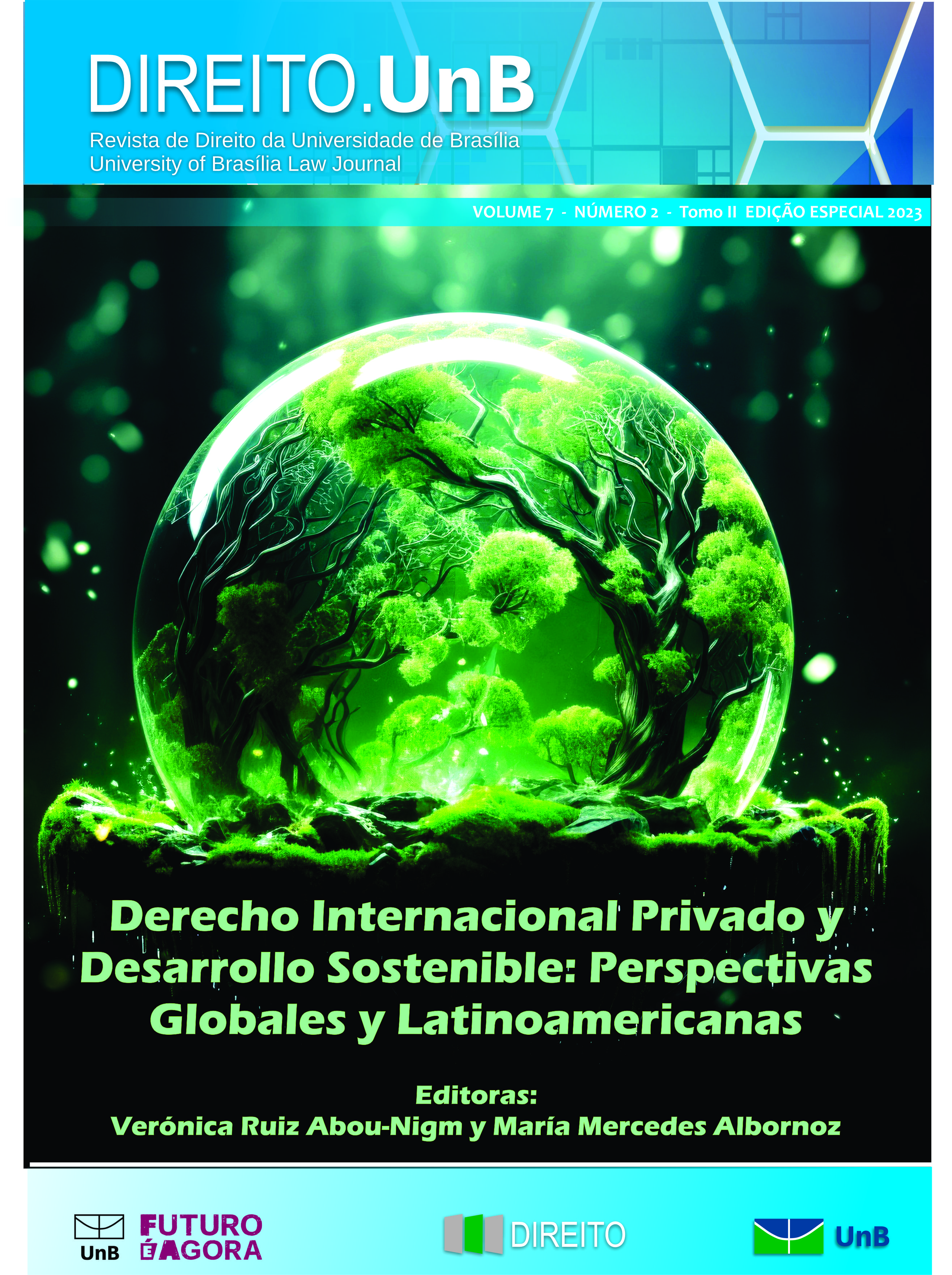
A new special issue of the University of Brasilia Law Journal is dedicated to the topic “Private International Law and Sustainable Development: Global and Latin American Perspectives”. The issue, co-edited by Véronica Ruiz Abou-Nigm and María Mercedes Albornoz, is based on contributions to a panel at the 15th conference of ASADIP in Asunción, Paraguay (2022), and contains some articles in Spanish, some in English. The issue is available as open access.
GEDIP Position paper on Parenthood
The European Group for Private International Law (GEDIP) has recently adopted a Position paper on the Proposal for a Council Regulation in matters of Parenthood.
The Group welcomes the EU’s intention to legislate in this field, since parenthood is a status from which persons derive numerous rights and obligations. However, the Group is of the opinion that there are important shortcomings in the Proposal due to the narrow perspective taken and an insufficient consideration of the legal complexities concerning parenthood in cross-border situations. It therefore encourages a reconsideration of the Proposal in the light of its observations.