


Views
The Netherlands Commercial Court holds its first hearing!
Written by Georgia Antonopoulou and Xandra Kramer, Erasmus University Rotterdam (PhD candidate and PI ERC consolidator project Building EU Civil Justice)
Only six weeks after its establishment, the Netherlands Commercial Court (NCC) held its first hearing today, 18 February 2019 (see our previous post on the creation of the NCC). The NCC’s maiden case Elavon Financial Services DAC v. IPS Holding B.V. and others was heard in summary proceedings and concerned an application for court permission to sell pledged shares (see here). The application was filed on 11 February and the NCC set the hearing date one week later, thereby demonstrating its commitment to offer a fast and efficient forum for international commercial disputes.
The parties’ contract entailed a choice of forum clause in favour of the court in Amsterdam. However, according to the new Article 30r (1) of the Dutch Code of Civil Procedure and Article 1.3.1. of the NCC Rules an action may be initiated in the NCC if the Amsterdam District Court has jurisdiction to hear the action and the parties have expressly agreed in writing to litigate in English before the NCC. Lacking an agreement in the initial contract, the parties in Elavon Financial Services DAC v. IPS Holding B.V. subsequently agreed by separate agreement to bring their case before the newly established chamber and thus to litigate in English, bearing the NCC’s much higher, when compared to the regular Dutch courts, fees. Unlike other international commercial courts which during their first years of functioning were ‘fed’ with cases transferred from other domestic courts or chambers, the fact that the parties in the present case directly chose the NCC is a positive sign for the court’s future case flow.
As we have reported on this blog before, the NCC is a specialized chamber of the Amsterdam District Court, established on 1 January 2019. It has jurisdiction in international civil and commercial disputes, on the basis of a choice of court agreement. The entire proceedings are in English, including the pronouncement of the judgment. Judges have been selected from the Netherlands on the basis of their extensive experience with international commercial cases and English language skills. The Netherlands Commercial Court of Appeal (NCCA) complements the NCC on appeal. Information on the NCC, a presentation of the court and the Rules of Procedure are available on the website of the Dutch judiciary. It advertises the court well, referring to “the reputation of the Dutch judiciary, which is ranked among the most efficient, reliable and transparent worldwide. And the Netherlands – and Amsterdam in particular – are a prime location for business, and a gateway to Europe.” Since a number of years, the Dutch civil justice system has been ranked no. 1 in the WJP Rule of Law Index.
In part triggered by the uncertainties of Brexit and the impact this may have on the enforcement of English judgments in Europe in particular, more and more EU Member States have established or are about to establish international commercial courts with a view to accommodating and attracting high-value commercial disputes (see also our previous posts here and here). Notable similar initiatives in Europe are the ‘Frankfurt Justice Initiative’ (for previous posts see here and here) and the Brussels International Business Court (see here). While international commercial courts are mushrooming in Europe, a proposal for a European Commercial Court has also come to the fore so as to effectively compete with similar courts outside Europe (see here and here).
The complexity of the post Brexit era for English LLPs and foreign legal professionals in EU Member States: a French perspective
Written by Sophie Hunter, University of London (SOAS)
In light of the turmoil in the UK Parliament since the start of 2019, the only certain thing about Brexit is that everything is uncertain. The Law Society of England and Wales has warned that “if the UK’s relationship with the rest of the EU were to change as the result of significant renegotiations, or the UK choosing to give up its membership, the effects would be felt throughout the legal profession.” As a result of Brexit, British firms and professionals will no longer be subject to European directives anymore. This foreshadows a great deal of complexity. Since British legal entities occupy a central place within the European legal market, stakes are high for both British and European lawyers. A quick overview of the challenges faced by English LLPs in France and the Paris Bar demonstrates a high level of complexity that, is not and, should be considered more carefully by politicians. Read more
The Aftermath of the CJEU’s Kuhn Judgment – Hellas triumphans in Vienna. Really.
Written by Stephan Walter, Research Fellow at the Institute for German and International Civil Procedure Law, University of Bonn, Germany
Claims brought by creditors of Greek state bonds against Greece in connection with the 2012 haircut do not fall under the substantive scope of the Brussels Ibis Regulation because they stem from the exercise of public authority. Hence, they cannot be regarded as civil and commercial matters in the sense of Article 1(1) Brussels Ibis Regulation. This is the essence of the CJEU’s Kuhn judgment (of 15 November 2018, Case C-308/17, ECLI:EU:C:2018:911), which was already discussed on this blog.
In said blog post, it was rightly pointed out that the judgment could be nothing but a Pyrrhic victory for Greece. Not least the – now possible – application of national (sometimes exorbitant) jurisdictional rules was considered to have the potential to backfire. This was, however, only the case, if Greece was not granted immunity in the first place. In short: the fallout of the CJEU’s judgment was hardly predictable. Read more
News
4-year PostDoc Position in European law at Humboldt University Berlin
The Law Faculty of Humboldt University is inviting applications for a four-year PostDoc position in European law. The position is fully paid and funded by the graduate research programme DynamInt (Dynamic Integration Order) which itself is funded by the German Research Foundation (Deutsche Forschungsgemeinschaft).
The PostDoc is supposed to pursue her/his research project in the field of European Law (including European Private International Law and International Civil Procedure). She/he is also expected to interact with the group of young researchers, who all work on their dissertation projects within the thematic framework of harmonization and plurality tendencies in the EU.
The position is targeting German-speaking researchers (in contrast to the international PostDoc positions advertised last week). More information is available here.
PhD positions in Antwerp
The University of Antwerp has opened two vacancies for PhD research related to private international law.
The first covers inter alia EU private international law, and will be supervised by prof. dr. Johan Meeusen and prof. dr. Mathieu Leloup. The four-year scholarship is sponsored by the Research Foundation – Flanders (FWO). The candidate will write a PhD on mutual trust and rule of law requirements in the field of judicial cooperation in civil and criminal matters. The researcher will have to examine, inter alia, the enforcement of the European Union’s rule of law requirements by courts applying EU private international law instruments. All information on this position, and how to apply, can be found on the University of Antwerp’s website.
The second is on the cusp of private and public international law and will be supervised by Thalia Kruger. This position, also for four years, is funded by the Law Faculty. The research will be about international contracts in the context of international treaties on water. The highland water project (Lesotho and South Africa) is a possible approach. More information and requirements are also available on the website of the University of Antwerp.
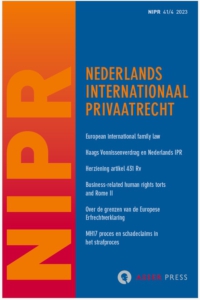
Dutch Journal of PIL (NIPR) – issue 2023/4
The latest issue of the Dutch Journal on Private International Law (NIPR) has just been published
NIPR 2023 issue 4
EDITORIAL
I. Sumner, The next stops on the European international family law train / p. 569-571
Abstract
The European legislature is not yet finished with the Europeanisation of private international family law. This editorial briefly introduces two new proposals, namely the Proposal for a European Parentage Regulation and the Proposal for a European Adult Protection Regulation.