Views
New Article on Non-Party Access to Court Documents and the Open Justice Principle
Written by Ana Koprivica Harvey
Ms Ana Koprivica Harvey (Max Planck Institute Luxembourg for International, European and Regulatory Procedural Law) recently posted a new paper in the MPILux Research Paper Series, titled Non-Party Access to Court Documents and the Open Justice Principle: The UK Supreme Court Judgment in Cape Intermediate Holdings Ltd v Dring. Below is an overview provided by the Author.
This article analyses the eagerly awaited the UK Supreme Court judgment in Cape Intermediate Holdings Ltd v Dring, unanimously delivered on 29th July 2019. Broadly speaking, the case concerned the scope and operation of the constitutional principle of open justice. More precisely, the questions before the Supreme Court were how much of the written material placed before a court in a civil action should be accessible to persons other than the parties to the proceedings, and how such access should be facilitated. Read more
Service of Process abroad: Lost in Translation
Written by Benedikt Windau
Benedikt Windau, Judge at the Oldenburg District Court (Landgericht Oldenburg), runs a very interesting blog (in German), focusing on German Civil Procedure. In one of his recent postings, he presented a very interesting judgment of the Frankfurt CoA, related to the Service Regulation. Upon my request, he prepared an English version of his post for our blog.
A recent ruling of the Frankfurt Court of Appeals (Docket No. 13 U 210/17) will potentially shake up the (German) law of cross-border service quite a bit, as it imposes new, hence unknown obligations on the plaintiff – and its legal counsel accordingly. Read more
First impressions from Kirchberg on the EAPO Regulation – Opinion of AG Szpunar in Case C-555/18
Written by Carlos Santaló Goris
Carlos Santaló Goris is a researcher at the Max Planck Institute Luxembourg for International, European and Regulatory Procedural Law, and Ph.D. candidate at the University of Luxembourg. He offers a summary and an analysis of AG Spuznar’s Opinion on the Case C-555/18, K.H.K. v. B.A.C., E.E.K.
I. Introduction
Less than three years after Regulation 655/2014 establishing a European Account Preservation Order (“the EAPO Regulation”) entered into force, the Court of Justice of the European Union (“CJEU”) released its first Opinion on this instrument. This regulation established a uniform provisional measure at the European level, which permits creditors the attachment of bank accounts in cross-border pecuniary claims. In many senses, the EAPO regulation represents a huge step forward, particularly in comparison to the ex-ante scenario regarding civil provisional measures in the Area of Freedom, Security and Justice. It is no accident that in the first line of the Opinion, AG Szpunar refers to the landmark case Denilauler. Besides the concrete assessment of the preliminary reference, he found a chance in this case to broadly analyse the EAPO Regulation as such, contextualizing it within the general framework of the Brussels system. Read more
News
Promulgation of the Interpretation of the Supreme People’s Court on Several Issues Concerning the Application of International Treaties and International Practices in the Trial of Foreign-related Civil and Commercial Cases
By Professor Du Tao* and Yang Zhenni**
On December 28, 2023, the Supreme People’s Court (SPC) held a press conference on Judicial Interpretations and Typical Cases on the Application of International Treaties and International Practices in Foreign-related Civil and Commercial Cases, deliberating the Interpretation of the Supreme People’s Court on Several Issues Concerning the Application of International Treaties and International Practices in the Trial of Foreign-related Civil and Commercial Cases (Interpretation) and some related typical cases. The Interpretations was adopted by the Trial Committee of the Supreme People’s Court at its 1908th meeting on December 5, 2023, which will come into force on January 1, 2024. We translated the press announcement as follows:
Out now: The Cambridge Handbook of Comparative Law (by Siems and Jen Yap)
There is no doubt that private international law works in close cooperation with comparative law. Horatia Muir Watt, for example, characterises the relationship between the two disciplines as “complementary” (H M Watt, “Private International Law”, in J M. Smits (ed.), Elgar Encyclopedia of Comparative Law (2nd ed., Edward Elgar Publishing, 2012) p. 701). Similarly, Mathias Reimann describes it as “intimate” (M Reimann, “Comparative Law and Private International Law”, in M Reimann and R Zimmermann (eds.), The Oxford Handbook of Comparative Law (2nd ed., OUP, 2019) p. 1340). Meanwhile, Ralf Michaels, another distinguished scholar of comparative and private international law, considers that “in private international law scholarship, comparison has always been prominent” (Ralf Michaels, “Comparative Law and Private International Law”, in J Basedow et al. (eds.), Encyclopedia of Private International law –Volume I (Edward Elgar Publishing, 2017) p. 416).
Understanding foreign legal systems and the diversity of the solutions dealing with common problems and issues has always been crucial for private international law scholars and researchers. This enables them to refine the techniques and theories of private international law, and ultimately serves one of the most important goals of private international law: the coordination of different legal systems.
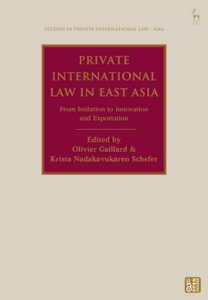
Out Now: Private International Law in East Asia: From Imitation to Innovation and Exportation (Gaillard/Nadakavukaren Schefer)
Hart Studies in Private International Law – Asia has officially released its 9th Volume in the Series as an open-access book. This edition, edited by Olivier Gaillard and Krista Nadakavukaren Schefer, is titled Private International Law in East Asia: From Imitation to Innovation and Exportation (Hart Publishing, 2024).