


Views
CJEU on the deceased’s habitual residence
Written by Vito Bumbaca, University of Geneva
On 16 July the CJEU issued its preliminary ruling in case E.E. & K.-D. E. (CJEU, C-80/19, ECLI:EU:C:2020:569, not yet available in English). The case concerned, inter alia, the assessment of the deceased’s habitual residence under the EU Succession Regulation No. 650/2012. Given the novelty of the ruling, which represents the very first CJEU assessment of the deceased’s habitual residence under the EU Succession Regulation, we will focus on this particular aspect only.
Facts:
A Lithuanian mother and her son moved to Germany to live with the mother’s husband. Prior to her death in Germany, she drew up a testament in Lithuania, naming her son as her sole heir. The mother owned an apartment in Lithuania and when she died (in Germany), her son approached a notary in Lithuania concerning the apartment and in order to obtain a Certificate of Succession. This notary refused both requests based on their interpretation of the EU Succession Regulation according to which the deceased’s last habitual residence was in Germany at the time of death. The deceased’s son appealed against such a decision; subsequently the proceedings reached the Lithuanian Supreme Court (Lietuvos Aukš?iausiasis Teismas), which decided to stay proceedings and ask the preliminary ruling of the CJEU. The CJEU found that a person can have only one habitual residence.
Relevance:
This is the first CJEU ruling on the determination of the deceased’s habitual residence under the EU Succession Regulation.
It is welcomed to the extent that it provides a guiding assessment of the hierarchical order and practical implementation of recitals 23, 24 and 25. These are considered as explanatory rules for the determination of international competence and applicable law in matters of EU 25 cross-border succession based on habitual residence as a primary connecting factor.
Specifically, the Court clarifies which key factors should be assessed in the determination of the deceased’s habitual residence by virtue of the above-mentioned recitals and in line with the objectives followed by the EU Succession Regulation. Furthermore, it confirms that, when assessing the deceased’s habitual residence at the time of death, a lengthy determination of the deceased’s life circumstances preceding his/her death should be made. Lastly, it leaves unresolved the factual assessment of the manifestly closest connection criterion applicable on an exceptional basis.
Brief analysis:
According to the Court, the deceased cannot simultaneously have more than one habitual residence at the time of death (§ 41). This however does not exclude the possibility of acquiring an alternative and consecutive habitual residence at different points in time during the deceased’s life. The Court indicated that by virtue of recital 23 the main element in determining the deceased’s habitual residence is the stability of his/ her stay, and therefore of his/ her physical presence, at the time of death (§ 38). In the absence of stability, therefore on a subsidiary basis (§ 39), recital 24 advises national authorities, in some circumstances including notaries (§ 46), to refer to the deceased’s nationality (personal factor) and/ or assets (economic factor). Finally, the criterion relating to the “manifestly closest connection” in relation to the determination of applicable law will have to be applied in a strict manner and not subsidiary to the complex determination of habitual residence, in accordance with the principles of predictability and legal certainty as provided for by the EU Regulation (§ 37). The exceptional use of the “manifestly closest connection” criterion, however, is left to the judicial discretion of the first seised national courts (§ 45).
Ultimately, according to the Court’s reasoning, which follows the Advocate General’s Opinion of 26 March 2020 (§ 52), the element of stability relating to the deceased’s physical presence at the time of death must be sought in the reasons (subjective element) and the conditions (objective element) of his/ her stay showing a close and stable link between the succession and the given State, in line with the objectives of the EU Succession Regulation (§ 37). The assessment of both objective and subjective elements, and generally of habitual residence, should consider the deceased’s life circumstances at the time of death and the years preceding his/ her death (§ 23). Such a “lengthy” determination of the deceased’s life assessment leaves the debate open as to its pertinence in an increasingly globalised society within which cross-border settlements regularly occur, in particular when involving expats holding multiple nationalities and various assets in different countries.
Lastly, the Court has made clear that the habitual residence assessment must be twofold in matters of competence and threefold in relation to applicable law. With regard to competence, according to the Advocate General, the Court first seised will have to look primarily at the duration and regularity of the deceased’s settlement and subsidiarily at his/ her nationality and/ or assets. In relation to the deceased’s settlement, the Advocate General clarified that duration (time factor) cannot be considered, in itself, a decisive element and that it should be accompanied by other relevant factors such as the deceased’s family and social integration, or his/ her proximity to the State in question (Advocate General’s Opinion, § 54). Furthermore, the Advocate General confirmed that, in line with recital 24, the contexts typically falling under the subsidiary assessment of the deceased’s nationality and/ or assets are: (i) the scenario involving expats; and (ii) that involving a “peripatetic” cross-border movement and life not allowing the establishing of stable connection (Advocate General’s Opinion, § 55-57).
In relation to applicable law, the Court first seised should consider, as a last resort when none of the above elements can be traced, specific factors indicating a situation falling under “manifestly closest connection”. According to the EU Succession Regulation, and confirmed by the Advocate General (§ 25 of the Opinion), a typical situation falling under “manifestly closest connection” is when the deceased moved to his/ her new habitual residence fairly recently before his/ her death. Nonetheless, the Court has not yet identified any specific elements for the determination of the exceptional “manifestly closest connection” criterion (§ 59).
New conflict of laws rule for minimum wages in road transport: UPDATE
Written by Fieke van Overbeeke, Legal Counsel at the International Institute for International and Foreign Law – the Netherlands and research fellow at the University of Antwerp – Belgium
On 10 June conflictoflaws.net posted a piece about ‘new conflict of laws rule for minimum wages in road transport’. At that time it seemed that the EU institutions still needed to overcome severe difficulties. However, fully according to the course of events around this very unpredictable file, on 10 July the institutions officially reached a compromise: the directive with conflict of law rules for road transport was finally has adopted and it will enter into force 18 months after publication in the EU’s Official Journal.
In short about these conflict of law rules: 1) Transit operations do not fall under the Posting of Working Directive and the labour conditions, i.a. minimum wages, cannot be applied to this type of transport; 2) Cabotage operations do fall under the Posting of Working Directive and the labour conditions should be guaranteed to this type of transport (‘guaranteed’ because this only needs to be done in case these conditions are more favourable to the lorry driver, see Article 3 section 7 Posting of Working Directive); 3) Bilateral operations do not fall under the Posting of Working Directive, and some correlated crosstrade operations do not either; 4) Crosstrade operations are supposed to fall under the Posting of Working Directive (however, a clear rule about this is lacking and provokes many questions).
Jurisdiction in relation to hostile trust litigation
In Ivanishvili, Bidzina v Credit Suisse Trust Ltd [2020] SGCA 62, the Singapore Court of Appeal considered a number of issues: (1) whether a plaintiff could amend its Statement of Claim at the appellate stage to tilt the balance of connecting factors towards Singapore; (2) whether a clause in the trust deed identifying Singapore as the “forum of administration” of the trust was a jurisdiction clause, and if so; (3) whether the clause covered hostile litigation in relation to the trust; and depending on the answers to the previous questions, (4) whether the Singapore proceedings ought to be stayed.
The case concerned Mr Ivanishvili, the former Georgian prime minister, who was a French and Georgian dual national. Mr Ivanishvili had set up the Mandalay Trust which was domiciled in Singapore. The trustee of the Mandalay Trust was Credit Suisse Trust Ltd, a Singapore trust company (“the Trustee”). The trustee’s asset management powers were delegated to the Geneva branch of Credit Suisse AG (“the Bank”). The Mandalay Trust suffered losses purportedly due to the actions of one the Bank’s employees (Mr Lescaudron) who was the portfolio manager of the Mandalay Trust. Mr Lescaudron was convicted in Swiss criminal proceedings for various forms of misconduct in relation to the Mandalay Trust. At first instance, Mr Ivanishvili and his wife and children, who were the beneficiaries of the Mandalay Trust, sued both the Trustee and the Bank alleging, inter alia, breaches of duties of care and skill and misrepresentation. A stay was granted by the court below on the grounds that Switzerland was a more appropriate forum for the action. At the Court of Appeal, Mr Ivanishvili et al strategically chose to discontinue proceedings against the Bank to strengthen their argument that Singapore was the appropriate forum for trial of the action and sought to amend their Statement of Claim to this effect. This also entailed reformulating some of the claims against the Trustee to remove references to the Bank. This was allowed by the Court of Appeal on the basis that absent bad faith, the appellants had the freedom of choice to choose its cause of action and to sue the party it wishes to sue.
On the second issue, the relevant clause provided that:
“2. (a) This Declaration is established under the laws of the Republic of Singapore and subject to any change in the Proper Law duly made according to the powers and provisions hereinafter declared the Proper Law shall be the law of the said Republic of Singapore and the Courts of the Republic of Singapore shall be the forum for the administration hereof.”
Clause 2(b) granted the Trustee the power to change the proper law and provided that if so, the courts of the jurisdiction of the new proper law would become the “forum for the administration” of the trust. Contrasting clause 2 with the equivalent clause in Crociani v Crociani (17 ITELR 624) where the relevant clauses referred to a country being the “forum for the administration”, the Court of Appeal noted that the references to “forum for the administration” in clause 2 was tied up with a reference to the courts. It therefore held that clause 2(a) was a jurisdiction clause. As a point of interest, it should be noted that, generally speaking, it is immaterial whether a jurisdiction clause naming Singapore as a forum is exclusive or non-exclusive in nature after the Court of Appeal’s decision in Shanghai Turbo v Liu Ming [2019] 1 SLR 779 (previously noted here); as Singapore is a named forum, the “strong cause” test would apply to cases falling within the scope of the jurisdiction clause.
The question which had to be considered next was whether clause 2(a) covered hostile litigation concerning breach of trust issues (such as in the present case) or was confined to litigation over administrative matters. On this, the Court engaged in an extensive review of case law in other off-shore trust jurisdictions. While tentatively observing that “there is no legal rule limiting the meaning of the phrase ‘forum for [the] administration’ to an administration action in the traditional sense”(at [75]), the Court ultimately followed the reasoning of the Privy Council in Crociani and other cases in its wake and held that that the phrase “is intended to refer to the court or jurisdiction which would settle questions arising in the day to day administration of the trust, and to denote the supervisory and authorising court for actions the trustee might need to take which were not specifically by the trust deed or where its terms were ambiguous”(at [76]). Such clauses did not cover hostile litigation between trustees and beneficiaries. The Court observed that: “The trust deed is not a contract between two parties with obligations on both sides – rather, it is a unilateral undertaking by the trustee, and in our view this difference must play a part when we consider whether the intention of the drafters was to impose a mandatory jurisdiction clause for the resolution of contentious disputes regarding allegations of breach of trust”(at [78]). This suggests that the “strong cause” test, which has as its starting point the upholding of the parties’ contractual bargain, is not appropriate in hostile litigation involving beneficiaries to a trust.
In any event, the Court’s conclusion on the scope of clause 2(a) meant that whether a stay ought to be granted was to be determined under the Spiliada test on forum non conveniens rather than the “strong cause” test. On this point, the Court split. A majority of the Court (Menon CJ and Prakash JA), held that the balance of connecting factors pointed towards Singapore and allowed the appeal against the stay. The appellants argued that with the amended claim, the focus was on the Trustee’s breaches of trust, all of which occurred in Singapore. The Court was unconvinced of the respondents’ argument that most of the relevant witnesses, such as Mr Lescaudron, were located in Switzerland and not compellable to appear before the Singapore court. The location of witnesses was but a weak factor pointing in favour of Switzerland being forum conveniens relative to Singapore. The respondents had also argued that Swiss banking secrecy laws meant that disclosure of certain documents could only be ordered by the Swiss court but the Court gave little weight to this, holding that it was not clear that the Trustee could not obtain the requisite documents from the Bank itself. In contrast, the shape of litigation post the re-framing of the actions by the appellants meant that the trust relationship, rather than the banking relationship, was at the forefront of the claims. This pointed towards Singapore being the centre of gravity of the action. Further, Singapore law was the governing law of the Mandalay Trust and the rights of all parties under the Trust Deed: “There is no doubt that the Singapore courts are the most well-placed to decide issues of Singapore trust law, and the Swiss courts, operating in a civil law jurisdiction with no substantive doctrine of trusts, would be far less familiar with these issues”(at [110]). This comment may be to understate the competence of the Swiss courts in this regard, as internal Swiss trusts which are governed by a foreign law are not an uncommon wealth management tool in Switzerland. The Court was also not persuaded by the Trustee’s argument that there was a risk of conflicting findings of fact due to related proceedings elsewhere, holding that this was not a “sufficiently real possibility” (at [114]). Thus, a majority of the Court held that, on an overall assessment of the connecting factors, Singapore would be the more appropriate forum vis-à-vis Switzerland.
There was a strong dissent by Chao SJ on the application of the Spiliada test. His Honour was of the view that whether the Trustee would be prejudiced by having to defend itself in Singapore formed the crux of the stay issue. In relation to this, His Honour observed that Mr Ivanishvili was a hands-on investor who corresponded directly with the Bank officers. The Trustee was not always copied into Mr Ivanishvili’s instructions to the Bank. The alleged losses occurred in Switzerland and the acts and omissions of the Bank and its officers and the role of Mr Ivanishvili himself remained relevant in determining the Trustee’s liability. In contrast, the Trustee played a passive role and the operative events in Singapore were merely secondary in nature (at [153]). This belied the appellants’ insistence that the Bank’s alleged wrongdoing was no longer relevant in the Singapore proceedings given the amended claim. His Honour was concerned about the respondents’ ability to defend itself properly in Singapore given that the evidence and witnesses central to defending the claims were mainly located in Switzerland. Chao SJ was therefore of the view that the action had a greater connection with Switzerland than with Singapore “by a significant margin” (at [154]). His Honour went on to say that if he was wrong on stage one of the Spiliada test, stage two would also point towards Switzerland. On stage two, Chao SJ agreed with the High Court that the ends of justice would best be met by the Swiss court applying Singapore trust law. This is as the trustee’s conduct may only be properly understood against the backdrop of Mr Ivanishvili’s relationship with the Bank and the Bank’s conduct in relation to its asset management duties (at [154]).
A pdf of the judgment can be downloaded here.
News
ZEuP – Zeitschrift für Europäisches Privatrecht 3/2024
Issue 3/2024 of ZEuP – Zeitschrift für Europäisches Privatrecht has just been published. It includes contributions on EU private law, comparative law, legal history, uniform law, and private international law. The full table of content can be accessed here.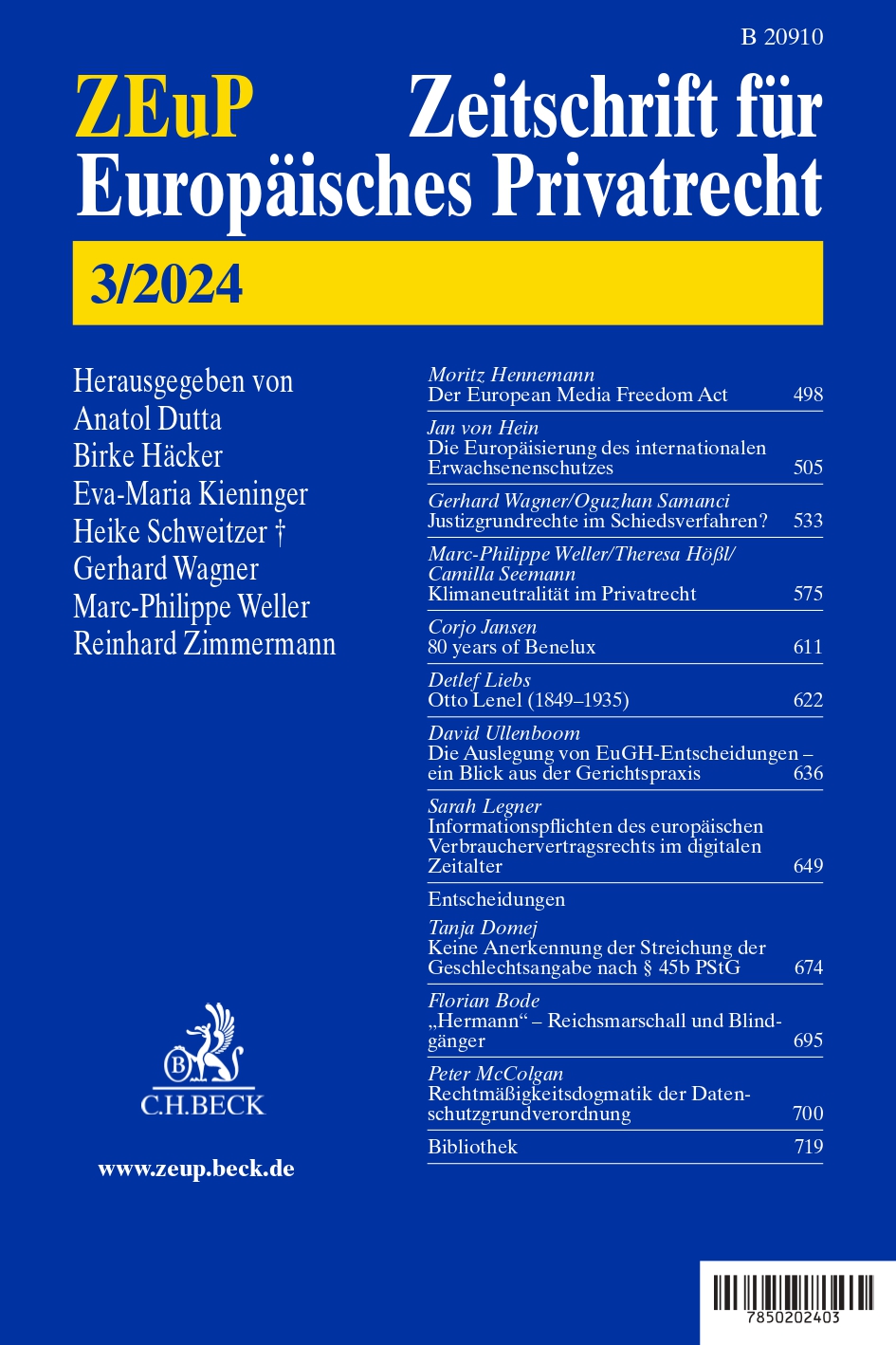
The following contributions might be of particular interest for the readers of this blog:
- Die Europäisierung des internationalen Erwachsenenschutzes
Jan von Hein on the proposal for a regulation on the international protection of adults: On 31.5.2023, the European Commission presented a proposal for a regulation on the international protection of adults. This proposal is closely intertwined with the Hague Convention on the international protection of adults. Therefore, the proposed regulation shall be accompanied by a Council decision authorising Member States to become or remain parties to the Hague Convention. The following contribution analyses the proposed regulation and its relationship with the Hague Convention. - Justizgrundrechte im Schiedsverfahren? – Pechstein und die Folgen fu?r die Handelsschiedsgerichtsbarkeit
Gerhard Wagner and Oguzhan Samanci on human rights and commercial arbitration: Does the ECHR and the German constitution require public hearings in arbitral proceedings, provided that one of the parties had the power to impose the arbitration agreement on the other through a contract of adhesion? This article analyzes the potential implications that the Pechstein decision of the Federal Constitutional Court and ist precursor in the jurisprudence of the ECHR may have for commercial arbitration. The focus is on arbitration clauses in general business terms and in contracts with undertakings that occupy a dominant position in a specific market. The conclusion is that, despite the broad formula employed by the Federal Constitutional Court, the right to a public hearing should remain limited to sports arbitration. - Die Auslegung von EuGH-Entscheidungen – ein Blick aus der Gerichtspraxis
David Ullenboom on the interpretation of CJEU decisions: This article examines the question whether a European methodology is needed to interpret judgments of the CJEU for judicial practice. It argues that judgments of the CJEU need to be interpreted in the same way as legal provisions and are therefore subject to a grammatical, systematic, genetic and teleological interpretation in order to determine their meaning for future legal cases. - Schweizerisches Bundesgericht, 8 June 2023, 5A_391/2021
Tanja Domej discusses a decision of the Swiss Federal Tribunal on the recognition of the deletion of a gender registration under German law.
OUT NOW!! New Book on Private International Law in BRICS: Convergence, Divergence, and Reciprocal Lessons (Stellina Jolly and Saloni Khanderia eds)
Hart Publishing, Oxford, UK is proud to announce the release of Private International Law in BRICS: Convergence, Divergence, and Reciprocal Lessons co-edited by Dr. Stellina Jolly, South Asian University, Delhi, India, and Professor Saloni Khanderia, O.P. Jindal Global University, Sonipat, India. The book forms part of Hart’s prestigious Private International Law Series with Professor Paul Beaumont, University of Stirling, as its Series Editor.
Authored by leading scholars and practitioners in private international law, the chapters draw on domestic legislation and case law interpretations in each of these emerging economies. They cover a wide array of topics, including contractual and non-contractual obligations, choice of court agreements, and personal matters such as marriage, divorce, matrimonial property, succession, and surrogacy—all within the context of increased cross-border movement of people.
As the title suggests, this book explores the intricate landscape of private international law within the BRICS countries—Brazil, Russia, India, China, and South Africa. Divided into six sections, each part of the book offers a thematic analysis of core private international law-related questions and an in-depth examination of the reciprocal lessons each BRICS country can share concerning each of three core conflict of law issues – the international jurisdiction of courts, the applicable law and the effectiveness of foreign decisions (both judgments and arbitral awards) overseas.
This book serves as an invaluable comparative resource for governments, legislators, traders, academics, researchers, and students interested in the intricate legal dynamics at play within the BRICS nations. With the BRICS countries collectively representing around 42% of the world’s population and approximately 23% of global GDP, the need for enhanced legal cooperation and harmonization is more critical than ever. Over the past decade, cross-border interactions within the BRICS bloc and beyond have escalated significantly. However, the diversity in political, legal, economic, and social structures, coupled with the lack of geographical proximity and historical connections, has posed challenges to effective cooperation and the ability of BRICS to play a proactive role in global governance. The 15 BRICS Summits held between 2009 and 2023 have primarily focused on economic cooperation, particularly in trade, investment, foreign affairs, and innovation. While these areas are crucial, they cannot be viewed in isolation. Increased trade and cooperation inevitably lead to the movement of persons, goods, and services across national boundaries, raising important legal questions. For instance, economic cooperation that facilitates the movement of people also impacts personal relationships. Scenarios such as marriage, divorce, adoption, surrogacy, and inheritance across borders create complex legal challenges that require a robust understanding of private international law. Will a marriage or divorce be recognized in the home country? How will the nationality of a child born through surrogacy or adopted abroad be determined? These questions, though critical, have not yet been thoroughly examined in the context of BRICS.
Recognizing this gap, our book seeks to explore and analyze the role of private international law in fostering enhanced cooperation among BRICS countries. In pursuit of its objectives, the project draws lessons from various multilateral and supranational instruments operating under the HCCH – Hague Conference on Private International Law and in the European Union, renowned for pioneering clear, predictable rules to regulate international disputes through the unification of laws.
Details of the book as well as purchase options can be found here!
PhD/Research Assistant Position at the University of Hamburg
Professor Konrad Duden, Chair of Private Law, Private International Law and Comparative Law at the University of Hamburg, is looking to appoint a research assistant, with the option to work towards a PhD.
More information can be found here.