


Views
How Litigation Imports Foreign Regulation
Guest Post by Diego A. Zambrano, Assistant Professor of Law, Stanford Law School
For years now, the concept of a “Brussels Effect” on global companies has become widely accepted. A simple version of the story goes as follows: the European Union sets global standards across a range of areas simply by virtue of its large market size and willingness to construct systematic regulatory regimes. That is true, for instance, in technology where European privacy regulations force American companies (including Facebook, Google, and Apple) to comply worldwide, lest they segment their markets. As Anu Bradford has expertly argued, it is also true in environmental protection, food safety, antitrust, and other areas. When companies decide to comply with European regulations across markets, the European Union effectively “exports” its regulatory regimes abroad, even to the United States.
In a forthcoming article, How Litigation Imports Foreign Regulation, I argue that foreign regulators not only shape the behavior of American companies—they also influence American litigation. From the French Ministry of Health to the Japanese Fair Trade Commission and the European Commission, I uncover how foreign agencies can have a profound impact on U.S. litigation. In this sense, the “Brussels Effect” is a subset of broader foreign regulatory influence on the American legal system.
Read more
European and International Civil Procedural Law: Some views on new editions of two leading German textbooks
For German-speaking conflict of law friends, especially those with a strong interest in its procedural perspective (and this seems to apply to almost all of them by now, I guess), the year 2021 has begun beautifully, as far as academic publications are concerned. Two fantastic textbooks were released, one on European civil procedural law, and one on international civil procedural law:
 After more than ten years the second edition of Burkhard Hess’s 2nd edition of his textbook on „Europäisches Zivilprozessrecht“ is now on the table, 1026 pages, a plus of nearly 300 pages and now part of the renowned series „Ius Communitatis“ by DeGruyter. It is a fascinating account of the foundations („Grundlegung“, Part 1, pp. 3 – 311) of European civil procedure as well as a sharp analysis of the instruments of EU law („Europäisches internationales Zivilprozessrecht“, Part 2, pp. 313 – 782). Part 3 focuses on the interplay between autonomous and European procedural law (pp. 783 – 976). Extensive tables of the cases by the ECJ and the ECtHR as well as a large subject index help to access directly the points in question. The foreword rightly points out that European civil procedural law has reached a new phase. Whereas 10 years ago, the execution of the agenda under the then still new competency in (now) Article 81 TFEU was at issue, today enthusiasm and speed have diminished. Indeed, the ECJ had to, and still has to, defend „the fundamental principles of EU law, namely mutual trust and mutual recognition, against populist attacks and growing breaks of taboos by right-wing populist governments in several Member States“ (Foreword, p. 1, translation here and all following ones by myself; see also pp. 93 et seq. on the struggle for securing independence of the national judge in Hungary and Poland as a matter of the EU‘s fundamental values, Article 2 TEU). At the same time, the EU legislator and the ECJ had shown tendencies towards overstreching the legitimatory potential of the principle of mutual trust before the EU returned to „recognition with open eyes“ (as is further spelled out at para. 3.34, at p. 119), as opposed to blind trust – tendencies that worried many observers in the interest of the rule of law and a convincing balancing of the freedom of movement for judgments and other juridical acts. The overall positive view by Hess on the EU’s dynamic patterns of judicial cooperation in civil matters, combined with the admirable clarity and comprehensiveness of his textbook, will certainly contribute considerably to address these challenges.
Eq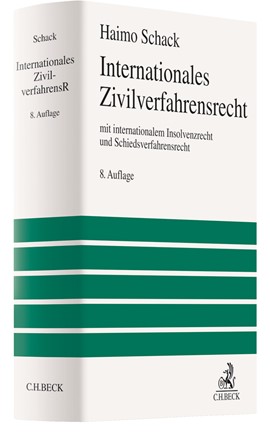 ually admirable for its clarity and comprehensiveness is Haimo Schack’s 8th edition of his textbook on „Internationales Zivilverfahrensrecht“, including international insolvency and international arbitration, 646 pp., now elevated from the „short textbook series“ to the „large textbook series“ at C.H.Beck. The first part addresses foundations of the subject (pp. 1 – 68), the second part describes the limits of adjudicatory authority under public international law (pp. 69 – 90), the third part analyses all international aspects of the main proceedings (pp. 91 – 334), the fourth part recognition and enforcement (pp. 335 – 427), the fifth and sixth part deal with insolvency (pp. 428 – 472) and arbitration (pp. 473 – 544). Again, an extensive table of cases and a subject index are offered as valuable help to the user. Schack is known for rather sceptical positions when it comes to the narrative of mutual trust. In his sharp analysis of the foundations of international procedural law, he very aptly states that the principle of equality („Gleichheit“) is of fundamental relevance, including the assumption of a principal equivalence of the adminstrations of justice by foreign states, which allows trust in and integration of foreign judicial acts and foreign laws into one’s own administration of justice: „Auf die Anwendung eigenen Rechts und die Durchführung eines Verfahrens im Inland kann man verzichten, weil und soweit man darauf vertraut, dass das ausländische Recht bzw. Verfahren dem inländischen äquivalent ist“ (We may waive the application of our own law and domestic proceedings because and as far as we trust in the foreign law and the foreign proceedings are equivalent to one’s own, para. 39, at p. 12) – a fundamental insight based, inter alia, on conceptual thinking by Alois Mittermaier in the earlier parts of the 19th century (AcP 14 [1831], pp. 84 et seq., at pp. 95, justifying recognition of foreign judgments by the assumption that the foreign judge should, in principle, be considered „as honest and learned as one’s own“), but of course also on Friedrich Carl v. Sagigny, which I allowed myself to further substantiate and transcend elsewhere to the finding: to trust or not to trust – that is the question of private international law (M. Weller, RdC, forthcoming). In Schack’s view, „the ambitious and radical projects“ of the EU in this respect „fail to meet with reality“ (para. 126, at p. 50). Equally sceptical are his views on the HCCH 2019 Judgments Convention („Blütenträume“, para. 141, at p. 57, in translation something like „daydreams“).
Perhaps, the truth lies somewhere in the middle, namely in a solid „trust management“, as I tried to unfold elsewhere.
European Parliament Resolution on corporate due diligence and corporate accountability
Our blog has reported earlier on the Proposal and Report by the Committee on Legal Affairs of the European Parliament for a Resolution on corporate due diligence and corporate accountability. That proposal contained recommendations to amend the EU Regulations Brussels Ia (1215/2015) and Rome II (864/2007). The proposals were discussed and commented on by Jan von Hein, Chris Tomale, Giesela Rühl, Eduardo Álvarez-Armas and Geert van Calster.
On 10 March 2021 the European Parliament adopted the Resolution with a large majority. However, the annexes proposing to amend the Brussels Ia and Rome II Regulations did not survive. The Resolution calls upon the European Commission to draw up a directive to ensure that undertakings active in the EU respect human rights and the environment and that they operate good governance. The European Commission has already indicated that it will work on this.
Even if the private international law instruments are not amended, the Resolution touches private international law in several ways.
* It specifies that the “Member States shall ensure that relevant provisions of this Directive are considered overriding mandatory provisions in line with Article 16 of Regulation (EC) No 864/2007” (Art. 20). It is a bit strange that this is left to national law and not made an overriding mandatory provision of EU law in line with the CJEU’s Ingmar judgment (on the protection of commercial agents – also a Directive). Perhaps the legislator decides otherwise.
* It proposes a broad scope rule covering undertakings “operating in the internal market” and encompassing activities of these undertakings or “those directly linked to their operations, products or services by a business relationship or in their value chains” (Art 1(1)). It thus imposes duties on undertakings to have due diligence strategies and communicate these even if the undertakings do not have their seat in an EU Member State. In this way it moves away from traditional seat theories and place of activities tests.
News

Book on PIL and Global Trends (in Croatian)
Following the conference held previously this year (reported here), the book on Private International Law and Global Trends (Medunarodno privatno pravo i globalni trendovi) has been published by the Croatian Academy of Sciences and Arts (Hrvatska akademija znanosti i umjetnosti, HAZU) within the series Modernisation of Law edited by the academic and professor Jaksa Barbic.
The book includes the following contributions (all in Croatian, while the titles are translated for the convenience of the readers of this blog):
Jaksa Barbic
Editorial
Ines Medic, University of Split, Faculty of Law
Challenges of globalization of private international law for national judiciary
Ivana Kunda, University of Rijeka, Faculty of Law
Have frontier digital technologies surpassed the boundaries of private international law?
Mirela Zupan, Assoc. Prof. Dr. Paula Poretti, Jura Golub, University of J. J. Strossmayer in Osijek, Faculty of Law
Foreign public documents in the digital age
Danijela Vrbljanac, University of Rijeka, Faculty of Law
Breach of personal data in private international law
Tena Hosko, University of Zagreb, Faculty of Law
Protection of workers in private international law
Dora Zgrabljic Rotar, University of Zagreb, Faculty of Law
The effect of the Hague Judgments Convention of 2019 on the recognition and enforcement of foreign court decisions in the Republic of Croatia
The book is presented at the HAZU official webisite, while it can be bought for a symbolic price at stores such as here.
HCCH Monthly Update: September 2024
Conventions & Instruments
On 1 November 2024, the 2007 Child Support Convention entered into force for Kyrgyzstan. At present, 52 States and the European Union are bound by the 2007 Child Support Convention. More information is available here.
On 21 November 2024, North Macedonia deposited its instrument of ratification of the 2005 Choice of Court Convention. With the ratification of North Macedonia, 36 States and the European Union are bound by the 2005 Choice of Court Convention. It will enter into force for North Macedonia on 1 March 2025. More information is available here.

Book on PIL on rights in rem in the EU
The book titled Private International Law on Rights in rem in the European Union. Derecho internacional privado sobre derechos reales en la Unión Europea and edited by Maria Font-Mas of the Universitat Rovira i Virgili in Spain, has just been released with Marcial Pons.
The book is the result of the several years of collaborative work (referred to here and here) of the researchers from different countries convened by Maria Font Mas under the project PID2020-112609GB-I0 “Property Rights System over Tangible Goods in the Field of European Private International Law: Aspects of International Jurisdiction and Applicable Law”, funded by the Spanish Government.
The great achievement of the editor is in her ability not only to gather and coordinate many authors of various provenance around under-researched topic of rights in rem in PIL but also to have this book published in open access so that it is available to all under no limitations except to have the internet access. The book may be viewed and downloaded at https://marcialpons-openaccess.es/index.php/juridicas/catalog/book/5 as a single volume or chapter-by-chapter. In case you prefer the paper version, it is available for purchase here.
The contributors (in the order of appearance) are: Maria Font-Mas, Georgina Garriga Suau, Josep M. Fontanellas Morell, Héctor Simón Moreno, Christopher A. Whytock, Rocío Caro Gándara, Josep M. Fontanellas Morell, Iván Heredia Cervantes, Nerea Magallón Elósegui, Ángel Serrano de Nicolás, Albert Font i Segura, Pau Oriol Cosialls Perpinyà, Ilaria Pretelli, Carmen Parra Rodríguez, Cristina González Beilfuss, Diana Marín Consarnau, Eva-Maria Kieninger, Francisco J. Garcimartín Alférez, Afonso Patrão, Pietro Franzina, Gilles Cuniberti, Jonathan Schenk, Birgit van Houtert, Alfonso Ortega Giménez, Ivana Kunda, Janeen M. Carruthers, Sabrina Ferrazzi, Guillermo Palao Moreno, Rosa Miquel Sala, Silvana Canales Gutiérrez and Vésela Andreeva Andreeva.