
European and International Civil Procedural Law: Some views on new editions of two leading German textbooks


For German-speaking conflict of law friends, especially those with a strong interest in its procedural perspective (and this seems to apply to almost all of them by now, I guess), the year 2021 has begun beautifully, as far as academic publications are concerned. Two fantastic textbooks were released, one on European civil procedural law, and one on international civil procedural law:
 After more than ten years the second edition of Burkhard Hess’s 2nd edition of his textbook on „Europäisches Zivilprozessrecht“ is now on the table, 1026 pages, a plus of nearly 300 pages and now part of the renowned series „Ius Communitatis“ by DeGruyter. It is a fascinating account of the foundations („Grundlegung“, Part 1, pp. 3 – 311) of European civil procedure as well as a sharp analysis of the instruments of EU law („Europäisches internationales Zivilprozessrecht“, Part 2, pp. 313 – 782). Part 3 focuses on the interplay between autonomous and European procedural law (pp. 783 – 976). Extensive tables of the cases by the ECJ and the ECtHR as well as a large subject index help to access directly the points in question. The foreword rightly points out that European civil procedural law has reached a new phase. Whereas 10 years ago, the execution of the agenda under the then still new competency in (now) Article 81 TFEU was at issue, today enthusiasm and speed have diminished. Indeed, the ECJ had to, and still has to, defend „the fundamental principles of EU law, namely mutual trust and mutual recognition, against populist attacks and growing breaks of taboos by right-wing populist governments in several Member States“ (Foreword, p. 1, translation here and all following ones by myself; see also pp. 93 et seq. on the struggle for securing independence of the national judge in Hungary and Poland as a matter of the EU‘s fundamental values, Article 2 TEU). At the same time, the EU legislator and the ECJ had shown tendencies towards overstreching the legitimatory potential of the principle of mutual trust before the EU returned to „recognition with open eyes“ (as is further spelled out at para. 3.34, at p. 119), as opposed to blind trust – tendencies that worried many observers in the interest of the rule of law and a convincing balancing of the freedom of movement for judgments and other juridical acts. The overall positive view by Hess on the EU’s dynamic patterns of judicial cooperation in civil matters, combined with the admirable clarity and comprehensiveness of his textbook, will certainly contribute considerably to address these challenges.
Eq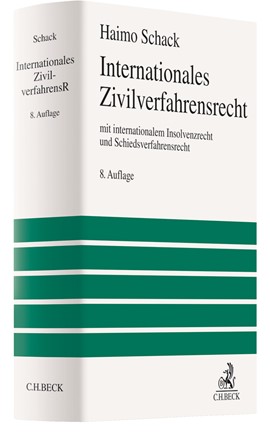 ually admirable for its clarity and comprehensiveness is Haimo Schack’s 8th edition of his textbook on „Internationales Zivilverfahrensrecht“, including international insolvency and international arbitration, 646 pp., now elevated from the „short textbook series“ to the „large textbook series“ at C.H.Beck. The first part addresses foundations of the subject (pp. 1 – 68), the second part describes the limits of adjudicatory authority under public international law (pp. 69 – 90), the third part analyses all international aspects of the main proceedings (pp. 91 – 334), the fourth part recognition and enforcement (pp. 335 – 427), the fifth and sixth part deal with insolvency (pp. 428 – 472) and arbitration (pp. 473 – 544). Again, an extensive table of cases and a subject index are offered as valuable help to the user. Schack is known for rather sceptical positions when it comes to the narrative of mutual trust. In his sharp analysis of the foundations of international procedural law, he very aptly states that the principle of equality („Gleichheit“) is of fundamental relevance, including the assumption of a principal equivalence of the adminstrations of justice by foreign states, which allows trust in and integration of foreign judicial acts and foreign laws into one’s own administration of justice: „Auf die Anwendung eigenen Rechts und die Durchführung eines Verfahrens im Inland kann man verzichten, weil und soweit man darauf vertraut, dass das ausländische Recht bzw. Verfahren dem inländischen äquivalent ist“ (We may waive the application of our own law and domestic proceedings because and as far as we trust in the foreign law and the foreign proceedings are equivalent to one’s own, para. 39, at p. 12) – a fundamental insight based, inter alia, on conceptual thinking by Alois Mittermaier in the earlier parts of the 19th century (AcP 14 [1831], pp. 84 et seq., at pp. 95, justifying recognition of foreign judgments by the assumption that the foreign judge should, in principle, be considered „as honest and learned as one’s own“), but of course also on Friedrich Carl v. Sagigny, which I allowed myself to further substantiate and transcend elsewhere to the finding: to trust or not to trust – that is the question of private international law (M. Weller, RdC, forthcoming). In Schack’s view, „the ambitious and radical projects“ of the EU in this respect „fail to meet with reality“ (para. 126, at p. 50). Equally sceptical are his views on the HCCH 2019 Judgments Convention („Blütenträume“, para. 141, at p. 57, in translation something like „daydreams“).
Perhaps, the truth lies somewhere in the middle, namely in a solid „trust management“, as I tried to unfold elsewhere.