


Views
New civil procedure rules in Singapore
New civil procedure rules in Singapore
New civil procedure rules (Rules of Court 2021) for the General Division of the High Court (excluding the Singapore International Commercial Court (‘SICC’)) have been gazetted and will be implemented on 1 April 2022. The reform is intended to modernise the litigation process and improve efficiency.[1] New rules for the SICC have also been gazetted and will similarly come into operation on 1 April 2022.
This update focuses on the rules which apply to the General Division of the High Court (excluding the SICC). New rules which are of particular interest from a conflict of laws point of view include changes to the rules on service out. The new Order 8 rule 1 provides that:
‘(1) An originating process or other court document may be served out of Singapore with the Court’s approval if it can be shown that the Court has the jurisdiction or is the appropriate court to hear the action.
…
(3) The Court’s approval is not required if service out of Singapore is allowed under a contract between the parties.
…’
The current rules on service out is to be found in Order 11 of the Rules of Court. This requires that the plaintiff (‘claimant’ under the new Rules) establish that (1) there is a good arguable case that the action fits within one of the heads of Order 11; (2) there is a serious issue to be tried on the merits; and (3) Singapore is forum conveniens.[2] The heads of Order 11 generally require a nexus to be shown between the parties or subject-matter of the action to Singapore and are based on the predecessor to the UK Civil Procedure Rules Practice Direction 6B paragraph 3.1. The wording of the new Order 8 rule 1(1) suggests a drastic departure from the current Order 11 framework; however, this is not the case.
There will be two alternative grounds of service out: either the Singapore court ‘has the jurisdiction’ to hear the action or ‘is the appropriate court’ to hear the action. The first ground of service out presumably covers situations such as where the Singapore court is the chosen court in accordance with the Choice of Court Agreements Act 2016,[3] which enacts the Hague Convention on Choice of Court Agreements into Singapore law. The second ground of service out i.e. that the Singapore court is the ‘appropriate court’ to hear the action could, on one view, be read to refer only to the requirement under the current framework that Singapore is forum conveniens. However, the Supreme Court Practice Directions 2021, which are to be read with the new Rules of Court, make it clear that the claimant still has to show:[4]
‘(a) there is a good arguable case that there is sufficient nexus to Singapore;
(b) Singapore is the forum conveniens; and
(c) there is a serious question to be tried on the merits of the claim.’
The Practice Directions go on to give as examples of a sufficient nexus to Singapore factors which are substantively identical to the current Order 11 heads.[5] As these are non-exhaustive examples, the difference between the current rules and this new ground of service out is that the claimant may still succeed in obtaining leave to serve out even though the action does not fit within one of the heads of the current Order 11. This is helpful insofar as the scope of some of the heads are uncertain; for example, it is unclear whether an action for a declaration that a contract does not exist falls within the current contractual head of service out[6] as there is no equivalent to the UK CPR PD 6B paragraph 3.1(8).[7] Yet at the same time, the Court of Appeal had previously taken a wide interpretation of Order 11 rule 1(n), which reads: ‘the claim is made under the Corruption, Drug Trafficking and Other Serious Crimes (Confiscation of Benefits) Act (Cap. 65A), the Terrorism (Suppression of Financing Act (Cap. 325) or any other written law’.[8] The phrase ‘any written law’ was held not to be read ejusdem generis[9] and would include the court’s powers, conferred by s 18 of the Supreme Court of Judicature Act read together with paragraph 14 of the First Schedule, to ‘grant all reliefs and remedies at law and in equity, including damages in addition to, or in substitution for, an injunction or specific performance.’[10] This interpretation of Order 11 rule 1(n) arguably achieves much the same effect as the new ‘appropriate court’ ground of service out.
The new Order 8 rule 1(3) is to be welcomed. However, it is important to note that a choice of court agreement for the Singapore court which is unaccompanied by an agreement to permit service out of Singapore will still require an application for leave to serve out under the ‘has jurisdiction’ ground (if the Choice of Court Agreements Act is applicable) or the ‘appropriate court’ ground (if the Choice of Court Agreements Act is not applicable).
Other provisions in the new Rules of Court 2021 which are of interest deal with a challenge to the jurisdiction of the court. A defendant may challenge the jurisdiction of the court on the grounds that the court has no jurisdiction to hear the action or the court should not exercise jurisdiction to hear the action. A challenge on either ground ‘is not treated as a submission to jurisdiction’.[11] This seemingly contradicts the established common law understanding that a jurisdictional challenge which attacks the existence of the court’s jurisdiction (a setting aside application) does not amount to a submission to the court’s jurisdiction, whereas a jurisdictional challenge which requests the court not to exercise the jurisdiction which it has (a stay application) amounts to a submission to the court’s jurisdiction.[12] Further to that, the provisions which deal with challenges to the exercise of the court’s jurisdiction are worded slightly differently depending on whether the action is commenced by way of an originating claim or an originating application. For the former, Order 6 rule 7(5) provides that ‘The challenge to jurisdiction may be for the reason that – … (b) the Court should not exercise jurisdiction to hear the action.’ For the latter, Order 6 rule 12(4) elaborates that ‘The challenge to jurisdiction may be for the reason that – … (b) the Court should not exercise jurisdiction because it is not the appropriate Court to hear the action.’ The difference in wording is puzzling because one assumes that the same types of challenges are possible regardless of whether the action is commenced by way of an originating claim or originating application – eg, challenges based on forum non conveniens, abuse of process or case management reasons. Given use of the word ‘may’ in both provisions though, it ought to be the case that the different wording does not lead to any substantive difference on the types of challenges which are permissible.
[2] Zoom Communications v Broadcast Solutions Pte Ltd [2014] 4 SLR 500 (CA).
[3] Cap 39A.
[4] Supreme Court Practice Directions 2021 (To be read with Rules of Court 2021), p 72.
[5] Ibid, pp 72-73.
[6] Rules of Court, Order 11 rule 1(d).
[7] ‘A claim is made for a declaration that no contract exists …’.
[8] Li Shengwu v Attorney-General [2019] 1 SLR 1081 (CA).
[9] Ibid, [168]-[170].
[10] Ibid, [161].
[11] Rules of Court 2021, Order 6 rule 7(6) (originating claim); Order 6 rule 12(5) (originating application.
[12] Zoom Communications v Broadcast Solutions Pte Ltd [2014] 4 SLR 500 (CA).
CJEU Rules on the interplay between Brussels IIA and Dublin III
This post was contributed by Dr. Vito Bumbaca, who is Assistant Lecturer at the University of Geneva
In a ruling of 2 August 2021 (A v. B, C-262/21 PPU), the Court of Justice of the European Union (CJEU) clarified that a child who is allegedly wrongfully removed, meaning without consent of the other parent, should not return to his/ her habitual residence if such a removal took place as a consequence of the ordered transfer determining international responsibility based on the Dublin III Regulation. The judgment is not available in English and is the first ever emanating from this Court concerning the Brussels IIA-Dublin III interplay.
The Council Regulation (EC) No 2201/2003 of 27 November 2003 concerning jurisdiction and the recognition and enforcement of judgments in matrimonial matters and the matters of parental responsibility, repealing Regulation (EC) No 1347/2000 (Brussels IIA Regulation) complements the Hague Convention of 25 October 1980 on the Civil Aspects of International Child Abduction, and is applicable to 26 EU Member States, including Finland and Sweden. The Regulation (EU) No 604/2013 of 26 June 2013 establishing the criteria and mechanisms for determining the Member State responsible for examining an application for international protection lodged in one of the Member States by a third-country national or a stateless person (recast) (Dublin III), is pertinent for asylum seekers’ applications commenced at least in one of the 31 Dublin Member States (EU/EFTA), comprising Finland and Sweden, bound by this Regulation.
Questions for a CJEU urgent preliminary ruling:
The CJEU was referred five questions, but only addressed the first two.
‘(1) Must Article 2(11) of [Regulation No 2201/2003], relating to the wrongful removal of a child, be interpreted as meaning that a situation in which one of the parents, without the other parent’s consent, removes the child from his or her place of residence to another Member State, which is the Member State responsible under a transfer decision taken by an authority in application of Regulation [No 604/2013], must be classified as wrongful removal?
(2) If the answer to the first question is in the negative, must Article 2(11) [of Regulation No 2201/2003], relating to wrongful retention, be interpreted as meaning that a situation in which a court of the child’s State of residence has annulled the decision taken by an authority to transfer examination of the file, and to take no further action since the mother and child have left the State of residence, but in which the child whose return is ordered, no longer has a currently valid residence document in his or her State of residence, or the right to enter or to remain in the State in question, must be classified as wrongful retention?’
Contents of the CJEU judgment:
In 2019, a married couple, third-State nationals (Iran), both with regard to Brussels IIA and Dublin III respective Member States, moved from Finland to settle in Sweden. Since 2016, the couple had lived in Finland for around three years. In 2019, a child was born in Sweden. The couple was exercising joint custody over the child in conformity with Swedish law. The mother was holding a family residency permit, in both Finland and Sweden, through the father’s employment rights. The approved duration of the mother’s residency right in Finland was around one year longer than in Sweden.
Two months after the child’s birth, the latter and the mother were placed under Swedish residential care (hostel). Essentially, the Swedish administrative decision to uphold this care protective measure was the result of the father’s violence against the mother, so to protect the child from the risks against his development and health, as well as to prevent his wrongful removal to Iran possibly envisaged by his father. Limited contact rights were granted to the father. A residency permit was requested, individually, by the father and the mother based on the family lien – request respectively filed on 21 November and 4 December 2019.
In August 2020, the mother submitted an asylum request, for the child and herself, before the Swedish authorities. The same month, the Finnish authorities declared themselves internationally responsible over the mother’s and child’s asylum request by virtue of article 12(3) of Dublin III – based on the longer duration of the residency permit previously delivered according to Finnish law. In October 2020, the Swedish authorities dismissed the father’s and rejected the mother’s respective residency and asylum requests, and ordered the transfer of the child and his mother to Finland. Taking into account the father’s presence as a threat against the child, the limited contacts established between them, and the father’s residency right in Finland, the Swedish authorities concluded that the child’s separation from his father was not against his best interests and that the transfer was not an obstacle to the exercise of the father’s visitation right in Finland. In November 2020, the mother and the child moved to Finland pursuant to article 29(1) of Dublin III. In December 2020, the father filed an appeal against the Swedish court’s decisions, which was upheld by the Swedish Immigration Tribunal (‘Migrationsdomstolen i Stockholm’), although it resulted later to be dismissed by the Swedish Immigration Authorities, and then rejected by the Immigration Tribunal, due to the child’s relocation to Finland (CJEU ruling, § 23-24).
In January 2021, the father filed a new request before the Swedish authorities for family residency permit on behalf of the child, which was still ongoing at the time of this judgment (CJEU ruling, § 25). During the same month, the mother deposited an asylum application before the Finnish authorities, which was still ongoing at the time of this judgment – the mother’s and child’s residency permits were withdrawn by the Finnish authorities (CJEU ruling, § 26). In April 2021, the Swedish Court (‘Västmanlands tingsrätt’), notwithstanding the mother’s objection to their jurisdiction, granted divorce, sole custody to the mother and refused visitation right to the father – upheld in appeal (‘Svea hovrätt’). Prior to it, the father filed an application for child return before the Helsinki Court of Appeal (‘Helsingin hovioikeus’), arguing that the mother had wrongfully removed the child to Finland, on the grounds of the 1980 Hague Convention. The return application was rejected. On the father’s appeal, the Finnish authorities stayed proceedings and requested an urgent preliminary ruling from the CJEU, in line with article 107 of the Luxembourg Court’s rules of procedure.
CJEU reasoning:
The Court reiterated that a removal or retention shall be wrongful when a child holds his habitual residence in the requesting State and that a custody right is attributed to, and effectively exercised by, the left-behind parent consistently with the law of that State (§ 45). The primary objectives of the Brussels IIA Regulation, particularly within its common judicial space aimed to ensure mutual recognition of judgments, and the 1980 Hague Convention are strictly related for abduction prevention and immediate obtainment of effective child return orders (§ 46).
The Court stated that, pursuant to articles 2 § 11 and 11 of the Brussels IIA Regulation, the child removal to a Member State other than the child’s habitual residence, essentially performed by virtue of the mother’s right of custody and effective care while executing a transfer decision based on article 29 § 1 of the Dublin III Regulation, should not be contemplated as wrongful (§ 48). In addition, the absence of ‘take charge’ request following the annulment of a transfer decision, namely for the purposes of article 29 § 3 of Dublin III, which was not implemented by the Swedish authorities, would lead the retention not to being regarded as unlawful (§ 50). Consequently, as maintained by the Court, the child’s relocation was just a consequence of his administrative situation in Sweden (§ 51). A conclusion opposing the Court reasoning would be to the detriment of the Dublin III Regulation objectives.
Some insights from national precedents:
In the case ATF 5A_121/2018, involving a similar scenario (cf. FamPra.ch 1/2019), the Swiss Federal Court maintained that a child born in Greece, who had lived for more than a year with his mother in Switzerland, had to be returned to Greece (place of the left-behind parent’s residence) based on the established child’s habitual residence prior to the wrongful removal to Switzerland, notwithstanding his pending asylum application in the latter State. Indeed, the Greek authorities had been internationally responsible over the child’s asylum request on the basis of his father’s residence document. However also in that case it was alleged that the father had been violent against the mother and that a judgment ordering the child’s return to Greece, alone or without his mother (§ 5.3), would not have caused harm to the child under the 1980 Hague Convention, art. 13.
In the case G v. G [2021] UKSC 9, involving a slightly different scenario in that no multiple asylum requests were submitted, the UKSC judged that a child, of eight years old born in South Africa, should not be returned – stay of proceedings – until an asylum decision, based on an asylum application filed in England, had been taken by the UK authorities. The UKSC considered that, although an asylum claim might be tactically submitted to frustrate child return to his/ her country of habitual residence prior to wrongful removal or retention, it is vital that an asylum claim over an applicant child, accompanied or not by his/ her primary carer, is brought forward while awaiting a final decision – in conformity with the ‘non-refoulement’ principle pursuant to article 33 of the 1951 Geneva Convention relating to the Status of Refugees.
Comment:
The CJEU ruling is momentous dictum in that it holds the not any longer uncommon intersection of private international law and vulnerable migration, especially with regard to children in need of international protection in accordance with both Brussels IIA and Dublin III Regulations (cf. Brussels IIA, § 9, and Dublin III, article 2 lit. b). The Luxembourg Court clarifies that a child who is allegedly wrongfully removed, meaning without consent of the other parent, should not return to his/ her habitual residence if such a removal took place as a consequence of the ordered transfer determining international responsibility based on the Dublin III Regulation. It is emphasised that, contrary to the Swiss judgment, the child in the instant case did not have any personal attachments with Finland at the time of the relocation – neither by birth nor by entourage – country of destination for the purposes of the Dublin III transfer. Moreover, the ‘transfer of responsibility’ for the purposes of Dublin III should be contemplated as an administrative decision only, regardless of the child’s habitual residence.
It is observed as a preamble that, according to a well-known CJEU practice, a child should not be regarded as to establish a habitual residence in a Member State in which he or she has never been physically present (CJEU, OL v. PQ, 8 June 2017, C-111/17 PPU; CJEU, UD v. XB, 17 October 2018, C-393/18 PPU). Hence, it appears procedurally just that the Swedish courts retained international jurisdiction over custody, perhaps with the aim of Brussels IIA, article 8 – the child’s habitual residence at the time of the seisin, which occurred prior to the transfer to Finland. On that procedural departure, the Swedish courts custody judgment is substantially fair in that the father’s abuse against the mother is indeed an element that should be retained for parental responsibility, including abduction, merits (CJEU ruling, § 48; UKSC judgment, § 62).
However, it is argued here that, particularly given that at the relevant time Sweden was the child’s place of birth where he lived for around 14 months with his primary carer, the Swedish and the Finnish authorities might have ‘concentrated’ jurisdiction and responsibility in one Member State, namely Sweden, ultimately to avoid further length and costs related to the asylum procedures in line with the same Dublin III objectives evoked by the CJEU – namely “guarantee effective access to the procedures for granting international protection and not to compromise the objective of the rapid processing of applications for international protection” (§ 5, Dublin III). Conversely, provided that the child’s relocation was not wrongful as indicated by the Finnish authorities, and confirmed by the CJEU ruling, the Swedish authorities may have opted for the ‘transfer of jurisdiction’ towards the Finnish authorities on the basis of Brussels IIA, article 15(1) lit. b, indicating the child’s new habitual residence (cf. Advocate General’s opinion, § 41) following the lawful relocation (cf. article 15.3., lit. a).
Importantly, concentration of jurisdiction-responsibility over a child seeking international protection in one Member State, in light of the Brussels IIA-Dublin III interplay, would essentially determine a coordinated interpretation of the child’s best interests (cf. Brussels II, § 12, and Dublin III, § 13), avoiding two parallel administrative-judicial proceedings in two Member States whose authorities may not always come to similar views, as opposed to the present case, over such interests (AG’s opinion, § 48). This is particularly true, if the child (non-)return to his/ her habitual residence might likely be influenced, as stated in the CJEU ruling, by his/ her administrative situation, which would potentially have an impact on the international custody jurisdiction determination. An example of controversial outcome, dealing with child abduction-asylum proceedings, is the profoundly divergent opinion arising from the UK and Swiss respective rulings, to the extent of child return in a situation where the mother, primary carer, is or could be subject to domestic violence in the requesting State.
Similarly, the UKSC guidance, in ‘G v. G’, affirmed: “Due to the time taken by the in-country appeal process this bar is likely to have a devastating impact on 1980 Hague Convention proceedings. I would suggest that this impact should urgently be addressed by consideration being given as to a legislative solution […] However, whilst the court does not determine the request for international protection it does determine the 1980 Hague Convention proceedings so that where issues overlap the court can come to factual conclusions on the overlapping issues so long as the prohibition on determining the claim for international protection is not infringed […] First, as soon as it is appreciated that there are related 1980 Hague Convention proceedings and asylum proceedings it will generally be desirable that the Secretary of State be requested to intervene in the 1980 Hague Convention proceedings” (UKSC judgment, § 152-157). Clearly, the legislative solution on a more efficient coordination of child abduction-asylum proceedings, invoked by the UK courts, may also be raised with the EU [and Swiss] legislator, considering their effects on related custody orders.
– Cross posted at the EAPIL blog.
The Tango Between Brussels Ibis Regulation and Rome I Regulation under the Beat of Package Travel Directive
Written by Zhen Chen, doctoral candidate at the University of Groningen, the Netherlands
The article titled ‘The Tango Between Art.17(3) Brussels Ibis and Art.6(4)(b) Rome I under the Beat of Package Travel Directive’ is published on Maastricht Journal of European and Comparative Law with open access, available at https://doi.org/10.1177%2F1023263X211048595
In the field of European private international law, Brussels Ibis Regulation and Rome I Regulation are dancing partners that work closely with different roles. When it comes to consumer protection, Brussels Ibis Regulation is the leader and Rome I Regulation is the follower, since special protective rules over consumer contracts were first introduced in Articles 13–15 Brussels Convention[1] and then followed by Article 5 Rome Convention.[2]
- Package travel in Article 17(3) Brussels Ibis and Article 6(4)(b) Rome I
Package travel tourists are explicitly protected as consumers under Article 6(4)(b) Rome I, but not under Article 17(3) Brussels Ibis since it does not expressly mention the term ‘package travel’. Instead, the term used in Article 17(3) Brussels Ibis is the same as that in Article 5(5) Rome Convention, which has been abandoned by its successor Article 6(4)(b) Rome I. Such discrepancy is widened with the replacement of Directive 90/314 by Directive 2015/2302 with the enlarged notion of package travel. This means that when Article 6(4)(b) Rome I Regulation is dancing under the beat of Directive 2015/2302, Article 17(3) Brussels Ibis Regulation is still dancing under the beat of Article 5(5) 1980 Rome Convention.
- A uniform concept of package travel under Directive 2015/2302
The CJEU clarified in the Pammer judgment that the concept ‘a contract which, for an inclusive price, provides for a combination of travel and accommodation’ in Article 15(3) Brussels I should be interpreted in line with Article 6(4)(b) Rome I by reference to Directive 90/314.[3] The CJEU did not follow the opinion of the Advocate General, according to which the concept prescribed in Article 15(3) Brussels I has to be interpreted in exactly the same way as the term ‘package’ enshrined in Article 2(1) Directive 90/314.[4] The court stated that the concept in Article 15(3) Brussels I is ‘close to’[5] the notion package in Directive 90/314. The wording ‘close to’, instead of ‘identical’ or ‘the same as’, indicates that the CJEU did not intend to interpret such two terms as having exactly the same meaning.
Since Article 15(3) Brussels I remains unchanged in its successor Article 17(3) Brussels Ibis, this article argues that Art.17(3) Brussels Ibis Regulation has been two steps behind Art.6(4)(b) Rome I when it comes to the protection of consumers in package travel contracts. In order to close the gap, a uniform concept of package travel should be given. It is suggested that Art.17(3) Brussels Ibis should adopt the concept of package travel provided in Directive 2015/2302.
- Deleting package travel contracts from the exception of transport contracts
Despite the adoption of a uniform concept, Article 17(3) Brussels Ibis and Article 6 Rome I only cover packages containing transport, as an exception of transport contracts. Packages not including transport do not fall under the exception of transport contracts. Since all package travel contracts should be protected as consumer contracts, regardless of containing transport or not, it is more logical to delete package travel contracts from the exception of transport contracts in Art.6(4)(b) Rome I as well as Art.17(3) Brussels Ibis and establish a separate provision to regulate package travel contracts.
To this end, Article 17(3) Brussels Ibis and Article 6(4)(b) Rome I can be simplified as ‘This Section/article shall not apply to a contract of transport/carriage’, whereas package travel contracts are expressly regulated as consumer contracts in a separate provision. In this regard, the framework in Article 5 Rome Convention is a better solution, according to which package travel contracts can be expressly included in Article 17 Brussels Ibis/Article 6 Rome I as follows:
Notwithstanding Article 17(3) Brussels Ibis/Article 6(4)(b) Rome I, this Section/article shall apply to a contract relating to package travel within the meaning of Council Directive 2015/2302/EU of 25 November 2015 on package travel and linked travel arrangements.
[1] The predecessor of Articles 17-19 Brussels Ibis Regulation.
[2] The predecessor of Article 6 Rome I Regulation.
[3] Joined cases C-585/08 and C-144/09 Pammer and Hotel Alpenhof, ECLI:EU:C:2010:740, para. 43
[4] Joined cases C-585/08 and C-144/09 Pammer and Hotel Alpenhof, ECLI:EU:C:2010:273, opinion of advocate general, para. 49.
[5] Case C-585/08 Pammer, ECLI:EU:C:2010:740, para. 36.
News
Virtual Workshop (in English) on February 4: Pietro Franzina on “EU Private International Law at a Time of ‘Broken Multilateralism’ and Growing Geo-Political Tensions”

On Tuesday, February 4, 2025, the Hamburg Max Planck Institute will host its monthly virtual workshop Current Research in Private International Law at 11:00 a.m. – 12:30 p.m. (CET). Professor Pietro Franzina (Catholic University of the Sacred Heart) will speak, in English, about the topic
“EU Private International Law at a Time of ‘Broken Multilateralism’ and Growing Geo-Political Tensions”
Multilateralism is in crisis. The role of world organisations in international politics and law-making is increasingly being questioned, as some key actors in the global arena no longer consider cooperation and collective action the best way to address common concerns. While multilateralism is not obsolete, let alone ‘dead’, as some claim, there is a growing consensus that current governance schemes need profound reconsideration. The EU, multilateralism’s staunchest defender, is especially exposed to these developments. While the evolution of multilateralism is set to affect all areas of international cooperation, each field has, arguably, its specificities. What features does cooperation in the field of private international law display in this regard? How can the crisis of multilateralism influence the way in which the EU deals with judicial cooperation, be it through its legislation, in the relations with its neighbours and at the global level? What structural changes are under way in global fora, such as the HCCH, and what is their impact on the EU’s own agenda and methods of work?
The presentation will be followed by open discussion. All are welcome. More information and sign-up here.
If you want to be invited to these events in the future, please write to veranstaltungen@mpipriv.de.
Out now: Buxbaum, “Extraterritoriality in Comparative Perspective” (Ius Comparatum)

In an increasingly interconnected world, the application of laws by States beyond their territorial borders is an everyday reality. Yet, almost a century after the (still) leading findings by the PCIJ in the Case of the S.S. “Lotus”, the details of the concept of “extraterritoriality” remain elusive, and one can easily get lost in the multitude of national practices, ranging from “presumptions against extraterritoriality” to be found mostly in federal systems (mostly for sub-units) to “effects doctrines” and the like in certain areas of law such as e.g. (early) in Germany, (later) in the EU’s competition law and today many other jurisdictions, in particular in Asia.
Given this complexity, this latest publication of the Ius Comparatum Series on “Extraterritoriality in Comparative Perspective” edited by Hannah L. Buxbaum offers a great deal of valuable guidance and insights. Featuring the reports from the most recent IACL/AIDC General Congress in Asunción, the volume provides the reader with unique insights by renowned legal scholars into the practices of 14 national jurisdictions (inter alia China, Germany, Japan, Korea, UK, U.S.) and the the European Union (EU). As is explained in the preface to the book:
Much of the vast scholarly literature on extraterritoriality approaches the topic from the outside in, assessing the extraterritorial projection of state law from the perspective of international law and the constraints it places on state authority. The goal of this project is to approach the topic from the inside out. Considering a range of legal systems, the authors investigate the geographic scope that states claim for their own laws, and the mechanisms by which states translate and locally implement principles of international jurisdictional law.

The Latin American and Caribbean Journal of International Law (LACJIL) has been launched
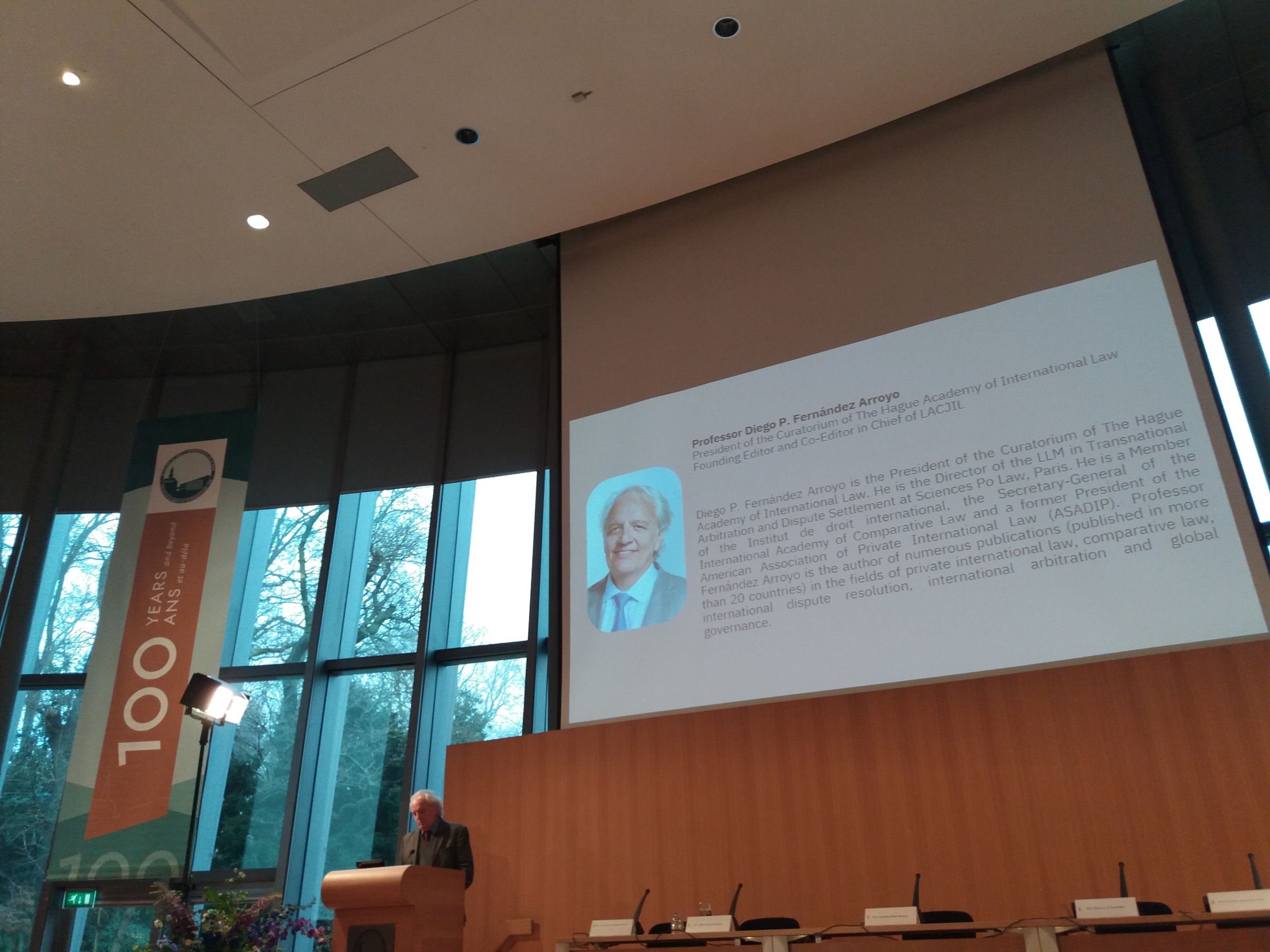
Today the Latin American and Caribbean Journal of International Law (LACJIL) was launched at the auditorium of the Hague Academy of the Peace Palace. Among the speakers were Prof. Diego Fernández Arroyo, president of the curatorium of the Hague Academy, and H.E. Leonardo Nemer Caldeira Brant, judge of the International Court of Justice. In addition, a very interesting panel was moderated by the Ambassador of Guatemala to the Kingdom of the Netherlands H.E. Ana Cristina Rodríguez Pineda. The panel was composed of the judge of the International Criminal Court H.E Althea Alexis-Windsor, the Ambassador of Colombia to the Kingdom of the Netherlands H.E. Carolina Olarte Bácares, the Ambassador of Argentina to the Kingdom of the Netherlands H.E. Mario J. A. Oyarzábal and the president of ASADIP Prof. Verónica Ruiz Abou-Nigm. The purpose of the panel was to discuss the recent legal developments in Latin America and the Caribbean, which included the ASADIP principles on transnational access to Justice (TRANSJUS). Read more