


Views
EFFORTS Questionnaire on Digitalization of Civil Procedures Relating to Cross-Border Enforcement
In the framework of the EFFORTS Project, a questionnaire has been drawn up on the digitalization of civil procedures relating to cross-border enforcement.
The questionnaire aims at collecting quantitative and qualitative data on the digitalization of enforcement procedures at the national and European level, with a view to identifying technical solutions and legislative amendments to implement such digitalization.
The questionnaire, together with information on the EFFORTS Project, may be accessed here
The EFFORTS project partners thank you in advance for your time and contribution!

Project JUST-JCOO-AG-2019-881802
With financial support from the Civil Justice Programme of the European Union
Ranking the Portability of ASEAN Judgments within ASEAN
Written by Catherine Shen, ABLI
The Asian Business Law Institute (ABLI) has recently released a free publication titled Enforcement of Foreign Judgments in ASEAN: Ranking the Portability of ASEAN Judgments within ASEAN, a derivative publication under its Foreign Judgments Project.
The Association of Southeast Asian Nations (ASEAN) comprises of Brunei Darussalam, Cambodia, Indonesia, Lao, Malaysia, Myanmar, Philippines, Singapore, Thailand and Vietnam. These jurisdictions are of different legal traditions of civil law (Cambodia, Indonesia, Lao, Thailand and Vietnam), common law (Brunei Darussalam, Malaysia, Myanmar and Singapore) and hybrid law (Philippines) tradition. There are two primary hurdles for increasing the portability of ASEAN judgments within the bloc. First, some ASEAN jurisdictions, such as Indonesia and Thailand, have no law that allows foreign judgments to be recognised and enforced. Second, most civil law jurisdictions in ASEAN still have rather rigid requirements on reciprocity. These two hurdles are the main influencers of the ranking.
Three key takeaways can be gleaned from the ranking.
First, Vietnamese judgments claim the crown of being the most portable of ASEAN judgments within ASEAN. They can be enforced in seven out of the other nine ASEAN countries, provided, of course, that the requirements for enforcement under the laws of those countries are satisfied. This is a portability rate of close to 78%. Compared to other ASEAN jurisdictions, Vietnam has the benefit of having bilateral agreements with Cambodia and Lao which allow its judgments to be enforced in the latter two jurisdictions. Cambodia requires a guarantee of reciprocity while Lao PDR requires a bilateral treaty with the relevant country covering the enforcement of each other’s judgments before reciprocity is satisfied.
Second, judgments rendered by the other civil law countries of ASEAN come in second place. They can be enforced in six out of nine ASEAN countries.
Third, judgments from the common law countries of ASEAN and the hybrid law jurisdiction of the Philippines are jointly in third place. They can be enforced in five out of nine ASEAN countries, namely in the other common law and hybrid law jurisdictions, as well as Vietnam. Although Vietnam, being a civil law jurisdiction, imposes a condition of reciprocity, it appears relatively easy to satisfy this requirement.
This result may be surprising or even perverse since most civil law jurisdictions, i.e., Cambodia, Indonesia, Lao and Thailand, have comparatively illiberal regimes for the enforcement of foreign judgments (whether due to the rigid requirement of reciprocity or the lack of relevant laws), while the common law and hybrid law jurisdictions in ASEAN have comparatively liberal rules for foreign judgments enforcement. This “asymmetry” is mainly due to the inability of those civil law jurisdictions to return the favour of the more liberal rules of the common law and hybrid law jurisdictions in ASEAN given the state of their laws, namely, the requirement that there be reciprocity between the two countries.
The Enforcement of Foreign Judgments in ASEAN: Ranking the Portability of ASEAN Judgments within ASEAN is available for free and can be downloaded here. ABLI regularly publishes latest developments in the field of recognition and enforcement of foreign judgments in Asia on its website and LinkedIn.
A few thoughts on Golan v. Saada – this week at the US Supreme Court
Written by Mayela Celis, UNED
The oral arguments of the case Golan v. Saada (20-1034) will take place tomorrow (Tuesday 22 March 2022) at 10 am Washington DC time before the US Supreme Court. For the argument transcripts and audio, click here. The live audio will be available here.
We have previously reported on this case here and here.
“QUESTION PRESENTED
The Hague Convention on the Civil Aspects of International Child Abduction requires return of a child to his or her country of habitual residence unless, inter alia, there is a grave risk that his or her return would expose the child to physical or psychological harm. The question presented is:
Whether, upon finding that return to the country of habitual residence places a child at grave risk, a district court is required to consider ameliorative measures that would facilitate the return of the child notwithstanding the grave risk finding.” (our emphasis)
Please note that US courts often use the terms “ameliorative measures” and “undertakings” interchangeably (as stated in the petition). Also referred to as protective measures in other regions.
This case stems from the fact that there is a split in the US circuits (as well as state courts).
There were several amicus curiae briefs filed, three of which are worthy of note: the amicus brief of the United States, the amicus brief of Hague Conventions delegates Jamison Selby Borek & James Hergen and finally, the amicus brief filed by Linda J. Silberman, Robert G. Spector and Louise Ellen Teitz.
The amicus brief of the United States stated:
“Neither the Hague Convention on the Civil Aspects of International Child Abduction nor its implementing legislation requires a court to consider possible ameliorative measures upon finding under Article 13(b) that there is a grave risk that returning a child to his country of habitual residence would expose the child to physical or psychological harm or otherwise place the child in an intolerable situation. Rather, the Convention and ICARA leave consideration of possible ameliorative measures to a court’s discretion.”
The amicus brief of the Hague Delegates coincide with this statement of the United States, while the brief of professors Silberman, Spector and Teitz holds the opposite view.
As is well known, the US Executive Branch’s interpretation of a treaty is entitled to great weight. See Abbott vs. Abbott 560 U. S. _ (2010); Sumitomo Shoji America, Inc. v. Avagliano, 457 U. S. 176.
In my personal opinion, the position taken by the United States is the correct one.
The fact is that the Hague Abduction Convention is silent on the adoption of ameliorative measures. Article 13 indicates: “the judicial or administrative authority of the requested State is not bound to order the return of the child if the person, institution or other body which opposes its return establishes that […]” (our emphasis). The discretion of the court is thus key. Besides, and as we all aware, the Child Abduction Convention is not a treaty on recognition and enforcement of protective measures.
In some legal systems, this void has been supplemented with additional legislative measures such as the Brussels II ter Regulation (2019/1111) in the European Union. Importantly, this instrument provides for the seamless enforcement of provisional – including protective – measures, which makes it a much more cogent system (see, for example, recitals 30, 45 and 46, and articles 2(1)(b), 15 – on jurisdiction-, 27(5), 35(2) and 36(1)). And not to mention the abolition of the declaration of enforceability or the registration for enforcement, which speeds up the process even more.
Furthermore, and particularly in the context of the United States, the onus that ameliorative measures exist or could be made available should be placed mainly on the parties requesting the return, and not on the court. See the amicus brief filed by former US judges where they stressed that “mandating judicial analysis of ameliorative measures forces US courts beyond their traditional jurisdiction and interactions with foreign law / civil law judges perform investigatory functions; common law judges do not.”
Arguably, the 13(1)(b) Guide to Good Practice may be read as supporting both views. See in particular:
See paragraph 36: “The examination of the grave risk exception should then also include, if considered necessary and appropriate, consideration of the availability of adequate and effective measures of protection in the State of habitual residence.” (our emphasis).}
See paragraph 44: “Protective measures may be available and readily accessible in the State of habitual residence of the child or, in some cases, may need to be put in place in advance of the return of the child. In the latter case, specific protective measures should only be put in place where necessary strictly and directly to address the grave risk. They are not to be imposed as a matter of course and should be of a time-limited nature that ends when the State of habitual residence of the child is able to determine what, if any, protective measures are appropriate for the child. In certain circumstances, while available and accessible in the State of habitual residence, measures of protection may not be sufficient to address effectively the grave risk. An example may be where the left-behind parent has repeatedly violated protection orders.” (our emphasis)
But see in contrast paragraph 41 of the Guide, which was mentioned in the amicus brief of Child Abduction Lawyers Association (CALA).
Putting this legal argument aside, and in the context of the United States, there are several reasons why US courts should not be required to consider ameliorative measures (but may do so on a discretionary basis):
- The United States is not a Contracting Party to any global treaty that would allow the recognition and enforcement of protective measures (such as the 1996 Hague Protection of Children Convention – USA is only a signatory State);
- A great number of child abductions occur to and from the United States and Mexico. The Mexican legal system is not familiar with the recognition and enforcement of undertakings or with adopting mirror orders in the context of child abduction (or in any other context for that matter);
- Requiring courts to look into ameliorative measures in every single case would unduly delay abduction proceedings;
- Social studies have revealed that undertakings are very often breached once the child has been returned (usually with the primary carer, the mother), which has the direct result of leaving children and women in complete vulnerability. See Lindhorst, Taryn, and Jeffrey L Edleson. Battered Women, Their Children, and International Law : The Unintended Consequences of the Hague Child Abduction Convention. Northeastern Series on Gender, Crime, and Law. Boston, MA: Northeastern University Press, 2012. See also amicus brief of domestic violence survivors.
In conclusion, I believe that we all agree that ameliorative measures (or undertakings) are important. But they must be adequate and effective and should not be adopted just for the sake of adopting them without any teeth, as this would not be in the best interests of the child (in concreto).
News
AMEDIP’s upcoming webinar: Private International Law in the Inter-American system: A glance in the light of the 50 anniversary of the CIDIP (27 February 2025 – in Spanish)
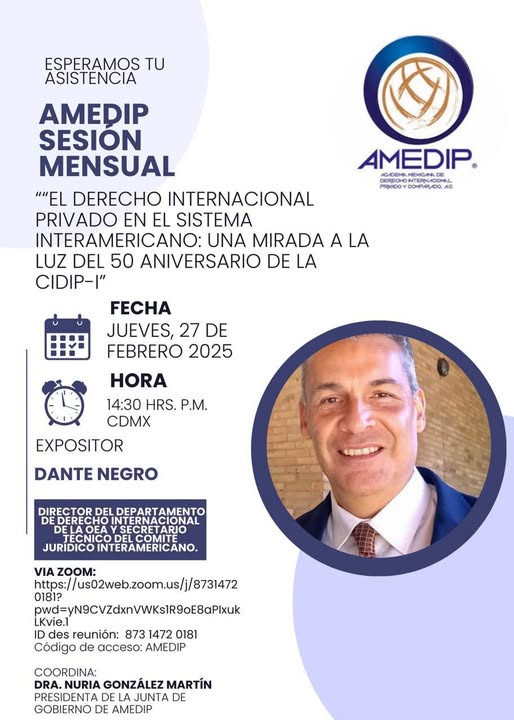
The Mexican Academy of Private International and Comparative Law (AMEDIP) is holding a webinar on Thursday 27 February 2025 at 14:30 (Mexico City time – CST), 21:30 (CET time). The topic of the webinar is ‘Private International Law in the Inter-American system: A glance in the light of the 50 anniversary of the CIDIP’ and will be presented by OAS Director Dante Negro (in Spanish).
CIDIP is the Spanish acronym for the Inter-American Specialized Conferences on Private International Law. For a history of the CIDIP, click here. Read more
Book Launch: Philosophical Foundations of Private International Law – Oxford, March 19, 4pm-6pm
In 2024, Oxford University Press published Philosophical Foundations of Private International Law, edited by Roxana Banu, Michael S Green, and Ralf Michaels. The book represents the first inter-disciplinary engagement with questions of private international law from a philosophical perspective, covers a wide range of philosophical questions in private international law and brings philosophers in conversation with private international law scholars to demystify the analytical tools of each discipline in relationship to the other. More information on the book, including a table of contents, is here.
Now, Oxford University is organizing a hybrid book launch on March 19, 4pm-6pm. An introduction from the Editors will be followed by a discussion on key themes by Gabriel Encinas, Verónica Ruiz Abu-Nigm, Robert Stevens, Antonios Tzanakopoulos, and Emmanuel Voyiakis. More information on the event and on how to sign up for physical or virtual participation is here.
Workshop on Cross-border Protection of Cultural Property-Agenda
Workshop on Cross-border Protection of Cultural Property Agenda
2025.2.28, UTC 8:00 – 12:15 (London Time)
| 8:00 – 8:05 | Opening Remarks | ||
| Zheng Tang | professor of Law, editor in chief, Chinese Journal of Transnational Law; Associate Dean, Wuhan University Academy of International Law and Global Governance | ||
| 8:05 – 8:45 | Keynote Address | ||
| Christa Roodt | Senior Lecturer of History of Art, University of Glasgow | ||
| Zhengxin Huo | Professor of Law, China University of Political Science and Law | ||
| Panel 1: Legal Mechanisms of Cross-Border Cultural Property Protection | |||
| 8:45 – 9:00 | Elena Moustaira | The contribution of Postcolonial Theory to the cross-border protection of Indigenous cultural heritage | |
| 9:00 – 9:15 | Yehya Badr | Restitution of stolen foreign cultural property and hurdles in choice of law | |
| 9:15 – 9:30 | Maggie Fleming Cacot | Forfeiture and freezing orders in transborder cultural property litigation | |
| 9:30 – 9:50 | Commentary and Discussion | ||
| Panel 2: Regional Practices and Challenges in Cultural Property Restitution | |||
| 9:50 – 10:05 | Andrzej’s Jakubowski | Moving People, Shifting State Borders and the Return of Cultural Property: The Case of Poland | |
| 10:05 – 10:20 | Miroslaw Michal Sadowski | From freedom to restitution (with special focus on Central and Eastern Europe and the Lusophone community) | |
| 10:20 – 10:35 | Ekin Omeroglu | The Issue of Applicable Law in Disputes Arising from Violations of Private Law Regulations on Cultural Properties: The Case of Turkiye | |
| 10:35 – 10:50 | Ruida Chen | Restitution of cultural property in China: In search of a new paradigm for cross-border cultural property claims | |
| 10:50 – 11:10 | Commentary and Discussion | ||
| Panel 3: Looking to the Past and the Future | |||
| 11:10 – 11:25 | Dabbie De Girolamo | The Relevance of ADR for transnational cultural property disputes: A Survey and Analysis of China’s experience | |
| 11:25 – 11:40 | Andreas Giorgallis | Restitution of cultural objects unethically acquired during the colonial era: The intersection of Public and Private International Law | |
| 11:40 – 11:55 | Evelien Campfens | Evolving Legal Models of Restitution | |
| 11:55 – 12:15 | Commentary and Discussion | ||
Join Zoom Meeting:
https://zoom.us/j/87424891864?pwd=8rHX72dmzi7FCDWWnm7F2n1OLIOFaC.1
Meeting ID: 874 2489 1864 Password: 574150