


Views
Court of Justice of the EU on the recognition of parentage
After the Coman judgment of 2018, the Grand Chamber of the Court of Justice of the European Union (CJEU) has again rendered a judgment in the field of free movement of citizens that is of importance for private international law. Like in Coman, the judgment in V.M.A. of 14 December 2021 concerned a non-traditional family of which the members sought to make use of their right to free movement in the EU under the Treaty on the Functioning of the European Union (TFEU) and Directive 2004/38. The Charter of Fundamental Rights of the EU (Charter) was also pertinent, particularly its Article 7 on respect for private and family life, Article 9 on the right to marry and the right to found a family, Article 24 on the rights of the child, and Article 45 on freedom of movement and of residence.
While Coman concerned the definition of “spouse” under Article 2 of the Directive, in V.M.A. the CJEU addressed the definition of “direct descendants” in the same provision.
Two women, V.M.A., a Bulgarian national, and K.D.K., a national of the United Kingdom, were married and lived in Spain. A daughter, S.D.K.A., was born in Spain. Her Spanish birth certificate indicated V.M.A. as “mother A” and K.D.K. as “mother”. V.M.A. applied to the Sofia municipality for a birth certificate for S.D.K.A. in order to obtain a Bulgarian identity document for her. She submitted a legalised and certified translation into Bulgarian of the extract from the civil register of Barcelona.
The Sofia municipality refused this application, due to the lack of information on S.D.K.A.’s biological mother and because the reference to two mothers was contrary to Bulgarian public policy.
The Administrative Court of the City of Sofia, to which V.M.A. appealed the municipality’s decision, posed four questions to the CJEU. It sought to know whether Articles 20 and 21 of the TFEU and Articles 7, 24 and 45 of the Charter oblige Bulgaria to recognise the Spanish birth certificate despite its mentioning two mothers and despite the fact that it was unclear who the biological mother of the child was. It also questioned EU Member States’ discretion regarding rules for the establishment of parentage. A further relevant point was Brexit and the fact that the child would not be able to get EU citizenship through the other mother, who is a UK citizen.
The Grand Chamber ruled as follows:
Article 4(2) TEU, Articles 20 and 21 TFEU and Articles 7, 24 and 45 of the Charter of Fundamental Rights of the European Union, read in conjunction with Article 4(3) of Directive 2004/38/EC of the European Parliament and of the Council of 29 April 2004 on the right of citizens of the Union and their family members to move and reside freely within the territory of the Member States amending Regulation (EEC) No 1612/68 and repealing Directives 64/221/EEC, 68/360/EEC, 72/194/EEC, 73/148/EEC, 75/34/EEC, 75/35/EEC, 90/364/EEC, 90/365/EEC and 93/96/EEC, must be interpreted as meaning that, in the case of a child, being a minor, who is a Union citizen and whose birth certificate, issued by the competent authorities of the host Member State, designates as that child’s parents two persons of the same sex, the Member State of which that child is a national is obliged (i) to issue to that child an identity card or a passport without requiring a birth certificate to be drawn up beforehand by its national authorities, and (ii) to recognise, as is any other Member State, the document from the host Member State that permits that child to exercise, with each of those two persons, the child’s right to move and reside freely within the territory of the Member States.
The CJEU thus obliges Bulgaria, through EU law, to recognise the Spanish birth certificate. The CJEU is not concerned with the issue of a birth certificate in Bulgaria, but rather with the identity document (the requirements under national law for the identity document cannot be used to refuse to issue such identity document – see para 45).
The parentage established lawfully in Spain has the result that the parents of a Union citizen who is a minor and of whom they are the primary carers, be recognised by all Member States as having the right to accompany that child when her right to move and reside freely within the territory of the Member States is being exercised (para 48)
The CJEU refers to the identity document as the document that permits free movement. This wording seems, on a first reading, to be broader than the ruling in Coman, where the CJEU ruled on the recognition of the same-sex marriage only for purposes of the right to residence. However, in para 57 the Court seems to include the Coman limitation: Such an obligation does not require the Member State of which the child concerned is a national to provide, in its national law, for the parenthood of persons of the same sex, or to recognise, for purposes other than the exercise of the rights which that child derives from EU law, the parent-child relationship between that child and the persons mentioned on the birth certificate drawn up by the authorities of the host Member State as being the child’s parents.
But I’m sure much debate will follow about the extent of the obligation to recognise. As readers might be aware, the European Commission earlier this year set up an Expert Group on the Recognition of Parentage between Member States.
The Hidden Treasure Trove of Conflicts of Law: the Case Law of the Mixed Courts of the Colonial Era
Guest post by Willem Theus, PhD Researcher (KULeuven, cotutelle with UCLouvain)
The history of private international law (or ‘conflict of laws’) is incomplete. Private international law textbooks have always referred to the essentials of the history of our discipline.[1] However, these essentials are often solely based on the history of conflict of laws in the West and on the works of western authors such as Huber, Von Savigny and Story. It is undoubtedly true that these authors played an important role and that the “modern” conflict of laws finds it origin in 19thcentury Europe, when the split between private and public international law occurred.[2] This is however only one part of history.
Conflict of laws systems have been around much longer and are definitely not uniquely western. They were already present in the very first civilizations, with some rules of that ancient history still resembling our present-day rules.[3]Conflict of laws is “the body of law that aims to resolve claims involving foreign elements”.[4] A state or international border is therefore not required to have a conflict of laws system,[5] only different jurisdictions and laws (i.e. legal pluralism[6]) are. A distinction could therefore be made between “external” (i.e. crossing an international State border) conflict of laws or private international law and “internal” conflict of laws (i.e. within one State).[7] Both the historical research and the contemporary study of our field should arguably reflect much more on precolonial and/or non-western conflict of laws systems and on the unique linkage between the national (or “internal”) and international (or “external”) spheres. This is especially so given that “external” conflict of laws rules seem to sometimes guide “internal” conflict of laws cases.[8] I offer one historical example to highlight the new perspectives that such a widening of scope could offer.
In a not so distant and colonial past, there were multiple “internationalized” or mixed courts in various regions and nations. The last such mixed court only closed its doors in 1980.[9] In general, mixed courts were local courts that employed a mixed (read mostly Western) bench, bar and legal system to deal with legal conflicts that had a mixed or “foreign” element, i.e. conflicts not exclusively related to one local or foreign resident population.[10] Those exclusively local or intra-foreigner -of the same nationality- legal conflicts were often dealt with by various local or consular courts. The mixed or “foreign” element was however often widely interpreted and therefore quickly kicked in, leading to overlapping jurisdictions in many instances and therefore to a conflict of laws system.
An example of such a set-up is the Tangier International Zone (1923-1956), a treaty-based multinational run zone, which remained under the Sovereignty of the Sultan of Morocco. It had various multinational institutions with local involvement. In the Zone, five different legal systems co-existed, each with their own courts. These were the American Consular Court, the Special Tribunal of the State Bank of Morocco, the Moroccan Sharia courts, the Moroccan Rabbinical courts and the Mixed Court. The latter dealt with all cases that had a “foreign” element (except American as they went to the aforementioned American Consular Court).[11] Both “internal” and “external” conflict of law systems in fact overlap here. Indeed the Mixed Court and the two Moroccan courts were “local” courts with the judges being formally appointed by the Sultan, whereas the American Consular Court was in essence an ad hoc American court in Tangier. The Special Tribunal was some sort of early investment protection court with very limited jurisdiction.
Naturally, in such a set-up conflict of laws cases were frequent, as illustrated by the Toledano-case which came before the Mixed Court. In 1949 a dispute between the heirs of the large inheritance of a Tangerine Jew, Isaac Toledano, broke out. The key question concerned the nationality of Isaac – and as such the questions of jurisdiction and applicable law. During his lifetime Isaac had become a Spanish citizen by naturalization, yet he had seemingly always lived in Morocco. Had he somehow lost his Moroccan citizenship? If so, the mixed courts would have jurisdiction and Spanish law would apply, leading his inheritance to be divided under all his children, including his married daughters. If not, the rabbinical courts of Tangier and rabbinical law would apply, leading to his inheritance to only go to his sons and unmarried daughters. On appeal the court overturned the judgment of first instance that held that he had retained his Moroccan nationality. He was deemed to be Spanish and therefore Spanish law was to be applied.[12]
Such jurisdictional caselaw is only a part of this conflict of laws treasure trove. The caselaw of the mixed courts seemingly encompasses all types of conflict of laws questions and many other legal questions. I have to say seemingly, as the caselaw of the mixed courts has in recent times barely been studied and their archives (if known at all) are scattered throughout the globe. A closer look could undoubtedly open up new perspectives to conflict of laws, and some of these mixed courts’ experiences and case-law could perhaps help to guide ever-recurring questions of personal status matters regarding foreigners. The Emirate of Abu Dhabi has for example reintroduced special personal status provisions for non-Muslim foreigners as reported on conflictoflaws recently. The courts also offer new perspectives for public international law as certain mixed courts acted as “true” international courts when interpreting their treaties. An example is the Court of Appeal of Mixed Court of Tangier going against the International Court of Justice in 1954 when it held that it alone had the authority to provide authoritative interpretations of the Zone’s constitutive treaties.[13] The Mixed Courts could even open new perspectives to EU-law as many early key EU lawyers and judges have ties to certain Mixed Courts.[14] Much work is therefore still to be done. This piece is a call to arms for just that.
[1] Hatzimihail, N.E. (2021) Preclassical Conflict of Laws. Cambridge University Press 51-52.
[2] For an overview of this period see: Banu, R. (2018). Nineteenth Century Perspectives on Private International Law. Oxford University Press
[3] Yntema, Hessel E. (1953). The Historic Bases of Private International Law. The American Journal of Comparative Law, vol. 2, no. 3, 301. Yntema refers to the following text found in a Fayoum Papyri: “Contracts between Greeks-who had established colonies in Egypt (red.)-and Egyptians, if in Greek form, should be tried before the chrematists, the Greek courts; if in Egyptian form, before the laocrites, the native courts, in accordance with the laws of the country.”
[4] Okoli, C.S.A. (2020). Private International Law in Nigeria. Hart, 3.
[5] Okoli, Op.cit., 3-7; Yntema. Op.cit., 299
[6] For a good overview of the different meanings of this term see: Benda-Beckmann, B. & Turner, B. (2018). Legal Pluralism, Social Theory, and the State. Journal of Legal Pluralism and Unofficial Law, 50(3), 255–274
[7] This distinction is not new and is used in legislation. See for example: Non-application of This Regulation to Internal Conflicts of Laws. (2016). In A. Calvo Caravaca, A. Davì, & H. Mansel (Eds.), The EU Succession Regulation: A Commentary (pp. 521-529). Cambridge University Press.
[8] Okoli Op.cit, 3.
[9] Pacific Manuscripts Bureau, Collection MS 1145: Judgements of the Joint Court of the New Hebrides. Retrieved from <https://asiapacific.anu.edu.au/pambu/catalogue/index.php/judgements-of-joint-court-of-new-hebrides> accessed 13 December 2021. It was known as a ‘Joint’ Court and not ‘Mixed’ as there were only two powers involved: France and the UK. Although in French it was still referred to as a Tribunal Mixte. Mixed Courts mostly existed in countries that were not-directly colonized, yet still under heavy Western influence such as Siam, China and Egypt. They were mostly founded due to western distrust for the local legal systems and build forth on the principle of personal jurisdiction (and the connected later principle of extraterritoriality and the connected Capitulations and Unequal Treaties).
[10] Erpelding, M. (2020). Mixed Courts of the Colonial Era. In Hélène Ruiz Fabri (ed), Max Planck Encyclopedia of International Procedural Law. Oxford University Press.
[11] Erpelding, M & Rherrousse, F. (2019) The Mixed Court of Tangier. In Héne Ruiz Fabri (ed), Max Planck Encyclopedia of International Procedural Law. Oxford University Press, paras 22-24.
[12] de Radigues de Chenneviere, C. (5 April 1949). ‘Procès Toledano’. Tangier, P 452/717, AF-12-A-3 (Diplomatic Archives of the Kingdom of Belgium)
[13] Grawitz, M. (1955). Arrêt du 13 août 1954. Annuaire français de droit international, 1(1), 324–328
[14] Erpelding, M. (2020). International law and the European Court of Justice: the Politics of Avoiding History, Journal of the History of International Law, 22(2-3), 446-471.
New civil procedure rules in Singapore
New civil procedure rules in Singapore
New civil procedure rules (Rules of Court 2021) for the General Division of the High Court (excluding the Singapore International Commercial Court (‘SICC’)) have been gazetted and will be implemented on 1 April 2022. The reform is intended to modernise the litigation process and improve efficiency.[1] New rules for the SICC have also been gazetted and will similarly come into operation on 1 April 2022.
This update focuses on the rules which apply to the General Division of the High Court (excluding the SICC). New rules which are of particular interest from a conflict of laws point of view include changes to the rules on service out. The new Order 8 rule 1 provides that:
‘(1) An originating process or other court document may be served out of Singapore with the Court’s approval if it can be shown that the Court has the jurisdiction or is the appropriate court to hear the action.
…
(3) The Court’s approval is not required if service out of Singapore is allowed under a contract between the parties.
…’
The current rules on service out is to be found in Order 11 of the Rules of Court. This requires that the plaintiff (‘claimant’ under the new Rules) establish that (1) there is a good arguable case that the action fits within one of the heads of Order 11; (2) there is a serious issue to be tried on the merits; and (3) Singapore is forum conveniens.[2] The heads of Order 11 generally require a nexus to be shown between the parties or subject-matter of the action to Singapore and are based on the predecessor to the UK Civil Procedure Rules Practice Direction 6B paragraph 3.1. The wording of the new Order 8 rule 1(1) suggests a drastic departure from the current Order 11 framework; however, this is not the case.
There will be two alternative grounds of service out: either the Singapore court ‘has the jurisdiction’ to hear the action or ‘is the appropriate court’ to hear the action. The first ground of service out presumably covers situations such as where the Singapore court is the chosen court in accordance with the Choice of Court Agreements Act 2016,[3] which enacts the Hague Convention on Choice of Court Agreements into Singapore law. The second ground of service out i.e. that the Singapore court is the ‘appropriate court’ to hear the action could, on one view, be read to refer only to the requirement under the current framework that Singapore is forum conveniens. However, the Supreme Court Practice Directions 2021, which are to be read with the new Rules of Court, make it clear that the claimant still has to show:[4]
‘(a) there is a good arguable case that there is sufficient nexus to Singapore;
(b) Singapore is the forum conveniens; and
(c) there is a serious question to be tried on the merits of the claim.’
The Practice Directions go on to give as examples of a sufficient nexus to Singapore factors which are substantively identical to the current Order 11 heads.[5] As these are non-exhaustive examples, the difference between the current rules and this new ground of service out is that the claimant may still succeed in obtaining leave to serve out even though the action does not fit within one of the heads of the current Order 11. This is helpful insofar as the scope of some of the heads are uncertain; for example, it is unclear whether an action for a declaration that a contract does not exist falls within the current contractual head of service out[6] as there is no equivalent to the UK CPR PD 6B paragraph 3.1(8).[7] Yet at the same time, the Court of Appeal had previously taken a wide interpretation of Order 11 rule 1(n), which reads: ‘the claim is made under the Corruption, Drug Trafficking and Other Serious Crimes (Confiscation of Benefits) Act (Cap. 65A), the Terrorism (Suppression of Financing Act (Cap. 325) or any other written law’.[8] The phrase ‘any written law’ was held not to be read ejusdem generis[9] and would include the court’s powers, conferred by s 18 of the Supreme Court of Judicature Act read together with paragraph 14 of the First Schedule, to ‘grant all reliefs and remedies at law and in equity, including damages in addition to, or in substitution for, an injunction or specific performance.’[10] This interpretation of Order 11 rule 1(n) arguably achieves much the same effect as the new ‘appropriate court’ ground of service out.
The new Order 8 rule 1(3) is to be welcomed. However, it is important to note that a choice of court agreement for the Singapore court which is unaccompanied by an agreement to permit service out of Singapore will still require an application for leave to serve out under the ‘has jurisdiction’ ground (if the Choice of Court Agreements Act is applicable) or the ‘appropriate court’ ground (if the Choice of Court Agreements Act is not applicable).
Other provisions in the new Rules of Court 2021 which are of interest deal with a challenge to the jurisdiction of the court. A defendant may challenge the jurisdiction of the court on the grounds that the court has no jurisdiction to hear the action or the court should not exercise jurisdiction to hear the action. A challenge on either ground ‘is not treated as a submission to jurisdiction’.[11] This seemingly contradicts the established common law understanding that a jurisdictional challenge which attacks the existence of the court’s jurisdiction (a setting aside application) does not amount to a submission to the court’s jurisdiction, whereas a jurisdictional challenge which requests the court not to exercise the jurisdiction which it has (a stay application) amounts to a submission to the court’s jurisdiction.[12] Further to that, the provisions which deal with challenges to the exercise of the court’s jurisdiction are worded slightly differently depending on whether the action is commenced by way of an originating claim or an originating application. For the former, Order 6 rule 7(5) provides that ‘The challenge to jurisdiction may be for the reason that – … (b) the Court should not exercise jurisdiction to hear the action.’ For the latter, Order 6 rule 12(4) elaborates that ‘The challenge to jurisdiction may be for the reason that – … (b) the Court should not exercise jurisdiction because it is not the appropriate Court to hear the action.’ The difference in wording is puzzling because one assumes that the same types of challenges are possible regardless of whether the action is commenced by way of an originating claim or originating application – eg, challenges based on forum non conveniens, abuse of process or case management reasons. Given use of the word ‘may’ in both provisions though, it ought to be the case that the different wording does not lead to any substantive difference on the types of challenges which are permissible.
[2] Zoom Communications v Broadcast Solutions Pte Ltd [2014] 4 SLR 500 (CA).
[3] Cap 39A.
[4] Supreme Court Practice Directions 2021 (To be read with Rules of Court 2021), p 72.
[5] Ibid, pp 72-73.
[6] Rules of Court, Order 11 rule 1(d).
[7] ‘A claim is made for a declaration that no contract exists …’.
[8] Li Shengwu v Attorney-General [2019] 1 SLR 1081 (CA).
[9] Ibid, [168]-[170].
[10] Ibid, [161].
[11] Rules of Court 2021, Order 6 rule 7(6) (originating claim); Order 6 rule 12(5) (originating application.
[12] Zoom Communications v Broadcast Solutions Pte Ltd [2014] 4 SLR 500 (CA).
News
AMEDIP’s upcoming webinar: Private international law aspects in the case Estados Unidos Mexicanos v. Smith & Wesson Brands, et al. (28 November 2024 – in Spanish)
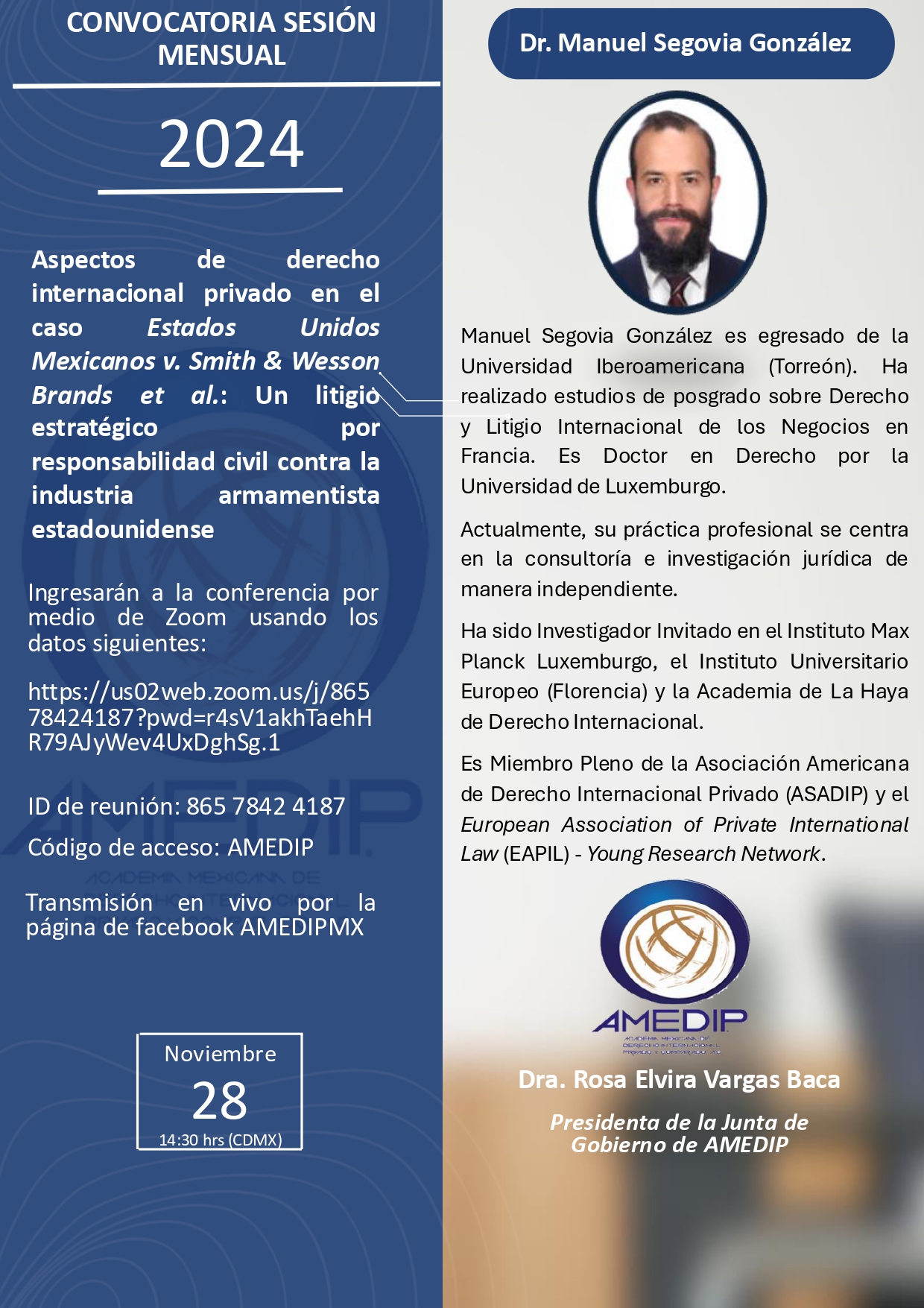
The Mexican Academy of Private International and Comparative Law (AMEDIP) is holding a webinar on Thursday 28 November 2024 at 14:30 (Mexico City time – CST), 21:30 (CET time). The topic of the webinar is the private international law aspects in the case Estados Unidos Mexicanos (Mexico) v. Smith & Wesson Brands et al. and will be presented by Dr. Manuel Segovia González (in Spanish). We have previously reported on the case here.
RabelsZ: New issue alert
 Issue 3 of RabelsZ 2024 has just been released. It contains the following articles:
Chris Thomale and Stephan Schmid, Das Private Enforcement der EU-Lieferkettenrichtlinie – Eine rechtsvergleichende und rechtsökonomische Beurteilung der finalen Fassung mit Anregungen für die mitgliedstaatlichen Umsetzungsgesetze (Private Enforcement in the EU Supply Chain Directive: A Critical Comparative Law and Economics Analysis of the Final Compromise with Suggestions for its Implementation by the Member States), pp. 425–493, https://doi.org/10.1628/rabelsz-2024-0046 Read more
Rethinking Private International Law Education – Insights from a Global Webinar
Guest Blog: Rethinking Private International Law Education – Insights from a Global Webinar
Written by: Corinna Chen (CAPLUS research intern, 2024, Sydney Law School, Australia)
Private international law (PIL) plays a critical role in shaping how future legal professionals and citizens engage with a complex, interconnected world. On 23 September 2024, the University of Sydney Law School hosted a webinar event in collaboration with the American Society of International Law (ASIL), Professor Xandra Kramer from Erasmus University Rotterdam and Utrecht University, and Professor Laura Carballo from the University of Vigo. Read more