I. Introduction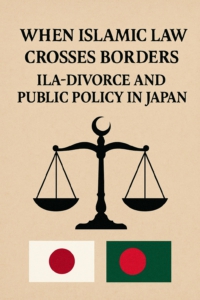
The question of the application of Islamic law in non-Muslim countries has triggered extensive discussions and debates regarding the consistency of Islamic law rules – whether codified in modern legislation or not – with the forum’s public policy. This issue has attracted particular attention in the field of family law, where various legal Islamic institutions (such as dower, polygamy, and early marriage) have sparked considerable controversy and posed significant challenges in both court practice and academic debate. This is particularly salient in the field of dissolution of marriage, as Islamic practices such as talaq and khul have often been the subject of intense discussions concerning their recognition and validity in non-Muslim jurisdictions.
The case presented here is another example of the complexity inherent in the reception of peculiar Islamic law institutions in private international law. Recently decided by the Nagoya High Court (second-instance court) in its ruling of 12 June 2025, it concerns a type of marital dissolution based on ila (an oath of sexual abstention). To the best of my knowledge, no comparable case involving ila has been decided before in any jurisdiction, which makes this ruling particularly important both in theory and in practice. This is especially so given that resorting to ila in this case appears to have been part of a litigation strategy, anticipating an unfavourable outcome if the case had been brought before the court as a talaq case (see infra V). As such, the case provides an opportunity to consider the nature of this unusual Islamic legal institution, its specific features, and the challenges it may raise when examined by foreign courts.
II. The Case:
The parties in this case are a Bangladeshi Muslim couple who married in accordance with Islamic law in Bangladesh and subsequently moved to Japan, where they had their children. All parties, including the children, are permanent residents of Japan.
The case concerns a divorce action filed by the husband (X) against his wife (Y), seeking dissolution of marriage primarily under Bangladeshi law, and alternatively under Japanese law. X argued that, in his complaint, he declared his intention “in the name of Allah” to abstain from sexual relations with his wife; and since four months had passed without any sexual relations with Y, a “talaq-divorce” had been effected and thereby completed in accordance with Bangladeshi law. The divorce action was filed as a result of continuous disagreement and disputes between the parties on various issues including property rights, management of the household finance, and alleged misbehaviour and even violence on the wife’s side. At the time the action was filed, X and Y had already been living separately for some time.
One of the main issues revolved around whether the application of Bangladeshi law, which provides for this form of marital dissolution (referred to in the judgment as “talaq-divorce”), should be excluded due to inconsistency with Japanese public policy under Article 42 of the Act on the General Rules of Application of Laws (AGRAL).
The court of first instance (Nagoya Family Court, judgment of 26 November 2024) held that the “talaq-divorce” (as referred to in the judgment) was valid under Bangladeshi law and that its recognition did not contravene Japanese public policy. Notably, the court emphasized that “any assessment of whether the legal rules applicable between spouses who share the same religious and cultural background violate Japanese public policy should be approached with a certain degree of restraint”, given the strong cultural and religious elements involved in the personal status of the parties, who are both originally Bangladeshi nationals and Muslims who were married in accordance with Islamic law, even if they had been living and residing in Japan for some time.
Dissatisfied with the judgment, Y appealed before the High Court.
Y challenged the first instance judgment on various grounds. She basically argued – inter alia – that, given the strong ties the parties and their children have with Japan and their established life there, the mere fact that the parties are Bangladeshi nationals and Muslims should not justify a restrained implication of public policy, especially considering that the effects and consequences of the divorce would take place in Japan.
III. The Ruling
The Nagoya High Court upheld the judgment of the court of first instance, stating as follows (only a summary is provided here, with modifications and adjustments):
Under Bangladeshi law, which governs the present divorce, a husband may dissolve the marriage either through talaq (a unilateral declaration of divorce by the husband) or through other modes. There are several forms of talaq-divorce available to the husband, including ila. The latter entails the husband taking an oath in the name of Allah to abstain from sexual relations with his wife. If no intercourse occurs within four months following the oath, the divorce is considered to have taken effect.
In the present case, considering that Bangladeshi law is the applicable law, the talaq-divorce would be deemed valid, and would be recognized, since a period of four months had passed without any sexual contact between the parties after X made his declaration in the complaint.
Generally, when determining the applicability of Article 42 of the AGRAL, it is not the foreign law’s provisions themselves that should be assessed in abstracto. Rather, the application of the foreign law as the governing law may be excluded [only] where (1)its concrete application would result in a consequence that is contrary to public policy, and (2) the case has a close connection with Japan.
Regarding (1), the marital relationship between the parties had deteriorated over time, and various elements, when taken together, indicate that the parties had already reached a serious state of discord that could reasonably be seen as leading to separation or divorce. Consequently, considering all these circumstances, and taking into account the background of the case, the nature of the parties’ interactions, and the duration of their separation, it cannot be said that applying Bangladeshi law and recognizing the talaq-divorce in this case would be contrary to public policy.
With respect to (2), Y argued that, due to the strong connection between the case and Japan, the exclusion of the application of Bangladeshi in application of article 42 of the AGRAL should be admitted. However, as previously noted, the application of Bangladeshi law in this case does not result in a violation of public policy. Therefore, even considering the strong connection of the case to Japan, the application of Article 42 of the AGRAL cannot be justified.
IV. Comments
(*) Unless otherwise indicated, all references to Islamic law here are about classical Islamic law as developed by the orthodox Sunni schools, and not Islamic law as codified and/or practiced in modern Muslim countries.
1. Islamic law before Japanese Court
There are several cases in which Japanese courts have addressed the application of foreign laws influenced by or based on Islamic law. These cases have involved matters such as the establishment of filiation, annulment of marriage, parental authority, adoption, and divorce (whether based on the unilateral will of the husband or not). While in few instances the courts have applied the relevant foreign law without particular difficulties (for example, allowing a Japanese woman married to a Pakistani Muslim man to seek and obtain a divorce under Pakistani law), in most cases, the courts have refused to apply such laws on the grounds that they were contrary to Japanese public policy. The rules found incompatible with public policy include, among others, the non-recognition of out-of-wedlock filiation, the prohibition of interfaith marriage, the prohibition of adoption, the automatic attribution of parental authority to the father, and talaq-based divorce (triple talaq). The foreign laws at issue in these cases originate either from Muslim-majority countries such as Iran, Pakistan, Indonesia, and Egypt, or from non-Muslim countries with Muslim minorities who are governed by their own personal status laws, such as Myanmar and the Philippines.
The case commented on here provides a new example of a Japanese court grappling with the application of foreign law grounded in Islamic legal principles.
2. Ila and dissolution of marriage
Like many other traditional – and in some views, “exotic” – Islamic legal institutions (such as zihar, li’an, khul, tamlik, tafwidh, mubara’a …… definitions are intentionally omitted), ila is often difficult to apprehend correctly, both in substance and in function.
a) What is ila?
Generally speaking, ila can be defined as “the swearing of an oath by a man that he will not have intercourse with his wife” for a period fixed in the Quran (chapter 2, verse 226) at four months (See Ibn Rushd (I. A. Khan Nyazee, trans.), The Distinguished Jurist’s Primer – Vol. II: Bidayat Al-Mujtahid wa Nihayat Al-Muqtasid (Garnet Publishing, 2000) 121).
It worth mentioning first that ila is not an Islamic invention but was practiced in pre-Islamic society. In that context, ila allowed the husband to place considerable pressure on his wife by placing her in a state of marital limbo, which can be for an indefinite period. This left the woman in a vulnerable and uncertain position, as she was neither fully married in practice, nor legally divorced.
Islamic Sharia addressed this practice and, while it did not abolish it – unlike some other pre-Islamic institutions and practices –, it attempted to alleviate its harmful effects, by introducing a period of four months, during which the husband is invited to reconsider his decision and either resume marital life (Quran chapter 2, verse 226) or dissolve the marriage (Quran chapter 2, verse 227).
b) Ila – Different Practices
However, regarding the actual operation of ila, the schools of Islamic religio-legal jurisprudence (fiqh) diverge significantly on several points (Ibn Rushd, op. cit.). Two issues are particularly relevant here:
i. The first concerns whether :
(i-a) the four-month period stated in the Quran represents a maximum period, at the end of which the marriage is dissolved; or
(i-b) the four-month period merely marks the threshold between an oath of abstention that does not lead to marital dissolution and one that does. According to this latter view, only an oath exceeding four months, or one made for an indefinite duration, qualifies as ila that may result in the dissolution of marriage.
ii. The second issue concerns whether
(ii-a) the marriage is automatically dissolved once the four-month period has elapsed, if the husband does take the necessary actions to resume the marital life, that is after performing an act of expiation (kaffara) in accordance with the Quranic prescriptions (notably Chapter 5, verse 89); or
(ii-b), upon expiry of the term, the wife may petition a qadhi (Muslim judge), requesting that her husband either end the marriage by pronouncing talaq, or resume marital relations after performing an act of expiation (Chapter 5, verse 89). In such a case, the qadhi would then grant the husband a specified period to decide. If the husband fails to take either course of action, the qadhi may pronounce the dissolution of the marriage on account of his inaction. Depending on the legal opinion, this dissolution may be categorized either as a talaq issued on behalf of the husband, or as a judicial annulment (faskh).
Traditionally, the Hanafi school, prevalent in Bangladesh, follows positions (1-a) and (2-a), while the other major schools adopt views (1-b) and (2-b).
3. Ila and talaq – what’s the difference?
It is not uncommon for ila to be described as “a form of talaq.” This appears to be the position of the High Court, seemingly based on the arguments presented by X’s representative during the trial. It is true that both ila and talaq are prerogatives reserved exclusively for men; women do not have equivalent right (except, in the case of talaq, where the husband may contractually delegate this right to his wife at the time of the marriage). It is also true that both ila and talaq may lead to the dissolution of marriage based on the unilateral intention of the husband. However, describing ila as a “form of talaq” is not – technically speaking – entirely accurate.
i. Under the majority of schools of fiqh – except for the Hanafi –, the distinction is quite clear. This is because unlike talaq, ila, by itself, does not lead to dissolution of marriage. A judicial intervention is required upon the wife’s request for the marriage to be dissolved (which is not required for talaq).
ii. Under the Hanafi school, however, the distinction between ila and talaq may be blurred due to their substantial and functional similarities. In both cases, a qualified verbal formula places the marriage in a suspended state(*) for a specified period (the waiting period (iddah) in the case of talaq, and the four-month period in the case of ila). If the husband fails to retract his declaration within this period, the marriage is dissolved.
(*) However, this does not apply in the case of a talaq that immediately dissolves the marriage: that is, a talaq occurring for the third time after two previous ones (whether or not those resulted in the dissolution of the marriage), or in the case of the so-called triple talaq, where the husband pronounces three talaqs in a single formula with the intention of producing the effect of three successive talaqs.
Nevertheless, a number of important distinctions remain between the two, even within the Hanafi doctrine.
a. The first concerns the frequency with which talaq and ila may be resorted to. Similar to ila, talaq does not necessarily lead to the dissolution of the marriage if the husband retracts during the wife’s waiting period (iddah). However, its use – even if followed by retraction – is limited to two occurrences (Chapter 2, verse 229). A third pronouncement of talaq results in immediate and irrevocable dissolution of the marriage, and creates a temporary impediment to remarriage. This impediment can only be lifted if the woman marries another man and that subsequent marriage is irrevocably dissolved (Quran, Chapter 2, verse 230). By contrast, ila, does not have such limitation and can be repeated without restriction (in terms of frequency), provided that the husband retracts by performing the act of expiation each time.
b. The second concerns the form of retraction. In the case of talaq, the husband can resume conjugal life at will. No particular formality is required; and retraction can be explicit or implied. In the case of ila, however, retraction must take the form of an act of expiation (kaffara) in accordance with the Quranic prescriptions (Chapter 5, verse 89) before marital relations may resume.
4. Ila and public policy
a) Ila – some inherent aspects
As previously noted, ila has traditionally been used as a means for a husband to exert pressure or express discontent within the marriage by vowing abstinence from sexual relations. Under Islamic Sharia, this practice is preserved: husbands – even without making any formal oath of abstinence (ila) – are allowed to “discipline their wives” in cases of marital discord by abstaining from sharing the marital bed (hajr) as a corrective measure (Quran, Chapter 4, verse 34). Indeed, it is not uncommon that Muslim scholars justify the “rationale” behind this practice by stating that “a man may resort to ila…when he sees no other option but to abstain from sharing the marital bed as a means of disciplining and correcting his wife (italic added)…. In this case, his abstention during this period serves as a warning to deter her from repeating such behavior” (O. A. Abd Al-Hamid Lillu, ‘Mirath al-mutallaqa bi-al-‘ila – Dirasa fiqhiyya muqarana ma’a ba’dh al-tashri’at al-‘arabiyya [The Inheritance Rights of a Woman Divorced by Ila’: A Comparative Jurisprudential Study with Selected Arab Legislations]’ (2020) 4(3) Journal of the Faculty of Islamic and Arabic Studies for Women 630). It is therefore not surprising that some would view ila as “troubling” due to its perceived “sexism” and the fact that wives may find themselves at their husbands’ “mercy” with little thing to do (Raj Bhala, Understanding Islamic Law (Shar’ia) (Carolina Academic Press, 2023) 803).
These aspects, in addition with inherent gender asymmetry in the rights involved, calls into question the compatibility of ila with the public policy of the forum.
b) The position of the Nagoya High Court
As the Nagoya High Court rightly indicated, the exclusion of foreign law under the public policy exception does not depend on the content of the foreign law itself, assessed in abstracto. On the contrary, as it is generally accepted in Japanese private international law, public policy may be invoked based on two elements: (1) the result of applying the foreign law in a concrete case is found unacceptable in the eyes of Japanese law, and (2) there is a strong connection between the case and the forum (see K. Nishioka & Y. Nishitani, Japanese Private International Law (Hart, 2019) 22).
The Nagoya High Court’s explicit adherence to this framework, notably by engaging in an in concreto examination of the foreign law and avoiding invoking public policy solely on the ground of its content as some earlier court decisions suggest (see e.g. Tokyo Family Court judgment of 17 January 2019; see my English translation in 63 (2020) Japanese Yearbook of International Law 373), is noteworthy and should be welcomed.
That said, the Court’s overall approach raises some questions. The impression conveyed by the Court’s reasoning is that it focused primarily on the irretrievable breakdown of the marital relationship and the period of separation to conclude that there was no violation of public policy. In other words, since the marital relationship had reached a dead end, dissolving the marriage on the basis of objective grounds or on the basis of ila does not alter the outcome.
Although this approach is understandable, it would have been more convincing if the Court had carefully considered the nature of ila and its specific implications in this case, and eventually explicitly state that such elements were not established. These aspects appear to have been largely overlooked by the High Court, seemingly due to its unfamiliarity with Islamic legal institutions. It would have been advisable for the Court to address these aspects, at least to demonstrate its concerns regarding the potential abusive use of ila.
V. Concluding Remarks: Ila as a litigation strategy?
One may wonder why the husband in this case chose to resort to ila to end his marriage. One possible explanation is that Japanese courts have previously ruled that a talaq divorce in the form of triple talaq is inconsistent with public policy (Tokyo Family Court judgment of 17 January 2019, op. cit.). It appears that, anticipating a similar outcome, the husband in this case was advised to take a “safer approach” by relying on ila rather than resorting to triple talaq (see the comment by the law firm representing the husband in this case, available here – in Japanese only). To be sure, associating talaq solely with its most contested form (i.e., triple talaq) is not entirely accurate. That said, considering how the case under discussion was decided, it is now open to question whether it would have been simpler for the husband to perform a single talaq and then abstain from retracting during his wife’s waiting period (iddah). At least in this way, the aspect of “disciplining the wife” inherent in ila would not be an issue that the courts would need to address