
New issue alert: RabelsZ 3 (2026)


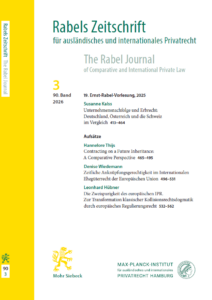 The latest issue of RabelsZ has just be released. It contains the following articles as well as an editorial with important information regarding the journal’s future governance structure and publication process. All content is Open Access: CC BY 4.0.
19TH RABEL LECTURE, 2025
Susanne Kalss, Unternehmensnachfolge und Erbrecht: Deutschland, Österreich und die Schweiz im Vergleich, [The Transfer of a Business and Succession Law Consequences: Germany, Austria, and Switzerland Compared], pp. 413–464, https://doi.org/10.1628/rabelsz-2026-0028
Business assets differ from other assets in many ways: Business assets can be difficult to divide, their value changes rapidly, economic benefits are separated from influence and decision-making power, and different stakeholders are ultimately affected. For these reasons, German-based legal systems stipulate a number of special provisions under current or impending law regarding the inheritance of businesses. The special provisions address the valuation of assets, the valuation date, and the deferral options for claims. When the business is transferred, an economic approach must be taken towards its management. This must be recognized as a value-adding, asset-based contribution made by the transferee for the benefit of all, and it therefore has to be taken into account when dividing the inherited assets among the beneficiaries.
ESSAYS
Hannelore Thijs, Contracting on a Future Inheritance: A Comparative Perspective, pp. 465–495, https://doi.org/10.1628/rabelsz-2026-0029
This article examines the possibilities to contract on a future inheritance from a European comparative perspective. Moving beyond the traditional dichotomy between the prohibition of agreements on a future inheritance in the Roman legal systems and their long-standing recognition in German legal systems, the article develops a refined typology of approaches to the question of whether and to what extent such agreements are permitted, distinguishing between succession agreements, waiver agreements, and agreements concerning the future estate of a third party. The comparative analysis reveals that many European jurisdictions recognise at least one type of such agreements, albeit often subject to significant limitations. Waiver agreements are accepted relatively widely, whereas succession agreements remain more controversial. Agreements concerning the future estate of a third party continue to be largely prohibited. While no uniform approach can be identified across Europe, the findings suggest a gradual shift towards greater acceptance of contractual arrangements to regulate a future inheritance.
Denise Wiedemann, Zeitliche Anknüpfungsgerechtigkeit im Internationalen Ehegüterrecht der Europäischen Union, [Temporal Fairness in Conflict of Laws: The Immutable Connecting Factor under the EU Matrimonial Property Regulation], 496–531, https://doi.org/10.1628/rabelsz-2026-0023
This article examines the use of a fixed connecting factor in the EU Matrimonial Property Regulation. The instrument covers not only matrimonial property matters in a strict sense but, in principle, all of the property-related relationships existing between spouses. The article begins by demonstrating, from a historical and comparative perspective, that this approach stands as a novelty in European conflict of laws. Consequently, it is not surprising that limits are being considered. The article identifies and examines two possible ways of achieving such a circumscription. First, despite the Regulation’s seemingly broad scope of application, the areas excepted from its sphere could be interpreted so as to create a narrow conception of matrimonial property law. Second, over-riding mandatory provisions could be used as a means of limiting the application of the Regulation. However, as is also explained, such means of restriction are themselves limited as a result of both the wording of the Regulation and the uniform interpretation of instruments advocated by the CJEU – an interpretive approach which is not always convincing.
Leonhard Hübner, Die Zweispurigkeit des europäischen IPR. Zur Transformation klassischer Kollisionsrechtsdogmatik durch europäisches Regulierungsrecht, [The Two-Track Nature of European Private International Law. The Transformation of Classic Conflict-of-Law Doctrine by European Regulatory Law], pp. 532–562, https://doi.org/10.1628/rabelsz-2026-0024
The article diagnoses a structural duality within European private international law. Namely, alongside classical coordination-PIL (Rome I-III), which coordinates legal orders on the premise of their fundamental equality, a distinct regulatory-PIL has emerged (GDPR, DSA, CSDDD) that purposefully extends European standards to third-state actors. Drawing on the concept of Lebenslügen (»life lies«, i.e. necessary acts of self-deception), the article deconstructs six classical doctrines – neutrality, multilateralism, decisional harmony, rule structure, separation from public law, and separation from procedural law. Whereas they remain valid for coordination-PIL, they generate systematic mischaracterizations when applied indiscriminately to regulatory-PIL. The article develops criteria for assigning instruments to either track and argues for a critically constructive engagement with the regulatory instrumentalization of private international law.
BOOK REVIEWS
This issue also contains several reviews of literature in the fields of comparative private and private international law and on related topics (pp. 563–592
Leave a Reply
Want to join the discussion?Feel free to contribute!