
Conflict of Laws
  • About
  • Editorial board
  • Subscription
  • Submission
  • Materials
  • Contact
  • Click to open the search input field Click to open the search input field Search
  • Menu Menu

New Uruguayan Private International Law Statute Passed

November 19, 2020/1 Comment/in News/by Ralf Michaels
image_pdfimage_print

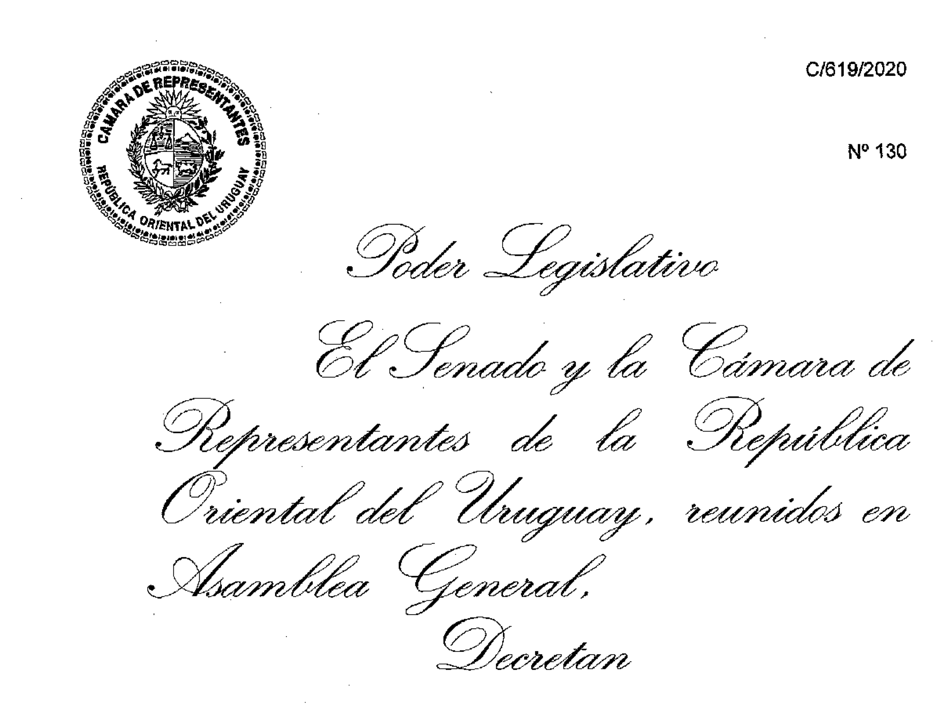
Two months ago I reported that the enactment of a new Uruguayan private international law statute was forthcoming after the bill had passed the Senate. Similar hope had been premature in the past, but this time it proved justified:On November 17, the bill was approved by the Cámara de Representantes. Opposition to the establishment of party autonomy managed to reduce its scope but not prevent the statute altogether. The debate is here, the text of the statute is here. Some more background information is in my earlier post.

Congratulations, Uruguay, and congratulations, world of private international law.

Share this entry
  • Share on Facebook
  • Share on X
  • Share on WhatsApp
  • Share on Pinterest
  • Share on LinkedIn
  • Share on Tumblr
  • Share on Vk
  • Share on Reddit
  • Share by Mail
https://conflictoflaws.net/News/2020/08/CoL_Banner-1.png 0 0 Ralf Michaels https://conflictoflaws.net/News/2020/08/CoL_Banner-1.png Ralf Michaels2020-11-19 16:30:082020-11-19 18:11:11New Uruguayan Private International Law Statute Passed
1 reply
  1. Beligh Elbalti says:
    November 20, 2020 at 8:29 am

    Just for information,

    The possibility for the parties to select non-state law as the governing law of their contract is admitted in the Bahraini 2015 CoL Act, article 4 (here is a link an unofficial English translation: http://bahrainbusinesslaws.com/laws/Conflict-of-Laws-in-Civil-and-Commercial-Matters). The provision is maintained in the reform project currently pending before the Bahraini Legislative authorities.

    In addition, a reform project of the PIL code was initiated in Tunisia and a draft was already submitted to the Ministry of Justice in 2019. The draft has not found its way to the parliament yet though. One of the major aspects of the reform is to extend the possibility for the party to choose non-State law as the governing law of their contract. It should be note that the solution is not new in Tunisia as Tunisian courts have already admitted the applicability of non-State law as the law chosen by the parties (see Sami Bostanji, De la promotion des usages du commerce international par la justice étatique (A propos de l’affaire interco c/ North African International Bank)’ Clunet, 2005 pp. 1067ss).

    It should be highlighted that the restrictions found in the Uruguayan legislation and the Hague Principles do not apply in Bahrain (aforementioned Article 4) and Tunisia (case law and proposed draft reform), the only limit to the parties’ freedom being public policy and overriding mandatory rules.

Comments are closed.

Categories

  • Views
  • News

Most Recent Posts

  • Support in cross-border transactions by Adults: Contract law vs capacity law August 12, 2026
  • Support in cross-border decision-making by Adults: Contract law vs capacity law August 12, 2026
  • Recognition of Italian Extrajudicial Divorces in Tunisia — Between Methodological Uncertainty and the Need to Preserve Continuity of Personal Status Across Borders August 9, 2026
  • Private International Law and European Society August 4, 2026
  • The New Zealand Supreme Court’s judgment in Kea Investments Ltd v Wikeley on anti-enforcement relief August 3, 2026
  • Beyond Domicile: The BHP Litigation and the Functional Interconnection of Public and Private International Law August 3, 2026
  • Conflicts of jurisdiction in Senegal: lesson from the Senegalese Supreme Court on Lis Pendens and the Exequatur of foreign judgments July 27, 2026
  • Adoption in the proposal for a European Parenthood Regulation July 21, 2026
  • Copyright, Targeting and Geo-Blocking: The CJEU Stirs the Pot July 15, 2026
  • A Follow-Up: The German Judges Association’s Response to the HCCH Draft Text of a Future Convention on Parallel Proceedings and Related Actions July 15, 2026
  • Private International Law Dimensions of Singapore’s New Legislation to Combat Online Harms July 14, 2026
  • The 1961 HCCH Apostille Convention: Why All African Countries Should Ratify It? — Insights from Judicial Practice in Africa July 14, 2026
  • The enforcement of an advance on costs for substitute performance at the expense of a Russian debtor in German-French legal relations July 2, 2026
  • “Yes, in principle, but not quite there yet…” – Some Observations on the Public Consultation on the HCCH Draft Text of a Future Convention on Parallel Proceedings and Related Actions June 29, 2026
  • Judgment Mobility Rules in India’s Private International Law Regime: No place for a revision au fond? June 26, 2026
Link to: Enhancing Enforcement under Brussels Ia and Beyond – Final (Online) Conference Link to: Enhancing Enforcement under Brussels Ia and Beyond – Final (Online) Conference Enhancing Enforcement under Brussels Ia and Beyond – Final (Online) C... Link to: How Chinese Courts Tackle Parallel Proceeding Issues When Offshore Arbitration Proceeding Is Involved? Link to: How Chinese Courts Tackle Parallel Proceeding Issues When Offshore Arbitration Proceeding Is Involved? How Chinese Courts Tackle Parallel Proceeding Issues When Offshore Arbitration...
Scroll to top Scroll to top Scroll to top