
Revue critique de droit international privé – Issue 2026/2


 Written by Hadrien Pauchard (assistant researcher and doctoral student at Sciences Po Law School)
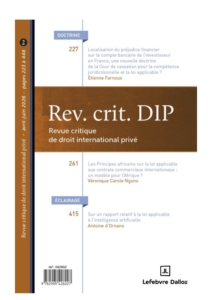
The second issue of the Revue Critique de droit international privé of 2026 was just released and is accessible online. It contains two articles, eight case notes, as well as five book reviews. In line with the Revue Critique’s recent policy, the doctrinal part will soon be made available in English on the editor’s website (for registered users and institutions).
The first article by Prof. Étienne Farnoux (Université de Strasbourg/Université Saint-Joseph de Beyrouth) scrutinizes the French Supreme Court’s recent case law pertaining to the Localisation du préjudice financier sur le compte bancaire de l’investisseur en France, une nouvelle doctrine de la Cour de cassation pour la compétence juridictionnelle et la loi applicable ? (The Localisation of Financial Losses on the Investor’s Bank Account in France: A New Doctrine from the Cour de Cassation Regarding Jurisdiction and Applicable Law?). Beyond the innovative solution in the particular cases (outlining a unitary connection of the financial loss centred on the investor’s bank account), this series of six rulings tackles some fundamental questions raised by the localisation of purely immaterial damages, which materialize broader concerns in contemporary private international law scholarship and judicial practice. The author identifies these trends as follows:
In four judgments delivered on October 1st and two further judgments on 26 November 2025, the Cour de cassation located the financial loss suffered by an investor at that investor’s domicile, within the framework of a unitary approach common to both the determination of jurisdiction and the identification of the applicable law. Beyond the outcome – favourable to the investor – the methodology adopted is noteworthy: the Cour de cassation applies a sophisticated connecting-factor, based on a multifactorial and case-by-case analysis, thereby rationalising the complex case law of the Court of Justice of the European Union concerning financial loss in the context of the European forum delicti. This article analyses these rulings, emphasising three significant methodological developments: the alignment of forum and jus, the disaggregation of the connecting rule, and the personalization of the connecting factor.
In the second article, Prof. Véronique Carole Ngono (Université de Douala) ponders over Les Principes africains sur la loi applicable aux contrats commerciaux internationaux : un modèle pour l’Afrique ? (The African Principles on the Law Applicable to International Commercial Contracts: A Model for Africa?). Informed by a large survey of legislative practices in numerous African jurisdictions and regional bodies, the author’s critical appraisal of the 2024 African Principles provides an informed glimpse into the main issues and challenges of modern codification within the field. Her inquiry is summarized as follows:
African private international law has been enriched by a flexible legal text: the African Principles on the Law Applicable to International Commercial Contracts, which were officially launched in 2024. While the objective of harmonising solutions for the choice of law in international commercial contracts in Africa is commendable, despite the fact that they are, in principle, an extension of the 2008 Rome I Regulation on the law applicable to contractual obligations and the Hague Principles on the choice of law applicable to international commercial contracts, the question of their impact arises. The answer is nuanced: while these principles constitute a necessary model given the unsatisfactory state of African legislation on the issue, their impact could be hampered by certain shortcomings.
The full table of contents is available here.
Previous issues of the Revue Critique (from 2010 to 2025) are available on Cairn.