Written by Hadrien Pauchard (assistant researcher and doctoral student at Sciences Po Law School)
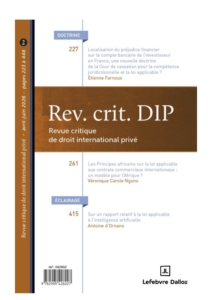
The second issue of the Revue Critique de droit international privé of 2026 was just released and is accessible online. It contains two articles, eight case notes, as well as five book reviews. In line with the Revue Critique’s recent policy, the doctrinal part will soon be made available in English on the editor’s website (for registered users and institutions).
https://conflictoflaws.net/News/2020/08/CoL_Banner-1.png00Etienne Farnouxhttps://conflictoflaws.net/News/2020/08/CoL_Banner-1.pngEtienne Farnoux2026-07-21 14:08:472026-07-21 14:08:47Revue critique de droit international privé – Issue 2026/2
By Sanjitha Ravi, Jindal Global Law School, OP Jindal Global University, Sonipat, India
The Singapore International Commercial Court (“SICC”) in Frontier Holdings Ltd v. Petroleum Exploration (Pvt) Ltd overturned a jurisdictional ruling by an International Chamber of Commerce (“ICC”) arbitral tribunal, holding that the tribunal did, in fact, have jurisdiction to hear the dispute. The SICC’s decision focused on interpreting the arbitration provisions in the Petroleum Concession Agreements (“PCAs”) and Joint Operating Agreements (“JOAs”), which had created ambiguity regarding whether disputes between foreign parties, i.e., Foreign Working Interest Owners (“FWIOs”), and Pakistan parties, i.e., Pakistani Working Interest Owners (“PWIOs”), were subject to international arbitration. The arbitral tribunal, by majority, had concluded the PCAs restricted ICC arbitration to disputes between FWIOs inter se or between FWIOs and the President of Pakistan, thereby excluding disputes between FWIOs and PWIOs. The SICC rejected this reasoning and concluded that the provisions should be applied with necessary modifications to fit the JOAs’ context by conducting an in-depth construction of the dispute resolution provisions of the different agreements involved. The court found that a reasonable interpretation of these provisions indicated an intention to submit FWIO-PWIO disputes to ICC arbitration rather than Pakistani domestic arbitration. Read more
https://conflictoflaws.net/News/2020/08/CoL_Banner-1.png00Saloni Khanderiahttps://conflictoflaws.net/News/2020/08/CoL_Banner-1.pngSaloni Khanderia2025-02-26 04:39:552025-02-26 07:15:50Going International: The SICC in Frontier Holdings
The recently published study titled ‘European Commercial Contract Law’, authored by Andrea Bertolini, addresses the theme of regulatory competition. It offers new policy recommendations to improve EU legal systems’ chances of being chosen as the law governing commercial contracts.
The Study’s main question
The European Parliament’s Committee on Legal Affairs has published a new study authored by Andrea Bertolini, titled ‘European Commercial Contract Law’ (the ‘Study’). The Study formulates the main question as follows: ‘why the law chosen in commercial contracts is largely non-European and non-member state law’. The expression ‘non-European and non-member state’ law is specified as denoting the legal systems of England and Wales, the United States, and Singapore, and more generally, common law legal systems. The Study states:
It is easily observed how most often international contracts are governed by non-European law. The reasons why this occurs are up to debate and could be quite varied both in nature and relevance. Indeed, a recent study by Singapore Academy of Law (SAL) found that 43 per cent of commercial practitioners and in-house counsel preferred English law as the governing law of the contracts. Read more
https://conflictoflaws.net/News/2020/08/CoL_Banner-1.png00Ekaterina Pannebakkerhttps://conflictoflaws.net/News/2020/08/CoL_Banner-1.pngEkaterina Pannebakker2023-11-18 14:50:152023-12-20 16:50:13Choice of law in commercial contracts and regulatory competition: new steps to be made by the EU?

 Written by Hadrien Pauchard (assistant researcher and doctoral student at Sciences Po Law School)