
Out now: Talia Einhorn, Private International Law in Israel, 3rd edition


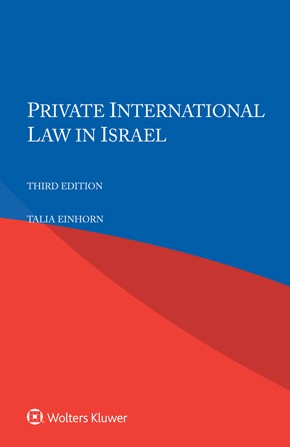 It is my pleasure to recommend to the global CoL community a real treat: Talia Einhorn’s “Private International Law in Israel”, an analysis of the country’s private international law of no less than almost 900 pages, now in its third edition. This monograph, significantly enlarged and extended, grounds on the respective country report for the International Encyclopedia of Laws/Private International Law amongst a large series of country reports on which the “General Section” by Bea Verschraegen, the editor of the entire series, builds.
According to the Encyclopedia’s structure for country reports, the text covers all conceivable aspects of a national private international law, from “General Principles (Choice of Law Techniques)” in Part I, including the sources of PIL, the technical and conceptual elements of choice of law rules (“determination of the applicable law”) as well as “basic terms”. Part II unfolds a fascinating tour d’horizon through the “Rules of Choice of Law” on persons, obligations, property law, intangible property rights, company law, corporate insolvency and personal bankruptcy, family law and succession law. Part III covers all matters of international civil procedure, including jurisdictional immunities, international jurisdiction, procedure in international litigation, recognition and enforcement and finally international arbitration.
The analyses offered seem to be extremely thorough and precise, including in-depth evaluations of key judgments, which enables readers to grasp quickly core concepts and issues beyond basic information and the mere black letter of the rules. For example, Chapter 4 of Part III on the recognition and enforcement of foreign judgments explains that Israel is a State Party to only one rather specific convention, the UN Convention on the Recovery Abroad of Maintenance 1956 (apparently operated without any implementing legislation, see para. 2434). Further, Israel entertains four bilateral treaties (with Austria, Germany, Spain and the UK) that provide generally for recognition and enforcement of judgments in civil and commercial matters. These four treaties, however, seem to differ substantially from each other and from the domestic statutory regime under the Israeli Foreign Judgments Enforcement Law (“FJEL”), see para. 2436. These differences are spelled out down to the level of decisions of first instance courts of the respective foreign State Party, see e.g. footnote 1927 with reference to recent jurisprudence (of the German Federal Court of Justice and) of the local court of Wiesbaden on Article 8(2) of the bilateral treaty with Germany stipulating, according to these courts’ interpretation, a far-reaching binding effect to the findings of the first court. This is contrasted with case law of the Israeli Supreme Court rejecting recognition and enforcement of a German judgment, due to the lack of a proper implementation of the Treaty in Israeli domestic law, see paras. 2437 et seq. – a state of things criticized by the author who also offers an alternative interpretation of the legal constellation that would have well allowed recognition and enforcement under the Treaty, see para. 2440. Additionally, interpretation of the domestic statutory regime in light of treaty obligations of the State of Israel, irrespective of a necessity of any specific implementation measures, is suggested, para. 2447. On the level of the domestic regime, the FJEL, in § 3 (1), prescribes as one out of a number of cumulative conditions for enforcement that “the judgment was given in a state, the courts of which were, according to its laws, competent to give it”, see para. 2520. Indeed, “the first condition is puzzling”, para. 2526, but by no means unique and does even appear in at least one international convention (see e.g. Matthias Weller, RdC 423 [2022], at para. 251, on Art. 14(1) of the CEMAC 2004 Agreement and on comparable national rules). At the same time, and indeed, controlling the jurisdiction of the first court according to its own law appears hardly justifiable, all the more, as there is no control under § 3 FJEL of the international jurisdiction according to the law of the requested court / State, except perhaps in extreme cases under the general public policy control in § 3 (3) FJEL. Additionally, on the level of domestic law, English common law seems to play a role, see paras. 2603, but the relation to the statutory regime seems to pose a question of normative hierarchy, see para. 2513, where Einhorn proposes that the avenue via common law should only be available as a residual means. In light of this admirably clear and precise assessment, one might wonder whether Israel should considering participating in the HCCH 2019 Judgments Convention and the reader would certainly be interested in hearing the author’s learned view on this. The instrument is not listed in the table of international treaties dealt with in the text, see pp. 821 et seq., nor is the HCCH 2005 Choice of Court Agreements Convention. Of course, these instruments do not (yet?) form part of the Israeli legal system, but again, the author’s position whether they should would be of interest.
As this very brief look into one small bit of Einhorn’s monograph shows, this is the very best you can expect from the outsider’s and a PIL comparative perspective, probably as well from the insider’s perspective if there is an interest in connecting the own with the other. Admirable!
Israel has signed the 2019 Judgments Convention and the 2005 Choice of Court Convention and the Ministry of Justice is currently considering how best to bring them into force in Israel so that it will be possible to ratify them,