
Conflict of Laws
  • About
  • Editorial board
  • Subscription
  • Submission
  • Materials
  • Contact
  • Click to open the search input field Click to open the search input field Search
  • Menu Menu

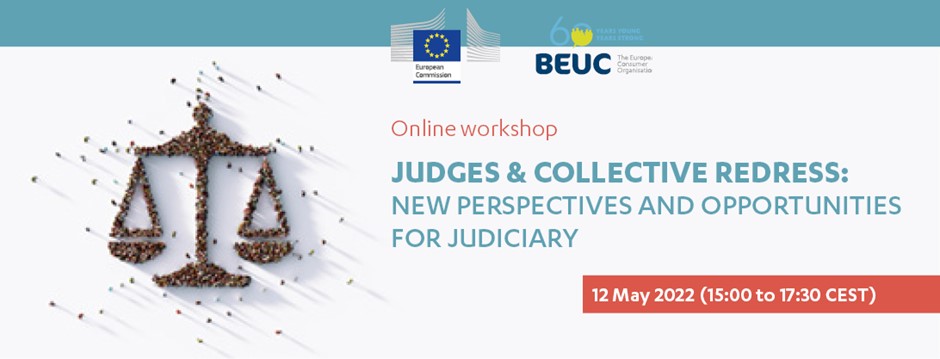
Online Seminar BEUC Judges & Collective Redress

April 12, 2022/in News/by Xandra Kramer
image_pdfimage_print

                    Judges & collective redress:

new perspectives and opportunities for judiciary

          Thursday 12 May 2022, 15:00 to 17:30 CEST

       This online event will be held in English and is reserved for judges and members of judiciaries.


                            >>> REGISTER HERE <<<

Judges may play an important role in collective redress actions following mass harm situations. Mass harm situations refer to cases where a number of persons are harmed by the same illegal practices relating to the violation of their rights by one or more traders or other persons. Collective redress actions may seek the cessation of such practices and/or compensation. The fact that such disputes concern large numbers of persons raises specific procedural challenges but also offers opportunities in terms of efficient administration of justice.

In the context of the EU’s Representative Actions Directive, which will come into application in June 2023, judges will be called upon to undertake specific tasks. Depending on the national rules transposing the Directive, they may be required to assess the admissibility and merits of the actions, to ensure that consumers are appropriately represented and informed, to verify that the interests of all represented parties are well-protected, etc. The objective of this workshop is to raise awareness on collective redress and to exchange on the roles of judges in collective redress actions.

During a panel discussion, three judges with recognised expertise in the field of collective redress will share their insight and experience:

Mr. Fabian Reuschle (judge at the Stuttgart Regional court – Landgericht – Germany). Fabian Reuschle actively participated in the adoption of the German Capital Markets Model Case Act (KapMuG) establishing a lead case procedure for the collective handling of capital market-related actions.

Sir Peter Roth (judge at the London High Court & UK Competition Appeal Tribunal). Sir Peter presided over a collective litigation against MasterCard lodged on behalf of 46 million consumers.

Mr. Jeroen Chorus (retired judge, formerly at the Amsterdam Court of Appeal, the Netherlands). Jeroen Chorus was notably in charge of the Dexia and Shell mass settlement with consequences on consumers in multiple European jurisdictions.

Programme:

15:00-15:05 Welcome
15:05-15:15 Setting the scene: What does collective redress mean for judges? (Stefaan Voet, KU Leuven University)
15:15 – 16:30 Panel discussion with:

  • Judge Roth
  • Judge Chorus
  • Judge Reuschle

Panel moderated by Maria José Azar-Baud (University of Paris-Saclay, France) & Ianika Tzankova (University of Tilburg, the Netherlands)

16:30-17:15 Questions & Answers session with the audience (moderated by Magdalena Tulibacka, Oxford University, UK/Emory  University – United States and with the participation of the representatives of the Directorate-General for Justice & Consumers of the European Commission
17:15-17:30 Concluding remarks

This project is funded by the European Union.

Attendance to the event is free but registration is mandatory. The number of registrations is limited. Therefore, please register as soon as possible via the following link.

For questions, please contact us.

Share this entry
  • Share on Facebook
  • Share on X
  • Share on WhatsApp
  • Share on Pinterest
  • Share on LinkedIn
  • Share on Tumblr
  • Share on Vk
  • Share on Reddit
  • Share by Mail
https://conflictoflaws.net/News/2020/08/CoL_Banner-1.png 0 0 Xandra Kramer https://conflictoflaws.net/News/2020/08/CoL_Banner-1.png Xandra Kramer2022-04-12 12:55:162022-04-12 12:56:53Online Seminar BEUC Judges & Collective Redress
Categories

  • Views
  • News

Most Recent Posts

  • Conflicts of jurisdiction in Senegal: lesson from the Senegalese Supreme Court on Lis Pendens and the Exequatur of foreign judgments July 27, 2026
  • Adoption in the proposal for a European Parenthood Regulation July 21, 2026
  • Copyright, Targeting and Geo-Blocking: The CJEU Stirs the Pot July 15, 2026
  • A Follow-Up: The German Judges Association’s Response to the HCCH Draft Text of a Future Convention on Parallel Proceedings and Related Actions July 15, 2026
  • Private International Law Dimensions of Singapore’s New Legislation to Combat Online Harms July 14, 2026
  • The 1961 HCCH Apostille Convention: Why All African Countries Should Ratify It? — Insights from Judicial Practice in Africa July 14, 2026
  • The enforcement of an advance on costs for substitute performance at the expense of a Russian debtor in German-French legal relations July 2, 2026
  • “Yes, in principle, but not quite there yet…” – Some Observations on the Public Consultation on the HCCH Draft Text of a Future Convention on Parallel Proceedings and Related Actions June 29, 2026
  • Judgment Mobility Rules in India’s Private International Law Regime: No place for a revision au fond? June 26, 2026
  • Nothing to See Here: The CJEU’s Decision in Case C-232/25 Idzinski June 18, 2026
  • Refusal to Enforce in Egypt of a Californian (U.S.) Judgment for Lack of Reciprocity: What Has Gotten into the Egyptian Supreme Court? June 15, 2026
  • PRC Double Interest neither Double nor Penal: Australian Courts Clear Its Name When Enforcing Chinese Judgments June 10, 2026
  • The AIFC Court, Gazprom v Naftogaz and the Emergence of a New Conduit Jurisdiction Debate June 6, 2026
  • Montana Supreme Court Decides International Child Custody Case June 3, 2026
  • China’s Countering Improper Foreign Extraterritorial Jurisdiction Regulation Blocked EU’s Extraterritorial Data Acquisition May 29, 2026
Link to: The Effect of Choice of Court Agreements on Third Parties: Lecture by Professor Yeo Tiong Min Link to: The Effect of Choice of Court Agreements on Third Parties: Lecture by Professor Yeo Tiong Min The Effect of Choice of Court Agreements on Third Parties: Lecture by Professor... Link to: Saudi Arabia has joined the HCCH Apostille Convention Link to: Saudi Arabia has joined the HCCH Apostille Convention Saudi Arabia has joined the HCCH Apostille Convention
Scroll to top Scroll to top Scroll to top