
Conflict of Laws
  • About
  • Editorial board
  • Subscription
  • Submission
  • Materials
  • Contact
  • Click to open the search input field Click to open the search input field Search
  • Menu Menu

Party Autonomy in Private International Law

September 6, 2018/in News/by Giesela Ruehl
image_pdfimage_print

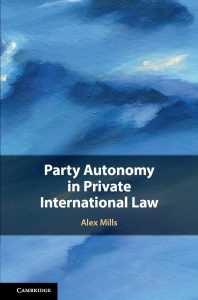
Alex Mills, University College London, has written a book on party autonomy in private international law which has just been published by Cambridge University Press. The author has kindly provided us with the following summary:

This book provides an unprecedented analysis and appraisal of party autonomy in private international law – the power of private parties to enter into agreements as to the forum in which their disputes will be resolved or the law which governs their legal relationships. Such agreements have become an increasingly important part of cross-border legal relations, but many aspects of party autonomy remain controversial and contested. This book includes a detailed exploration of the historical origins of party autonomy as well as its various theoretical justifications. It also provides an in-depth comparative study of the rules governing party autonomy in the European Union, the United States, common law systems, and in international codifications, with particular consideration of some other important jurisdictions including China and Brazil. It examines party autonomy in both choice of forum and choice of law, including arbitration agreements and choice of non-state law. It also examines the effectiveness of party choice of forum and law not only for contractual disputes, but also for a variety of non-contractual legal relations.

The book focuses its analysis around five questions of consistency in party autonomy – consistency between party autonomy in choice of forum and choice of law, consistency in the treatment of party autonomy in contractual and non-contractual relations, consistency between the choice of state and non-state forums or law, consistency between party autonomy in theory and practice, and consistency between different legal systems in relation to the effects of (and limits on) exercises of party autonomy. This analysis demonstrates that while an apparent consensus around the core principle of party autonomy has emerged, its coherence as a doctrine is open to question as there remains significant variation in practice across its various facets and between legal systems.

More information is available here.

Share this entry
  • Share on Facebook
  • Share on X
  • Share on WhatsApp
  • Share on Pinterest
  • Share on LinkedIn
  • Share on Tumblr
  • Share on Vk
  • Share on Reddit
  • Share by Mail
https://conflictoflaws.net/News/2020/08/CoL_Banner-1.png 0 0 Giesela Ruehl https://conflictoflaws.net/News/2020/08/CoL_Banner-1.png Giesela Ruehl2018-09-06 07:45:042018-09-06 07:46:37Party Autonomy in Private International Law
Categories

  • Views
  • News

Most Recent Posts

  • The New Zealand Supreme Court’s judgment in Kea Investments Ltd v Wikeley on anti-enforcement relief August 3, 2026
  • Beyond Domicile: The BHP Litigation and the Functional Interconnection of Public and Private International Law August 3, 2026
  • Conflicts of jurisdiction in Senegal: lesson from the Senegalese Supreme Court on Lis Pendens and the Exequatur of foreign judgments July 27, 2026
  • Adoption in the proposal for a European Parenthood Regulation July 21, 2026
  • Copyright, Targeting and Geo-Blocking: The CJEU Stirs the Pot July 15, 2026
  • A Follow-Up: The German Judges Association’s Response to the HCCH Draft Text of a Future Convention on Parallel Proceedings and Related Actions July 15, 2026
  • Private International Law Dimensions of Singapore’s New Legislation to Combat Online Harms July 14, 2026
  • The 1961 HCCH Apostille Convention: Why All African Countries Should Ratify It? — Insights from Judicial Practice in Africa July 14, 2026
  • The enforcement of an advance on costs for substitute performance at the expense of a Russian debtor in German-French legal relations July 2, 2026
  • “Yes, in principle, but not quite there yet…” – Some Observations on the Public Consultation on the HCCH Draft Text of a Future Convention on Parallel Proceedings and Related Actions June 29, 2026
  • Judgment Mobility Rules in India’s Private International Law Regime: No place for a revision au fond? June 26, 2026
  • Nothing to See Here: The CJEU’s Decision in Case C-232/25 Idzinski June 18, 2026
  • Refusal to Enforce in Egypt of a Californian (U.S.) Judgment for Lack of Reciprocity: What Has Gotten into the Egyptian Supreme Court? June 15, 2026
  • PRC Double Interest neither Double nor Penal: Australian Courts Clear Its Name When Enforcing Chinese Judgments June 10, 2026
  • The AIFC Court, Gazprom v Naftogaz and the Emergence of a New Conduit Jurisdiction Debate June 6, 2026
Link to: Wanted: Research Assistant / Doctoral Student Link to: Wanted: Research Assistant / Doctoral Student Wanted: Research Assistant / Doctoral Student Link to: The race is on: German reference to the CJEU on the interpretation of Art. 14 Rome I Regulation with regard to third-party effects of assignments Link to: The race is on: German reference to the CJEU on the interpretation of Art. 14 Rome I Regulation with regard to third-party effects of assignments The race is on: German reference to the CJEU on the interpretation of Art. 14...
Scroll to top Scroll to top Scroll to top