Tag Archive for: public international law

Law without Borders? Extraterritorial Regulation and Unilateral Action

In an increasingly multipolar world, national and regional actors are reasserting regulatory control over cross-border economic activities. States such as the United States and China, as well as the European Union, are increasingly relying on unilateral measures with extraterritorial reach – particularly in areas such as sanctions, digital regulation, supply chains, competition law, and data protection. At the same time, the multilateral order appears to be under strain: international organizations are being sidelined, agreements are terminated or ignored, and established norms are openly challenged.

To explore the implications of these developments for international (economic) law and the future of global economic cooperation, the German Society of International Law (DGIR) will host a conference in Munich on 11–12 June 2026. Focusing on “Law without Borders? Extraterritorial Regulation and Unilateral Action” the event promises to provide a timely and critical forum for discussing the evolving role of extraterritorial regulation and unilateralism in shaping the international legal order.

Programme

Thursday, 11 June 2026 – National (Regional) Law and Global Markets
The first day will focus on national (regional) law and the regulation of global markets. It will feature presentations by Moritz Renner (Mannheim)  and Romy Klimke (BSP Business and Law School Berlin) followed by a commentary by Andreas Ziegler (Lausanne).

In the evening, Frank Hoffmeister (Brussels) will deliver a practitioner keynote on “The European Union as an Actor in International Economic Law,” followed by a reception.

Friday, 12 June 2026 – Economic Sanctions and International Conflicts
The second day will deal with economic sanctions and international conflicts. Presentations will be delivered Till Patrik Holterhus (Saarbrücken) and Markus Lieberknecht (Osnabrück) followed with a commentary by Tanja Domej (Zurich).

Venue and Contact

The conference will take place at the Carl Friedrich von Siemens Foundation in Munich (Südliches Schlossrondell 23, 80638 Munich). If you wish to join please contact the organizing team at dgir-kurztagung-2026@jura.uni-muenchen.de.

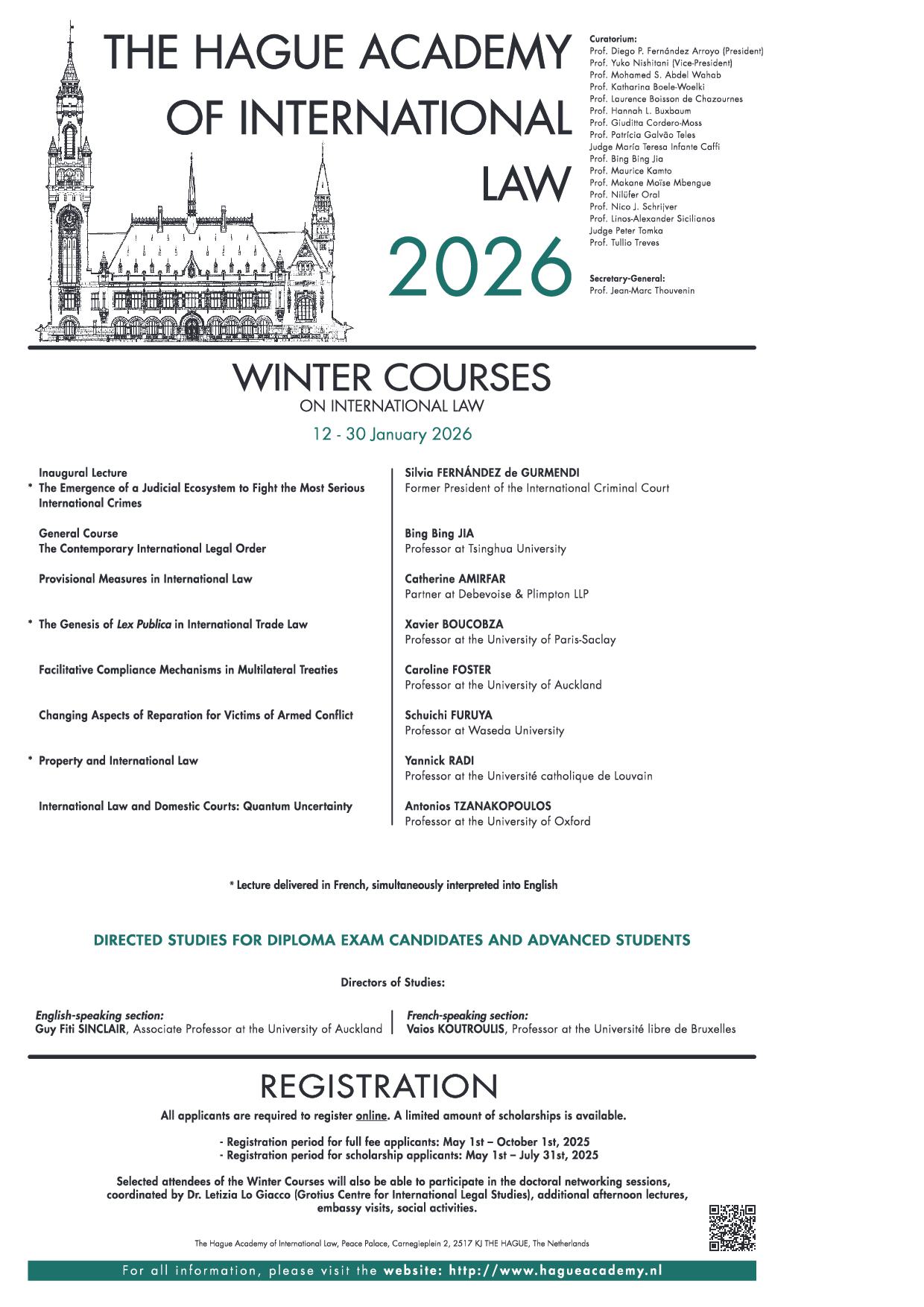
Registration Open Soon: The Hague Academy of International Law’s Winter Courses 2026

Recently, the Hague Academy of International Law published the 2026 programme of its renowned Winter Courses in International Law (12-30 January 2026). Unlike the Summer Courses, this program presents lectures on both Public and Private International Law and therefore provides for a particularly holistic academic experience. Once again, the Academy has spared no effort in inviting legal scholars from around the world to The Hague, including speakers from countries as diverse as Argentina, Belgium, China, France, Japan, the United Kingdom, and the United States, offering its audience a truly global perspective on the topic. Read more

PhD positions in Antwerp

The University of Antwerp has opened two vacancies for PhD research related to private international law.

The first covers inter alia EU private international law, and will be supervised by prof. dr. Johan Meeusen and prof. dr. Mathieu Leloup. The four-year scholarship is sponsored by the Research Foundation – Flanders (FWO). The candidate will write a PhD on mutual trust and rule of law requirements in the field of judicial cooperation in civil and criminal matters. The researcher will have to examine, inter alia, the enforcement of the European Union’s rule of law requirements by courts applying EU private international law instruments. All information on this position, and how to apply, can be found on the University of Antwerp’s website.

The second is on the cusp of private and public international law and will be supervised by Thalia Kruger. This position, also for four years, is funded by the Law Faculty. The research will be about international contracts in the context of international treaties on water. The highland water project (Lesotho and South Africa) is a possible approach. More information and requirements are also available on the website of the University of Antwerp.