Conflict of Laws
  • About
  • Editorial board
  • Subscription
  • Submission
  • Materials
  • Contact
  • Click to open the search input field Click to open the search input field Search
  • Menu Menu

Tag Archive for: German PIL

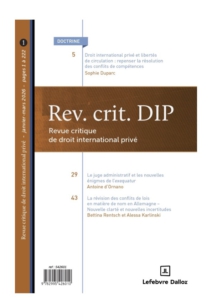
Revue critique de droit international privé – Issue 2026/1

May 5, 2026/in News/by Etienne Farnoux

Written by Hadrien Pauchard (assistant researcher and doctoral student at Sciences Po Law School)

The first issue of the Revue Critique de droit international privé of 2026 has just come off the press and is available online. It contains three articles, nine case notes, and eight book reviews. In line with the Revue Critique’s recent policy, the doctrinal part will soon be made available in English on the editor’s website (for registered users and institutions).
Read more

https://conflictoflaws.net/News/2020/08/CoL_Banner-1.png 0 0 Etienne Farnoux https://conflictoflaws.net/News/2020/08/CoL_Banner-1.png Etienne Farnoux2026-05-05 06:23:302026-05-05 06:23:30Revue critique de droit international privé – Issue 2026/1

Out Now: Gössl/Kienle, Grundkurs Internationales Privat- und Zivilverfahrensrecht

July 27, 2025/in News/by Tobias Lutzi

Any student of German private international law will take delight in the news that a new textbook has just been published by our co-editor Susanne Goessl together with Florian Kienle. The book covers questions of both the applicable law (internationales Privatrecht) and of jurisdiction and foreign judgments (internationales Zivilverfahrensrecht), with a certain focus on the former area. As one might expect from a new text, it puts the European instruments of private international law (and the areas governed by them) into the centre (pp. 16–144) – without neglecting the areas that remain governed by domestic law (pp. 145–282).

Abbildung von Gössl / Kienle | Grundkurs Internationales Privat- und Zivilverfahrensrecht | 1. Auflage | 2025 | beck-shop.deReaders looking to familiarize themselves with German PIL will appreciate the concise introduction to the field (pp. 1–15), the comprehensive coverage of fundamental questions (such as renvoi, characterisation, etc.; starting at p. 157), and the revision questions provided at the end of each chapter. Above all else, however, they will notice the many topical examples used by the authors to explain the material, ranging from climate change and human rights litigation to Covid, the Volkswagen emissions scandal, and the 2021 Suez Canal obstruction by the Ever Given. The wealth of these examples alone makes the book a great read even for those who may consider themselves already well acquainted with German PIL (not least if they need to teach it).

More information on the book is available here.


https://conflictoflaws.net/News/2020/08/CoL_Banner-1.png 0 0 Tobias Lutzi https://conflictoflaws.net/News/2020/08/CoL_Banner-1.png Tobias Lutzi2025-07-27 01:13:562025-07-27 01:13:56Out Now: Gössl/Kienle, Grundkurs Internationales Privat- und Zivilverfahrensrecht

Trending Topics in German PIL 2024 (Part 2 – Online Marriages, Gender Afiliation and Name Law)

March 24, 2025/in Views/by Susanne Gössl

As already mentioned in my previous post, at the end of each year I publish an article (in German) about the Conflict of Laws developments in Germany of the last twelve months, covering more or less the year 2024 and the last months of 2023. This post is the second with an overview over those topics that seem to be most trending.

The two parts focus on the following topics (part 1 contained 1. and 2.):

  1. Restitution of Money lost in Illegal Gambling
  2. Applicable Law in the Dieselgate litigation
  3. The (Non-)Valitidy of Online Marriages
  4. New German conflict-of-law rules regarding gender afiliation / identity
  5. Reforms in international name law

I will now give attention to the last three topics that focus on the three areas that are not harmonized by EU law (yet) and are mainly questions of family law.

Read more

https://conflictoflaws.net/News/2020/08/CoL_Banner-1.png 0 0 Susanne Gössl https://conflictoflaws.net/News/2020/08/CoL_Banner-1.png Susanne Gössl2025-03-24 09:10:232025-03-27 16:27:31Trending Topics in German PIL 2024 (Part 2 – Online Marriages, Gender Afiliation and Name Law)

5th German Conference for Young Researchers in Private International Law, 14 and 15 Feb 2025, University of Heildeberg

December 13, 2024/in News/by Tobias Lutzi


On 14 and 15 February 2025, the 5th iteration of the German Conference for Young Researchers in Private International Law will take place at the University of Heidelberg. The conference – which is being organized by Felix Berner, Andreas Engel, Aron Johanson, Markus Lieberknecht, Sophia Schwemmer, Ann-Kathrin Voß, Charlotte Wendland, and Anton Zimmermann –  is dedicated to the topic of ‘Digital transformation and Private International Law. Local connections in boundless spaces’:

After statute theory, Savignyan PIL and Europeanisation, digitalisation has the potential to initiate a fourth evolutionary stage in the history of conflict of laws, which is characterised by decentralisation and delocalisation. We may therefore be on the threshold of a PIL 4.0. At our conference, we would like to discuss how the conflict-of-laws problems arising from the boundless spaces of digitalisation can be solved in European and autonomous German, Austrian and Swiss private international law. At the same time, we would like to look at the possibilities for legal changes at national, European and international level.

A keynote will be given by Christiane Wendehorst (University of Vienna).

The programme can be found here; registration is possible here.

More information can also be found on the conference website.

https://conflictoflaws.net/News/2024/12/uh.jpg 940 1440 Tobias Lutzi https://conflictoflaws.net/News/2020/08/CoL_Banner-1.png Tobias Lutzi2024-12-13 09:38:302024-12-13 09:44:585th German Conference for Young Researchers in Private International Law, 14 and 15 Feb 2025, University of Heildeberg

Colonialism and German PIL (4) – Exploiting Asymmetries Between Global North and South

January 15, 2024/in Views/by Susanne Gössl

This post is part of a series regarding Colonialism and the general structure of (German) Private International Law, based on a presentation I gave in spring 2023. See the introduction here.

As mentioned in the introduction, this series does not intent to automatically pass judgment on a norm or method influenced by colonialism as inherently negative. Instead, the aim is to reveal these influences and to initiate a first engagement with and awareness of this topic and to stimulate a discussion and reflection.

The first post (after the introduction) dealt with classic PIL and colonialism. This second considered structures and values inherent in German or European law, implicitly resonating within the PIL and, thus, expanding those values to people and cases from other parts of the world.  The third category discusses an imagined hierarchy between the Global North and Global South that is sometimes inherent in private international law thinking. The fourth and for the moment last (but not least) category deals with PIL rules that allow or at least contribute to the exploitation of a power asymmetry between parties from the Global North and the Global South. For example, this power and negotiation asymmetry, in conjunction with generous rules on party autonomy, can lead to arbitration and choice of law clauses being (ab)used to effectively undermine rights of land use under traditional tribal law.

After the first post, in the comment section a discussion evolved regarding the (non-)application of tribal law. One question asked for an example. This post can also (hopefully) serve as such an example.

Read more

https://conflictoflaws.net/News/2020/08/CoL_Banner-1.png 0 0 Susanne Gössl https://conflictoflaws.net/News/2020/08/CoL_Banner-1.png Susanne Gössl2024-01-15 23:29:262024-01-15 23:29:26Colonialism and German PIL (4) – Exploiting Asymmetries Between Global North and South

Colonialism and German PIL (3) – Imagined Hierachies

January 12, 2024/in Views/by Susanne Gössl

This post is part of a series regarding Colonialism and the general structure of (German) Private International Law, based on a presentation I gave in spring 2023. See the introduction here.

As mentioned in the introduction, this series does not intent to automatically pass judgment on a norm or method influenced by colonialism as inherently negative. Instead, the aim is to reveal these influences and to initiate a first engagement with and awareness of this topic and to stimulate a discussion and reflection.

The first post (after the introduction) dealt with classic PIL and colonialism and already sparked a vivid discussion in the comments section. This second considered structures and values inherent in German or European law, implicitly resonating within the PIL and, thus, expanding those values to people and cases from other parts of the world.  The third category discusses an imagined hierarchy between the Global North and Global South that is sometimes inherent in private international law thinking, for instances where courts or legislators abstractly or paternalistically apply the public policy to “protect” individuals from foreign legal norms. This is especially evident in areas like underage marriages and unilateral divorce practices found inter alia in Islamic law.

Read more

https://conflictoflaws.net/News/2020/08/CoL_Banner-1.png 0 0 Susanne Gössl https://conflictoflaws.net/News/2020/08/CoL_Banner-1.png Susanne Gössl2024-01-12 14:37:362024-01-12 14:37:36Colonialism and German PIL (3) – Imagined Hierachies

Colonialism and German PIL (2) – German and European Structures and Values

January 8, 2024/in Views/by Susanne Gössl

This post is part of a series regarding Colonialism and the general structure of (German) Private International Law, based on a presentation I gave in spring 2023. See the introduction

Read more
https://conflictoflaws.net/News/2020/08/CoL_Banner-1.png 0 0 Susanne Gössl https://conflictoflaws.net/News/2020/08/CoL_Banner-1.png Susanne Gössl2024-01-08 22:15:082024-01-08 22:15:08Colonialism and German PIL (2) – German and European Structures and Values

Colonialism and German PIL (1) – Colonial Structures in Traditional PIL

January 5, 2024/11 Comments/in Views/by Susanne Gössl

This post is the first of a series regarding Colonialism and the general structure of (German) Private International Law, based on a presentation I gave in spring 2023. See the introduction here.

As mentioned in the introduction, this series does not intent to automatically pass judgment on a norm or method influenced by colonialism as inherently negative (I emphasise this because my experience shows that the impression quickly arises). Instead, the aim is to reveal these influences and to initiate a first engagement with and awareness of this topic and to stimulate a discussion and reflection.

The first category, to be discussed today, relates to the (sometimes unconscious) implementation and later continuation of the colonial structure in PIL – now and then.

Read more

https://conflictoflaws.net/News/2020/08/CoL_Banner-1.png 0 0 Susanne Gössl https://conflictoflaws.net/News/2020/08/CoL_Banner-1.png Susanne Gössl2024-01-05 11:59:252024-01-05 22:06:31Colonialism and German PIL (1) – Colonial Structures in Traditional PIL

Colonialism and German Private International Law – Introduction to a Post Series

January 3, 2024/in Views/by Susanne Gössl

In March 2023 I gave a talk at the conference of the German Society of International Law. The conference had the title “Colonial Continuities in International Law“ and my presentation focused on  “Continuation of colonialism in contemporary international law? – Foundations, structures, methods from the perspective of PIL“. Thus, I was exploring those foundations, basic structures, and fundamental methods of mainly German Private International Law (PIL) and whether and how they have been influenced by colonialism.

Read more

https://conflictoflaws.net/News/2020/08/CoL_Banner-1.png 0 0 Susanne Gössl https://conflictoflaws.net/News/2020/08/CoL_Banner-1.png Susanne Gössl2024-01-03 21:26:432024-01-05 22:05:07Colonialism and German Private International Law – Introduction to a Post Series

Categories

  • Views
  • News

Most Recent Posts

  • Conflicts of jurisdiction in Senegal: lesson from the Senegalese Supreme Court on Lis Pendens and the Exequatur of foreign judgments July 27, 2026
  • Adoption in the proposal for a European Parenthood Regulation July 21, 2026
  • Copyright, Targeting and Geo-Blocking: The CJEU Stirs the Pot July 15, 2026
  • A Follow-Up: The German Judges Association’s Response to the HCCH Draft Text of a Future Convention on Parallel Proceedings and Related Actions July 15, 2026
  • Private International Law Dimensions of Singapore’s New Legislation to Combat Online Harms July 14, 2026
  • The 1961 HCCH Apostille Convention: Why All African Countries Should Ratify It? — Insights from Judicial Practice in Africa July 14, 2026
  • The enforcement of an advance on costs for substitute performance at the expense of a Russian debtor in German-French legal relations July 2, 2026
  • “Yes, in principle, but not quite there yet…” – Some Observations on the Public Consultation on the HCCH Draft Text of a Future Convention on Parallel Proceedings and Related Actions June 29, 2026
  • Judgment Mobility Rules in India’s Private International Law Regime: No place for a revision au fond? June 26, 2026
  • Nothing to See Here: The CJEU’s Decision in Case C-232/25 Idzinski June 18, 2026
  • Refusal to Enforce in Egypt of a Californian (U.S.) Judgment for Lack of Reciprocity: What Has Gotten into the Egyptian Supreme Court? June 15, 2026
  • PRC Double Interest neither Double nor Penal: Australian Courts Clear Its Name When Enforcing Chinese Judgments June 10, 2026
  • The AIFC Court, Gazprom v Naftogaz and the Emergence of a New Conduit Jurisdiction Debate June 6, 2026
  • Montana Supreme Court Decides International Child Custody Case June 3, 2026
  • China’s Countering Improper Foreign Extraterritorial Jurisdiction Regulation Blocked EU’s Extraterritorial Data Acquisition May 29, 2026
Scroll to top Scroll to top Scroll to top