Tag Archive for: EU law

Publication and Webinar: ELI Report on the EU Parenthood Proposal

Yesterday, the Project Report of the ELI Project “Enhancing Child Protection: Private International Law on Filiation and the European Commission’s Proposal COM/2022/695 final

It contains constructive amendments to the original Commission’s Parenthood Proposal and intends to bring it more in line with the acquis and general considerations of EU PIL. Furthermore, it puts the best interest of the child in the focus of the analysis.

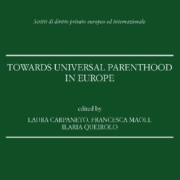
Recent Publication: Towards Universal Parenthood in Europe

The recently published book Towards Universal Parenthood in Europe (Editoriale Scientifica, 2025), edited by Laura Carpaneto, Francesca Maoli, and Ilaria Queirolo, offers a timely and rigorous contribution to European private international law and family law scholarship.

This volume follows the convention reported at this blog here and likewise presents the results of the UniPAR – Towards Universal Parenthood in Europe project, an EU-co-funded research initiative that addresses some of the most complex legal challenges in cross-border parenthood. Bringing together expert authors from different universities across European Union, the book combines theoretical frameworks with practical insights into how parenthood is recognised and regulated across different Member States. Covering six EU jurisdictions (Spain, Belgium, Italy, Bulgaria, Croatia and Poland) the book provides comprehensive national reports and comparative analyses on key issues of jurisdiction, applicable law, adoption, recognition of decisions and birth certificates and judicial cooperation in parenthood matters. The contents are available here.

This scholarly work advances the debate on the need for coherence in legal frameworks governing parentage and family relationships in European Union, especially in contexts involving cross-border mobility, assisted reproductive technologies and the recognition of family statuses across Member States. The final conclusions and recommendations serve both academic and policy audiences, offering structured reflections on legislative gaps and potential paths towards harmonised rules in EU private international law.This is an essential resource that deepens understanding of the legal implications of cross-border parenthood and strengthens the foundation for future legislative reform in European Union.

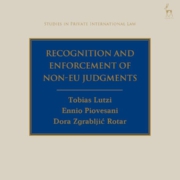
New Book Alert: Recognition and Enforcement of Non-EU Judgments

An upcoming milestone in private international law — Recognition and Enforcement of Non-EU Judgments (Bloomsbury / Hart Publishing, Feb. 19 2026), edited by Tobias Lutzi, Ennio Piovesani, and Dora Zgrabljic Rotar.

This is not just another doctrinal text, but the first comprehensive comparative deep dive into how EU Member States handle judgments from outside the EU, an area of law that has been notoriously fragmented and under-theorized.

The book contains country reports from 21 EU Member States on their national rules on recognition and enforcement of non-EU judgments in a unified framework, giving the reader both breadth and comparative depth. The editors pull these strands together in a detailed comparative report that highlights patterns of convergence and divergence across EU jurisdictions. Additionally, the book situates the Member State approaches in relation to the Brussels I regime and the 2019 HCCH Judgments Convention, which is itself reshaping global judicial cooperation. It had practical and scholarly appeal

The release date is 19 February 2026 and it is available for pre-order already at here.

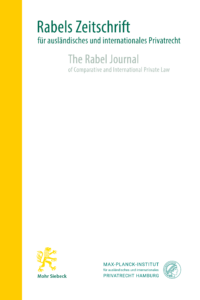
RabelsZ 89 (2025): Issue 3

The latest issue of RabelsZ has just been released. It contains the contributions to the symposium in honor of Jürgen Basedow that was held in Hamburg in November 2024. The table of contents is available here. All content is Open Access: CC BY 4.0 and more articles are available Online First.

Eva-Maria Kieninger, Konrad Duden and Ralf Michaels, Preface to the Symposium Issue, pp. 409–410, https://doi.org/10.1628/rabelsZ-2025-0046


Hannah L. Buxbaum, The New Unilateralism in EU Cross-Border Regulation: Objectives, Methods, Institution, oo. 411–431, https://doi.org/10.1628/rabelsZ-2025-0043

For years, Europe was a site of resistance to regulatory unilateralism, particularly as practiced by the United States. Today, though, there are signs of a robust unilateralism at work in EU regulatory practices. To some extent it simply mirrors practices adopted in the United States and elsewhere: Like other lawmakers, the EU has begun to act unilaterally where necessary to achieve effective regulation of its own markets and to protect local interests. In other respects, though, the new unilateralism in the EU presents quite differently. First, the EU increasingly uses its own legislation not to advance purely local regulatory interests, but rather to achieve international or global goals – classically a more multilateral objective. Second, under EU law individual regulations in particular substantive areas are embedded in a larger framework of norms and values that claim universal appeal. In both of these regards, the EU version of unilateralism appears more benign than purely »self-interested« unilateralism. It nevertheless raises important questions about the way that local laws and institutions are used to project regulatory power in the international arena. The goal of this article is to explore these questions. It begins by describing the characteristics of this new unilateralism, in terms of both its doctrinal foundations and its regulatory objectives. It then focuses on one particular mechanism: the adequacy regime established under EU data protection law.

Read more

PIL conference in Ljubljana, 18 September 2025

University of Ljubljana is organising Private International Law Conference with sessions in Slovenian and English. The conference, which will take place in Ljubljana (Slovenia) on 18 September 2025, will gather reknown academics and practitioners who will address current topics in European and international PIL.

The programme is available by clicking here: PIL-Ljubljana2025 and for more infromation you are welcome to contact the organisers at: ipp.pf@pf.uni-lj.si.