
Conflict of Laws
  • About
  • Editorial board
  • Subscription
  • Submission
  • Materials
  • Contact
  • Click to open the search input field Click to open the search input field Search
  • Menu Menu

Tag Archive for: England

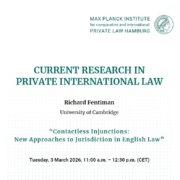
Richard Fentiman’s Lecture on Contactless Injunctions in English Law

February 11, 2026/in News/by Ivana Kunda

Richard Fentiman will be speaking on “Contactless Injunctions: New Approaches to Jurisdiction in English Law” at the forthcomming virtual workshop in the Max Planck Institute for Comparative and International Private Law series “Current Research in Private International Law” to be held on on Tuesday, 3 March 2026, at 11:00 (CET).

Richard Fentiman is Professor Emeritus of Private International Law at the University of Cambridge. His research is especially concerned with the law and practice of international commercial litigation and in particular with issues concerning jurisdiction and interim remedies. He will be speaking about the practice of the English courts which regularly grant extraterritorial injunctions to freeze foreign assets or prevent foreign proceedings. In a departure from past practice they will now do so even in the absence of any material link with England. This reveals much about English law’s distinctive approach to injunctions and begs deeper questions about the appropriate grounds for exercising jurisdiction in private international law.

The virtual lecture will be held as a video conference via Zoom. Prior registions is necesarry by Monday, 2 March 2026, using this link.

https://conflictoflaws.net/News/2026/02/MPI2026-03-03-e1770802474948.jpg 789 904 Ivana Kunda https://conflictoflaws.net/News/2020/08/CoL_Banner-1.png Ivana Kunda2026-02-11 14:37:022026-02-11 09:37:24Richard Fentiman’s Lecture on Contactless Injunctions in English Law

New Publication online in ICLQ

November 13, 2024/in News/by Chukwuma Okoli

Yesterday, the ICLQ published an article by Dr Maria Hook titled, “The Purpose of the Gateways for Service out of the Jurisdiction.” It is open access and it’s abstract reads as follows:

This article argues that the purpose of the English gateways for service out of the jurisdiction is to identify a presumptive meaningful connection; that courts have used different mechanisms to rebut the presumption of a meaningful connection established by the gateways; and that there are lessons to be learnt from a clearer, more explicit understanding of this presumptive purpose of the gateways. The article uses Brownlie (I and II) and Fong v Ascentic Ltd to support and illustrate these arguments.

https://conflictoflaws.net/News/2020/08/CoL_Banner-1.png 0 0 Chukwuma Okoli https://conflictoflaws.net/News/2020/08/CoL_Banner-1.png Chukwuma Okoli2024-11-13 14:09:162024-11-13 14:09:16New Publication online in ICLQ

UKSC on Traditional Rules of Jurisdiction: Brownlie v Four Seasons Holdings Incorporated

January 14, 2018/in Views/by Stephen Pitel

Shortly before Christmas the UKSC released its decision on jurisdiction in Brownlie v Four Seasons Holdings Incorporated (available here). Almost all the legal analysis is obiter dicta because, on the facts, it emerges that no claim against the British Columbia-based holding corporation could succeed (para 15) and the appeal is allowed on that basis. I suppose there is a back story as to why it took a trip to the UKSC and an extraordinary step by that court (para 14) for the defendant to make those facts clear, but I don’t know what it is. On the facts there are other potential defendants to the plaintiffs’ claim and time will tell whether jurisdictional issues arise for them.

The discussion of the value of the place of making a contract for jurisdiction purposes is noteworthy. In para 16 two of the judges (Sumption, Hughes) are critical of using the traditional common law rules on where a contract is made for purposes of taking jurisdiction. This has been the subject of debate in some recent Canadian decisions, notably the difference in approach between the Court of Appeal for Ontario and the Supreme Court of Canada in Lapointe Rosenstein Marchand Melançon LLP v Cassels Brock & Blackwell LLP, 2016 SCC 30 (available here). The SCC was fine with using the traditional rules for this purpose. In Brownlie, I do not think it is clear as to what view the other three judges take on this point.

Even more interestingly, the UKSC judges split 3-2 on how to understand the idea of damage in the forum as a basis for jurisdiction. Three judges (Hale, Wilson, Clarke) retain the traditional broad common law view – the position in many Canadian provinces prior to Club Resorts Ltd v Van Breda, 2012 SCC 17 (available here) – that ongoing suffering in the forum in respect of a tort that happened abroad is sufficient. Two judges (Sumption, Hughes) reject that approach and adopt a more narrow meaning of damage in the forum (it must be direct damage only).

This 3-2 split is closer even than it might first seem, since Lord Wilson (para 57) suggests that in a different case with fuller argument on the point the court might reach a different result.

Canadian law does not get a fair description in the UKSC decision. The court notes twice (para 21 and para 67) that Canada’s common law uses a broad meaning of damage for taking jurisdiction. Club Resorts, and the change to the law it represents on this very issue, is not mentioned. This is yet another illustration of the importance of being careful when engaging in comparative law analysis.

https://conflictoflaws.net/News/2020/08/CoL_Banner-1.png 0 0 Stephen Pitel https://conflictoflaws.net/News/2020/08/CoL_Banner-1.png Stephen Pitel2018-01-14 10:39:052018-08-11 18:42:28UKSC on Traditional Rules of Jurisdiction: Brownlie v Four Seasons Holdings Incorporated

Categories

  • Views
  • News

Most Recent Posts

  • Private International Law and European Society August 4, 2026
  • The New Zealand Supreme Court’s judgment in Kea Investments Ltd v Wikeley on anti-enforcement relief August 3, 2026
  • Beyond Domicile: The BHP Litigation and the Functional Interconnection of Public and Private International Law August 3, 2026
  • Conflicts of jurisdiction in Senegal: lesson from the Senegalese Supreme Court on Lis Pendens and the Exequatur of foreign judgments July 27, 2026
  • Adoption in the proposal for a European Parenthood Regulation July 21, 2026
  • Copyright, Targeting and Geo-Blocking: The CJEU Stirs the Pot July 15, 2026
  • A Follow-Up: The German Judges Association’s Response to the HCCH Draft Text of a Future Convention on Parallel Proceedings and Related Actions July 15, 2026
  • Private International Law Dimensions of Singapore’s New Legislation to Combat Online Harms July 14, 2026
  • The 1961 HCCH Apostille Convention: Why All African Countries Should Ratify It? — Insights from Judicial Practice in Africa July 14, 2026
  • The enforcement of an advance on costs for substitute performance at the expense of a Russian debtor in German-French legal relations July 2, 2026
  • “Yes, in principle, but not quite there yet…” – Some Observations on the Public Consultation on the HCCH Draft Text of a Future Convention on Parallel Proceedings and Related Actions June 29, 2026
  • Judgment Mobility Rules in India’s Private International Law Regime: No place for a revision au fond? June 26, 2026
  • Nothing to See Here: The CJEU’s Decision in Case C-232/25 Idzinski June 18, 2026
  • Refusal to Enforce in Egypt of a Californian (U.S.) Judgment for Lack of Reciprocity: What Has Gotten into the Egyptian Supreme Court? June 15, 2026
  • PRC Double Interest neither Double nor Penal: Australian Courts Clear Its Name When Enforcing Chinese Judgments June 10, 2026
Scroll to top Scroll to top Scroll to top