
Tag Archive for: adjudicative jurisdiction

Jurisdiction in the Middle Ages
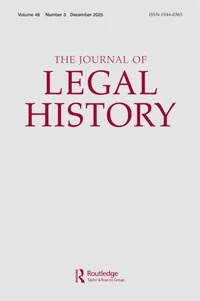
Since not all readers of the blog can be presumed to be avid consumers of the Journal of Legal History, it may be worth pointing out that issue 46/1 (2025) (table of contents  here) was dedicated to jurisdiction in the European Central Middle Ages. In their (open access) introduction, historians Danica Summerlin and Alice Taylor suggest explaining medieval law neither through the (rediscovered) Codex Justinianus as the basis of a ius commune, nor through the concept of legal pluralism, but instead through the emerging law of jurisdiction. Indeed, their approach deviates from earlier state-focused analyses on struggles between state and church and instead “foregrounds actors and performances as the means by which jurisdictions were asserted, defined and formalized – or, to put it another way, as the means by which jurisdiction came into being.”  The issue emerges from a British Academy funded multi-year research project on Jurisdictions, political discourse, and legal community, 1050–1250 that brought together (legal) historians from Europe and North America – but not, it seems, conflict of laws scholars. The contributions are fascinating and relevant for those of us who want to understand conflict of laws through its history – and may perhaps even provide a basis for future collaborations across disciplines?

Supreme Court of Canada to Hear Jurisdiction Appeal

Canada’s highest court does not grant leave to appeal in many cases involving private international law.  In November 2025 it granted leave to appeal from NHK Spring Co., Ltd. v Cheung, 2024 BCCA 236, in which the British Columbia Court of Appeal agreed with the court below in holding that it had jurisdiction to hear a price fixing class action.  The action is interesting because it involves what could be described as a “foreign” conspiracy that had effects within Canada.

The defendants are Japanese entities and the claim alleges that they conspired to fix the price of “suspension assemblies” which are a component of hard disk drives which are in turn a component of things like computers.  The claim alleges that Canadians purchased products that contained these assemblies and because of the price fixing they paid more than they otherwise would have done.

Read more

Torts and Tourists in the Supreme Court of Canada

In Sinclair v Venezia Turismo, 2025 SCC 27 (available here) the Supreme Court of Canada has, by 5-4 decision, held that the Ontario court does not have jurisdiction to hear claims by Ontario residents against three Italian defendants in respect of a tort in Italy.  The Sinclair family members were injured in a gondola collision in Venice that they alleged was caused by the Italian defendants.  But there were several connections to Ontario.  The trip to Italy had been booked by Mr Sinclair using a premium credit card’s concierge and travel agency service [4, 156] and the gondola ride had been arranged through that service [15, 160].  The card was with Amex Canada and one or more contracts connected to the gondola ride had been made in Ontario.  The Sinclairs were also suing Amex Canada and the travel service for carelessness in making the arrangements with the Italian defendants, and those defendants attorned in Ontario [167, 172].  A core overall issue, then, was whether the plaintiffs would be able to pursue all of their claims arising from the gondola collision, against various defendants, in one legal proceeding in Ontario.

Read more

Choice of Law in the American Courts in 2022: Thirty-Sixth Annual Survey

The 36th Annual Survey of Choice of Law in the American Courts (2022) has been posted to SSRN.

The cases discussed in this year’s survey cover such topics as: (1) choice of law, (2) party autonomy, (3) extraterritoriality, (4) international human rights, (5) foreign sovereign immunity, (6) foreign official immunity, (7) adjudicative jurisdiction, and (8) the recognition and enforcement of foreign judgments. Happy reading!

John Coyle (University of North Carolina School of Law)
William Dodge (University of California, Davis School of Law)
Aaron Simowitz (Willamette University College of Law)