Views
The DSA/DMA Package and the Conflict of Laws
A couple of weeks ago, I had the pleasure of speaking about the scope of application of the Digital Services Act (DSA) and Digital Markets Act (DMA), which together have been labelled the ‘European constitution for the internet’, at an event at the University of Strasbourg, organized by Etienne Farnoux and Delphine Porcheron. The preprint of my paper, forthcoming at Dalloz IP/IT, can be found on SSRN.
 Disappointingly, both instruments only describe their territorial scope of application through a unilateral conflicts rule (following a strict ‘marketplace’ approach; see Art. 2(1) DSA and Art. 1(2) DMA), but neither of them contains any wider conflicts provision. This is despite the many problems of private international law that it raises, e.g. when referring to ‘illegal’ content in Art. 16 DSA, which unavoidably requires a look at the applicable law(s) in order to establish this illegality. I have tried to illustrate some of these problems in the paper linked above and Marion Ho-Dac & Matthias Lehmann have also mentioned some more over at the EAPIL Blog.
Unfortunately, though, this reliance on unilateral conflicts rules that merely define the scope of application of a given instrument but otherwise defer to the general instruments of private international law seems to have become the norm for instruments regulating digital technology. It can be found, most famously, in Art. 3 of the GDPR, but also in Art. 1(2) of the P2B Regulation, Art. 3(1) of the proposed ePrivacy Regulation, and in Art. 1(2) of the proposed Data Act. Instruments that have taken the form of directive (such as the DSM Copyright Directive) even rely entirely on the general instruments of private international law to coordinate the different national implementations.
These general instruments, however, are notoriously ill-equipped to deal with the many cross-border problems raised by digital technology, usually resulting in large overlaps between national laws. These overlaps risk to undermine the regulatory aims of the instrument in question, as the example of the DSM Copyright Directive aptly demonstrates: With some of the most controversial questions having ultimately been delegated to national law, there is a palpable risk of many of the compromises that have been found at the national level to be undermined by the concurrent application of other national laws pursuant to Art. 8 I Rome II.
The over-reliance on general instruments of PIL despite their well-established limitations also feels like a step back from the e-Commerce Directive, which at least made a valiant attempt to reduce the number of national laws, although arguably not at the level of the conflict of laws (see CJEU, eDate, paras. 64–67). The balance struck by, and underlying rationale of, the e-Commerce Directive can certainly be discussed – indeed, given its importance for the EU’s ambition of creating a ‘Digital Single Market’, it should be. The drafting of the DSA/DMA package would arguably have provided the perfect opportunity for this discussion.
The long tentacles of the Helms-Burton Act in Europe (III)
Written by Nicolás Zambrana-Tévar LLM(LSE) PhD(Navarra), Associate Professor KIMEP University (Kazakhstan), n.zambrana@kimep.kz
There has recently been a new and disappointing development in the saga of the Sánchez-Hill, a Spanish-Cuban-US family who filed a lawsuit before Spanish courts against a Spanish Hotel company (Meliá Hotels) for unjust enrichment. Meliá is exploiting several hotels located on land owned by Gaviota S.A., a Cuban company owned by the Republic of Cuba. That land was expropriated by Cuba without compensation, following the revolution of 1959.
Read more
Choice of Law in the American Courts in 2022: Thirty-Sixth Annual Survey
The 36th Annual Survey of Choice of Law in the American Courts (2022) has been posted to SSRN.
The cases discussed in this year’s survey cover such topics as: (1) choice of law, (2) party autonomy, (3) extraterritoriality, (4) international human rights, (5) foreign sovereign immunity, (6) foreign official immunity, (7) adjudicative jurisdiction, and (8) the recognition and enforcement of foreign judgments. Happy reading!
John Coyle (University of North Carolina School of Law)
William Dodge (University of California, Davis School of Law)
Aaron Simowitz (Willamette University College of Law)
News
The Supreme People’s Court of the People’s Republic of China issued the Notice on Procedural Matters Related to Civil Cases Involving Foreign State Immunity
(This is written by Xiaoxuan Gu, a PhD student in School of Law, University of Macau)
The Foreign State Immunity Law of the People’s Republic of China (CFSIL) took effect on January 1, 2024.[i] To ensure its proper implementation and guide courts nationwide in lawfully and efficiently adjudicating civil cases involving foreign state immunity, the Supreme People’s Court (SPC) formulated supporting procedural rules. On March 26, 2025, the SPC issued the Notice on Procedural Matters Related to Civil Cases Involving Foreign State Immunity (hereinafter the “Notice”), which provides definitive guidance to courts at all levels in handling such novel foreign-related cases.
The Notice stipulates provisions on key procedural matters, including case acceptance criteria, centralized jurisdiction mechanisms, service of process rules, jurisdictional immunity review procedures, and protocols for obtaining evidentiary certifications from the Ministry of Foreign Affairs. Read more
ASADIP: Annual Conference, Moot and New Board


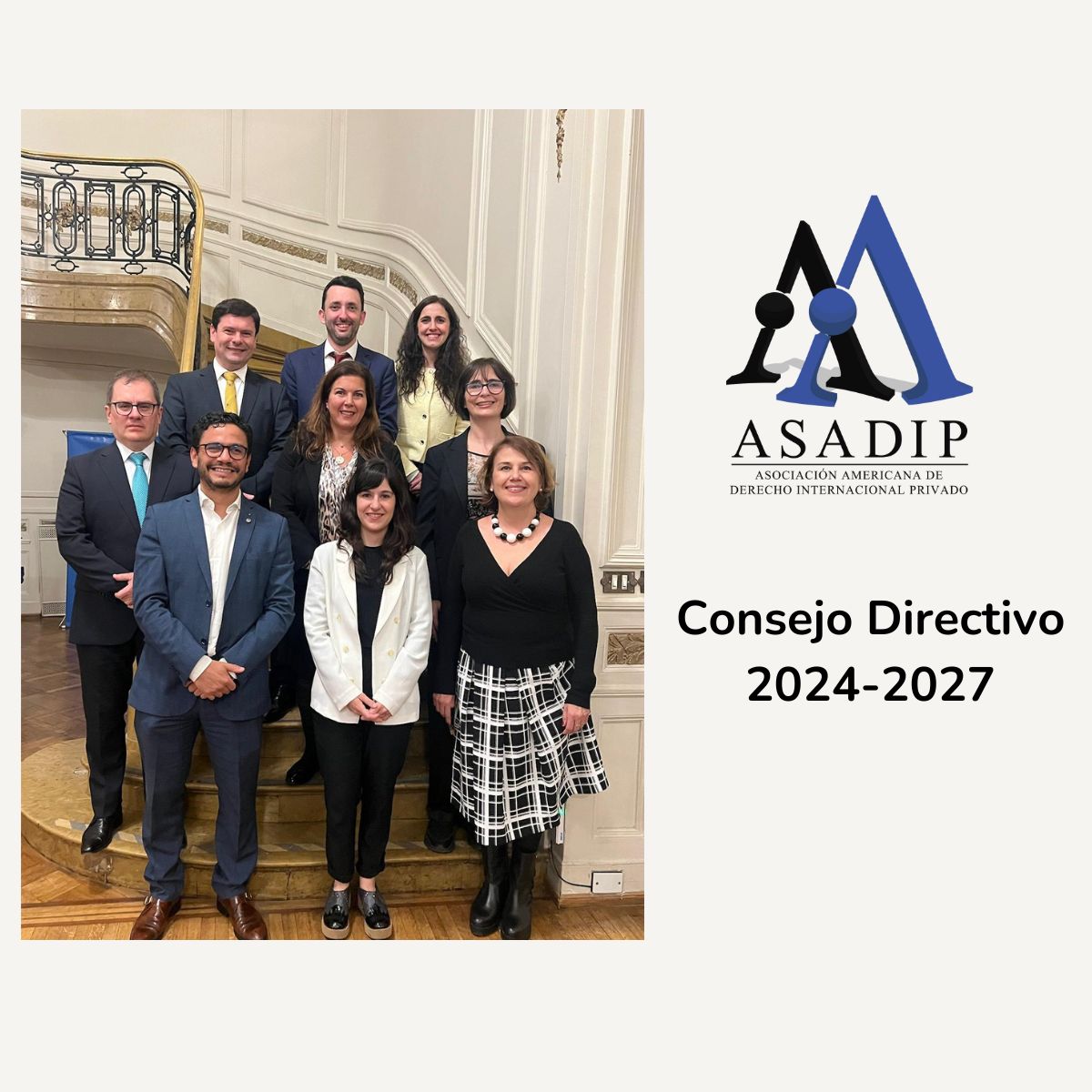
Annual conference
The Annual Conference of the American Association of Private International Law (ASADIP) will take place on 7-9 August 2025 in Rio de Janeiro (Brazil). More information will be available soon. Read more
Legal Internships at the HCCH
Applications are now open for three- to six-month legal internships at the headquarters of the Permanent Bureau of the Hague Conference on Private International Law (HCCH) in The Hague, for the period from July to December 2025!
Interns work with our legal teams in the Family and Child Protection Law Division, the Transnational Litigation and Apostille Division, and the Commercial, Digital and Financial Law Division. Duties may include carrying out research on particular points of private international law and/or comparative law, taking part in the preparation of HCCH meetings and contributing to the promotion of the HCCH and its work.
Applications should be submitted by Friday, 25 April 2025 at 18.00 (CEST). For more information, please visit the Internships Section of the HCCH website.
This post is published by the Permanent Bureau of the Hague Conference of Private International Law (HCCH).