


Views
Denial of Natural Justice as a Defence to Enforcement of a Chinese Judgment in Australia
In Yin v Wu [2023] VSCA 130, the Court of Appeal of the Supreme Court of Victoria set aside a judgment[1] which had affirmed the enforcement a Chinese judgment by an Associate Justice of the Supreme Court.[2] This was a rare instance of an Australian court considering the defence to enforcement of a foreign judgment on the basis that the judgment debtor was denied natural justice—or procedural fairness—before the foreign court.
Background
The dispute concerned a payment made by a Chinese national living in China, Di Wu, to a Chinese national living in Australia, Ke Yin. The payment was made pursuant to a foreign exchange agreement: Yin had promised to pay Wu a sum of US Dollars in exchange for Wu’s Chinese RMB.
The arrangement was made unusually through a series of Telegram and WhatsApp messages, from accounts with different numbers and aliases. (In Australia, we would say that the arrangement sounded ‘suss’.) The agreement was seemingly contrary to Chinese law, which may have contributed to the clandestine character of communications underlying the agreement; see [30].
Change of gender in private international law: a problem arises between Scotland and England
Written by Professor Eric Clive
The Secretary of State for Scotland, a Minister of the United Kingdom government, has made an order under section 35 of the Scotland Act 1998 blocking Royal Assent to the Gender Recognition Reform (Scotland) Bill 2022, a Bill passed by the Scottish Parliament by a large majority. The Scottish government has challenged the order by means of a petition for judicial review. The case is constitutionally important and may well go to the United Kingdom Supreme court. It also raises interesting questions of private international law.
At present the rules on obtaining a gender recognition certificate, which has the effect of changing the applicant’s legal gender, are more or less the same in England and Wales, Scotland and Northern Ireland. The Scottish Bill would replace the rules for Scotland by less restrictive, de-medicalised rules. An unfortunate side effect is that Scottish certificates would no longer have automatic effect by statute in other parts of the United Kingdom. The United Kingdom government could remedy this by legislation but there is no indication that it intends to do so. Its position is that it does not like the Scottish Bill.
One of the reasons given by the Secretary of State for making the order is that having two different systems for issuing gender recognition certificates within the United Kingdom would cause serious problems. A person, he assumes, might be legally of one gender in England and another in Scotland. There would therefore be difficulties for some organisations operating at United Kingdom level – for example, in the fields of tax, benefits and pensions. This immediately strikes a private lawyer as odd. Scotland and England have had different systems in the law of persons for centuries – in the laws on marriage, divorce, legitimacy, incapacity and other matters of personal status – and they have not given rise to serious problems. This is because the rules of private international law, even in the absence of statutory provision, did not allow them to.
Judgments Convention – No Thanks?
On September 1st, 2023, the 2019 Hague Judgments Convention will enter into force for the Member States of the EU and Ukraine. According to the HCCH, the Convention is “a true gamechanger in international dispute resolution”, which will “reduce transactional and litigation costs, facilitate rule-based multilateral trade and investment, increase certainty and predictability” and “promote effective justice for all”. The international conference taking place in Bonn later this week will likely strike an equally celebratory tone.
This sentiment is not shared universally, though. In a scathing article just published in Zeitschrift für Europäisches Privatrecht (ZEuP) entitled ‘Judgments Convention: No Thanks!‘, Haimo Schack (University of Kiel) labels the Convention as “evidently worthless”.
Schack comes to this damning conclusion in three steps. First, he argues that the 2005 Choice of Court Convention, the first outcome of the decades-long HCCH Jurisdiction Project, has been of minimal use for the EU and only benefited Singapore and London. Read more
News
Praxis des Internationalen Privat- und Verfahrensrechts (IPRax) 4/2025: Abstracts
The latest issue of the „Praxis des Internationalen Privat- und Verfahrensrechts“ (IPRax) features the following articles:
Judgment of the Hellenic Supreme Court Part 2: Relatives’ rights to compensation for emotional distress in fatal car accidents under the Rome II Regulation
Following a judgment by the Supreme Court of Greece in 2023, the issue of direct damages was once again brought before Areios Pagos. In a decision that diverged from the ruling of the Court of Justice of the European Union (CJEU) in the Lazar case, the Supreme Court reaffirmed its position. However, one member of the court expressed a dissenting opinion, emphasizing the obligation of national courts to submit a preliminary reference. This judge provided rationale for the Supreme Court’s departure from established case law, highlighting the importance of adhering to the CJEU’s precedents in the context of European legal integration.
Out Now: The 50th anniversary of the first Inter-American specialized conference on private international law. The future of private international law in the Americas by Dante Mauricio Negro Alvarado
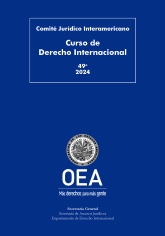
The Department of International Law (Secretariat for Legal Affairs) of the Organization of American States (OAS) has just published in essay form the lectures delivered during the 49th Course on International Law, which was held on 5 -16 August 2024. For more information, click here.
The book features the following piece: The 50th anniversary of the first Inter-American specialized conference on private international law. The future of private international law in the Americas by Dante Mauricio Negro Alvarado (in English, p. 295-335). This is a must-read for Private International Law academics and lawyers from the region and beyond. Read more