Views
New EU Digitalisation Regulation: A Stepping Stone to Digitalised EU?
Author: Martina Ticic, assistant at the University of Rijeka, Faculty of Law and doctoral student funded by the Croatian Science Foundation (Hrvatska zaklada za znanost – HRZZ)
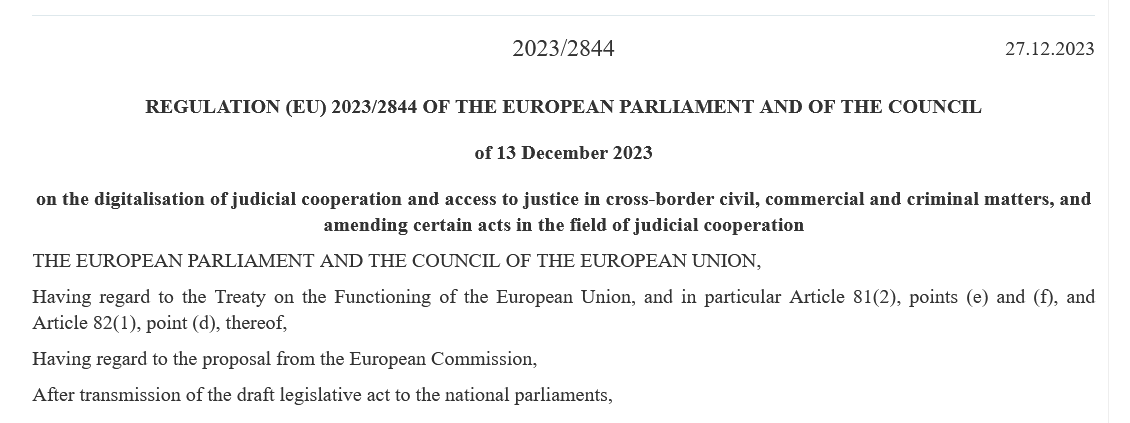
On 13 December 2023, two years after the first legislative proposal has been published, the new Regulation (EU) 2023/2844 of the European
Parliament and of the Council of 13 December 2023 on the digitalisation of judicial cooperation and access to justice in cross-border civil, commercial and criminal matters, and amending certain acts in the field of judicial cooperation (Digitalisation Regulation) has been adopted. While the process of digitalisation of judicial cooperation and cross-border procedures in the EU has been ongoing for some time already, the new Digitalisation Regulation represents a major step for advancing digitalisation practices in the EU.
Bahraini High Court on Choice of Court and Choice of Law Agreements
I. Introduction
It is widely recognized that choice of court and choice of law agreements are powerful tools for structuring and planning international dispute resolution. These agreements play an important role in “increasing legal certainty for the parties in cross-border transactions and reducing incentives for (the harmful version of) forum shopping.” (Alex Mills, Party Autonomy in Private International Law (CUP, 2018) p. 75). However, the realization of these objectives depends on the enforcement of the parties’ choice. Unfortunately, general practice in the MENA (North Africa and the Middle East) region shows that, with a few exceptions, the status quo is far from satisfactory. Choice-of-court agreements conferring jurisdiction on foreign courts are often disregarded or declared null and void. Similarly, the foreign law chosen as the governing law of a contract is often not applied because of the procedural status of foreign law as a matter of fact, the content of which must be ascertained by the party invoking its application. The recent judgment of the High Court of Bahrain (a first instance court in the Bahraini judicial system) in the Case No. 2/13276/2023/02 of 17 January 2024 is nothing but another example of this entrenched practice that can be observed in the vast majority of countries in the region.
U.S. Supreme Court Decides Great Lakes
On February 21, 2024, the U.S. Supreme Court handed down its decision in Great Lakes Insurance SE v. Raiders Retreat Realty Company, LLC.
The question presented was whether, under federal admiralty law, a choice-of-law clause in a maritime contract can be rendered unenforceable if enforcement is contrary to the “strong public policy” of the U.S. state whose law is displaced. In a unanimous opinion authored by Justice Kavanaugh, the Court concluded that the answer to this question was no. It held that choice-of-law provisions in maritime contracts are presumptively enforceable as a matter of federal maritime law. It further held that while there are narrow exceptions to this rule, state public policy is not one of them.
News
AMEDIP’s annual seminar: Program and registration (in Spanish)
The program of the XLVIII Seminar of the Mexican Academy of Private International and Comparative Law (AMEDIP) has been published, click here.
To register, click here. Registration is free of charge (except if a certificate of attendance is requested). Only in-person participation is possible this year (with the exception of speakers, who may present online). Read more
20th Regional Private International Law Conference (6-8 November 2025, Istanbul)
20th Regional Private International Law Conference will be held in Istanbul on 6-8 November 2025 in collaboration with Erdem&Erdem Law Office and Istanbul Arbitration Center (ISTAC). This year’s conference topics are focusing on choice of court/arbitration agreements and the enforcement of decisions rendered by chosen courts or arbitral tribunals. The conference programme can be viewed in here.
Participation is available via Zoom, through the link provided: https://us06web.zoom.us/j/84302415223?pwd=JdVlMzX7dzabawYUF6TnjKnjp8xKhf.1 (Meeting ID: 843 0241 5223 Password: 786753)
For further questions you may contact the organizers Prof. Dr. Zeynep Derya Tarman (Koç University Faculty of Law, Dean) and Prof. Dr. Ceyda Süral Efeçinar (Piri Reis University Faculty of Law, Dean) at meoba@ku.edu.tr (Dr. M. Ece Oba, Research Assistant at Koç University Faculty of Law).
HCCH Vacancy: Legal Officer
The Permanent Bureau of the HCCH welcomes applications for the position of Legal Officer, based at its headquarters in The Hague, Netherlands.
The successful candidate will work in the field of international commercial, digital and financial law, under the responsibility of the Deputy Secretary General. In addition to work in relation to the operation of the 1985 Trusts Convention, the 2006 Securities Convention, and the 2015 Choice of Law Principles, duties will include general assistance in relation to the projects on Central Bank Digital Currencies (CBDCs), Carbon Markets, Digital Tokens, and the Digital Economy. Depending on the work programme established by CGAP, the successful candidate may be called upon to carry out work in other areas, and will respond to requests for information, assist with comparative law research, the preparation of research papers and other documentation, the organisation and preparation of materials for publication, the preparation of, and participation in, conferences, seminars and training programmes.
The successful candidate will also support the work of the office of the Deputy Secretary General, and may be called to take on such other work as may be required by the Secretary General from time to time.
Applications should be submitted by 1 November 2025 (5.00 p.m. CET). For more information, please visit the Recruitment section of the HCCH website.
This post is published by the Permanent Bureau of the Hague Conference of Private International Law (HCCH).