Views
Advocate General in Case Mirin (C-4/23): Refusal of recognition of a new gender identity legally obtained in another Member State violates the freedom of movement and residence of EU citizens
The following case note has been kindly provided by Dr. Samuel Vuattoux-Bock, LL.M. (Kiel), University of Freiburg (Germany).
On May 7, 2024, Advocate General Jean Richard de la Tour delivered his opinion in the case C-4/23, Mirin, concerning the recognition in one Member State of a change of gender obtained in another Member State by a citizen of both States. In his opinion, Advocate General de la Tour states that the refusal of such a recognition would violate the right to move and reside freely within the Union (Art. 21 TFEU, Art. 45 EU Charter of Fundamental Rights) and the right of respect for private and family life (Art. 7 EU Charter of Fundamental Rights). Read more
The Kenyan Supreme Court holds that Scottish Locus Inspection Orders must be Examined by the Kenyan Courts for Recognition and Enforcement in Kenya
Miss Anam Abdul-Majid (LLM, University of Birmingham; LLB, University of Nairobi; BSC.IBA, United States International University; Advocate and Head of Corporate and Commercial Department, KSM Advocates, Nairobi, Kenya).
Dr Chukwuma Okoli (Assistant Professor in Commercial Conflict of Laws at the University of Birmingham; Senior Research Associate; Private International Law in Emerging Countries, University of Johannesburg)
We would like to thank Joy Chebet, Law Student at Kenyatta University, for her research assistance and comments. We would also like to thank Professor Beligh Elbalti for his critical comments on the draft blogpost.
I. INTRODUCTION
Kenya is one of the countries that make up East Africa and is therefore part of the broader African region. As such, developments in Kenyan law are likely to have a profound impact on neighbouring countries and beyond, consequently warranting special attention.
In the recent case of Ingang’a & 6 others v James Finlay (Kenya) Limited (Petition 7 (E009) of 2021) [2023] KESC 22 (KLR), the Kenyan Supreme Court dismissed an appeal for the recognition and enforcement of a locus inspection order issued by a Scottish Court. The Kenyan Supreme Court held that ‘decisions by foreign courts and tribunals are not automatically recognized or enforceable in Kenya. They must be examined by the courts in Kenya for them to gain recognition and to be enforced’ [para 66]. In its final order, the Court recommended that in Kenya:
‘The Speakers of the National Assembly and the Senate, the Attorney-General, and the Kenya Law Reform Commission, attended with a signal of the utmost urgency, for any necessary amendments, formulation and enactment of statute law to give effect to this judgment and develop the legislation on judicial assistance in obtaining evidence for civil proceedings in foreign courts and tribunals.’
This Case is highly significant, because it extensively addresses the recognition and enforcement of foreign judgments in Kenya and the principles to be considered by the Kenyan Courts. It is therefore a Case that other African countries, common law jurisdictions, and further parts of the globe could find invaluable.
II. FACTS
The Case outlined below pertained to the enforcement of a foreign judgment/ruling in Kenya, specifically, a Scottish ruling. As a brief overview, the Appellants were individuals who claimed to work for the Respondent, the latter being a company incorporated in Scotland. However, their place of employment was Kenya, namely, Kericho. The nature of the claim consisted of work-related injuries, attributed to the Respondent’s negligence due to the Appellants’ poor working conditions at the tea estates in Kericho. The claim was filed before the courts in Scotland, where inspection orders were sought by the Appellants and granted by the Courts. The purpose of the locus inspection order was to collect evidence by sending experts to Kenya and submit a report which can be used by the Scottish court to determine the liability of the Respondent. However, the respondent fearing compliance with the Scottish locus inspection order, sought an order from Kenyan Court to prevent the execution of the locus inspection order in Kenya, leading to a petition being filed by the Appellants before the Employment and Labour Relations Court in Kenya.
Nevertheless, the trial court ruled against the Appellants and stated that the enforcement of foreign judgments in Kenya, especially interlocutory orders, required Kenyan judicial aid to ensure that the foreign judgments aligned with Kenya’s public policy. This was further affirmed by the Court of Appeal, which expressed the same views and reiterated the need for judicial assistance in enforcing foreign judgments and rulings in Kenya. The Court of Appeal held that decisions issued by foreign courts and tribunals are not automatically recognised or enforceable in Kenya and must be examined by the Kenyan courts to gain recognition and be enforced.
The matter was then brought before the Supreme Court of Kenya.
III. SUMMARY OF THE JUDGMENT BEFORE THE SUPREME COURT OF KENYA
With regard to the enforcement of foreign judgments, the Supreme Court had to determine ‘whether the locus inspection orders issued by the Scottish Court could be executed in Kenya without intervention by Kenyan authorities.’
However, the Appellants argued that the locus inspection orders were self-executing and did not require an execution process. Instead, inspection orders only required the parties’ compliance. Conversely, the Respondents argued that any decision not delivered by a Kenyan court should be scrutinised by the Kenyan authorities before its execution.
In its decision, the Supreme Court relied on the principle of territoriality, which it referred to as a ‘cornerstone of international law’ [para 51], and further elaborated on the importance of sovereignty. Based on the principle of territoriality, while upholding the principle of sovereignty, the Supreme Court stated that the ‘no judgment of a Court of one country can be executed proprio vigore in another country’ [para 52]. The Supreme Court’s view was that the universal recognition and enforcement of foreign decisions leads to the superiority of foreign nations over national courts. It likewise paves the way for the exposure of arbitrary measures, which are then imposed on the residents of a country against whom measures have been taken abroad. In its statements, the Supreme Court concreted the decision that foreign judgments in Kenya cannot be enforced automatically, but must gain recognition in Kenya through acts of authorisation by the Judiciary, in order to be enforced in Kenya.
The Supreme Court grounded the theoretical basis for enforcing foreign judgments in Kenyan common law as comity. It approved the US approach (Hilton v Guyot) to the effect that: ‘The application of the doctrine of comity means that the recognition of foreign decisions is not out of obligation, but rather out of convenience and utility’ [para 59]. The Court justified comity as:
‘prioritizing citizen protection while taking into account the legitimate interests of foreign claimants. This approach is consistent with the adaptability of international comity as a principle of informed prioritizing national interests rather than absolute obligation, as well as the practical differences between the international and national contexts.’ [para 60]
The Kenyan Supreme Court further established the importance of reciprocity and asserted that the Foreign Judgements (Reciprocal Enforcement) Act 2018 was the primary Act governing foreign judgments. The Court recognised that as a constituent country of the United Kingdom, Scotland is a reciprocating country under the Foreign Judgments (Reciprocal Enforcement) Act. However, the orders sought did not fall under the above Act, as locus inspection orders are not on the list of decisions that are expressly mentioned in the Act. Moreover, locus inspection orders are not final orders. Thus, the Supreme Court’s position was that the locus inspection orders could not fall within the ambit of the Foreign Judgments (Reciprocal Enforcement) Act, and the trial court and the Court of Appeal were incorrect in extending the application of the Act to these orders.
Consequently, the Supreme Court highlighted the correct instrument to be relied on for the above matter. It was the Supreme Court’s position that although the Civil Procedure Act does not specifically establish a process for the judicial assistance of orders to undertake local investigations, the same process as for judicial assistance in the examination of witnesses could be imitated for local investigation orders. Thus, the Supreme Court stated that:
‘The procedure of foreign courts seeking judicial assistance in Kenya for examination of witnesses was the same procedure to be followed for carrying out local investigations, examination or adjustment accounts; or to make a partition. That procedure was through the issuance of commission rogatoire or letter of request to the High Court in Kenya seeking assistance. That procedure was not immediately apparent. The High Court and Court of Appeal were wrong for extending the spirit of the beyond its application as that was not the appropriate statute that was applicable to the instant case.’ [para 26]
The process is therefore as under the Sections 54 and 55 of the Civil Procedure Act, Order 28 of the Civil Procedure Rules, as well as the Practice Directions to Standardize Practice and Procedures in the High Court made pursuant to Section 10 of the Judicature Act. It entails issuing a commission rogatoire or letter of request to the Registrar of the High Court in Kenya, seeking assistance. This would then trigger the High Court in Kenya to implement the Rules as contained in Order 28 of the Civil Procedure Rules, 2010 [92 – 99].
IV. COMMENTS
An interesting point of classification in this case might be whether this was simply one of judicial assistance for the Kenyan Courts to implement Scottish locus inspection orders in its jurisdiction. Seen from this light, it was not a typical case of recognising and enforcing foreign judgment. Nevertheless, the case presented before the Kenyan Courts, including the Kenyan Supreme Court was premised on recognition and enforcement of foreign judgments.
The Kenyan Supreme Court has settled the debate on the need for foreign judgments to be recognised in Kenya before they can be enforced. The Court also settled that owing to the principle of finality, interim orders could not fall within the Foreign Judgments (Reciprocal Enforcement) Act. It is owing to this principle of finality that the Supreme Court refused to extend the application of the Act to local investigation orders, but rather proceeded to tackle the latter in the same manner as under the Civil Procedure Act and Civil Procedure Rules.
The Supreme Court was correct in establishing that recognition is necessary before foreign judgments can be enforced in Kenya. The principles upon which the Supreme Court came to this conclusion were also correct since territoriality and sovereignty dictate the same. The Supreme Court set a precedent that the Civil Procedure Act and the Civil Procedure Rules are the correct instruments to be relied upon in issuing orders for local investigations, in contrast to the position of the Court of Appeal, which placed local investigations in the ambit of the Foreign Judgments (Reciprocal Enforcement) Act. The Supreme Court adopted its position based on section 52 of the Civil Procedure Act, which empowers courts to issue commission orders and lists local investigations under commission orders.
This decision is crucial, because not only did the Supreme Court lay to rest any confusion over what should constitute the applicable law for local investigations, it also sets down the procedure for foreign courts seeking judicial assistance in Kenya with regard to all four commission orders, as under the Civil Procedure Act. The Civil Procedure Act is the primary Act governing civil litigation in Kenya, while the Civil Procedure Rules 2010 are the primary subsidiary regulations for the same. Commission orders under this Act are divided into four as highlighted above: examination of witnesses, carrying out local investigations, examination or adjustment accounts, or making a partition.
This decision thus did not only tackle orders of local investigation but concluded the process for all four commission orders as highlighted above. In doing so, it established a uniform process for all four of the commission orders, in accordance with the Primary Act and Rules governing civil litigation in Kenya. Although it may appear that the Supreme Court has stretched the application of the Civil Procedure Rules, 2010 in the same way that the Court of Appeal stretched the application of the Foreign Judgments (Reciprocal Enforcement) Act; the Civil Procedure Rules, 2010 are more relevant, given that the rules touch on these four commission orders and are tackled in turn, in the same category, under the Civil Procedure Rules, 2010. Moreover, while it is true that there is currently a gap in the law as the process for local investigations has not been outlined in the same way that it has been for examination of witnesses, by parity of reasoning the Supreme Court’s reasoning fits, and the logic behind adopting the same process is laudable.
Another interesting aspect of the Supreme Court’s decision is the endorsement of the US approach of comity as the basis of recognising and enforcing foreign judgments in Kenyan common law. This is indeed a radical departure from the common law approach of the theory of obligation, which prevails in other Commonwealth African Countries. In an earlier Case, the Kenyan Court of Appeal in Jayesh Hasmukh Shah vs Navin Haria & Anor [para 25 – 26] adopted the US principle of comity to recognise and enforce foreign judgments. The principle of comity also formed the sole basis of enforcing a US judgment in Uganda in Christopher Sales v Attorney General, where no reciprocal law exists between the state of origin and the state of recognition. Consequently, it is safe to say that some East African judges are aligning more with the US approach of comity in recognising and enforcing foreign judgments at common law, while many other common law African countries continue to adopt the theory of obligation.
An issue that was not explicitly directed to the Kenyan Supreme Court was that this was a business and human rights case, and one involving the protection of weaker parties. This may have provoked policy reasons from the Court that would have been very useful in developing the law as it relates business and human rights issues, and protection of employees in cross-border matters.
On a final note, the robust reasoning of their Lordships must be commended in this recent Supreme Court decision, given that it adds significant value to the jurisprudence of recognising and enforcing foreign judgments in the Commonwealth as a whole, in East Africa overall, and particularly in Kenya. The comparative approach adopted in this judgment will also prove to be edifying to anyone with an interest in comparative aspects of the recognition and enforcement of foreign judgments globally.
In Memoriam Erik Jayme (1934-2024)

With great sadness did we receive notice that Erik Jayme passed away on 1 May 2024, shortly before his 90th birthday on 8 June. Everyone in the CoL and PIL world is familiar with and is probably admiring his outstanding and often path-breaking work as a global scholar. Those who met him in person were certainly overwhelmed by his humour and humanity, by his talent to approach people and engage them into conversations about the law, art and culture. Anyone who had the privilege of attending lectures of his will remember his profound and often surprising and unconventional views, paths and turns through the subject matter, often combined with a subtle and entertaining irony.
Erik Jayme was born in Montréal, as the son of a German Huguenot of French origin and a Norwegian. The parents had married in Detroit before a protestant priest. What else if not a profound interest in cross-border relations, different cultures and languages as well as bridging cultural differences and, ultimately, Private International Law could have been the result? “There was no other way“, as he put it once. His father, Georg, born on 10 April 1899 in Ober-Modau in South Hesse of Germany, passed away on 1 January 1979 in Darmstadt, later became a professor of what today would probably be called chemical engineering, with great success, on cellulose production technologies at the University of Darmstadt. His passion for collecting Expressionist and 19th century art undoubtedly served as an inspiration for Erik to later devote himself to art, art history and finally art law. During his youth, as Erik mentioned once, he would use his (exceptionally broad) knowledge on art and any aspect of culture that crossed his mind to draw his tennis partners into sophisticated and demanding conversations on the court. Perhaps not least with a view to his father’s expectations, Erik decided to study law at the University of Munich, but added courses in art history to his curriculum. He liked to recall, how he approached the world-famous art historian, Hans Sedlmayr, to ask him whether he might allow him to attend his seminars, despite being (“unfortunately“) a law student. Sedlmayr replied that Spinoza had been wise to be grinding optical lenses to earn a living, and in light of a similar wisdom that the applicant showed, he was accepted.
In 1961, at the age of 27, Erik Jayme delivered his doctoral thesis on „Spannungen bei der Anwendung italienischen Familienrechts durch deutsche Gerichte“ (“Tension in the application of Italian family law by German courts“).[1] While clerking at the court of Darmstadt, Erik Jayme published his first article in this field, inspired by a case in which he was involved. International family and succession law as well as questions of citizenship became a focus of his academic research and publications for decades, including his Habilitation in 1971 on „Die Familie im Recht der unerlaubten Handlungen” (“The Family in Tort Law“),[2] in particular with a view to relations connected with Italy. This may show early traces of what became more apparent later: More than others, Erik Jayme took the liberty to make use of law, legal research and academia to build his own way of life (that should definitely include Italy), inspired by seemingly singularities in a concrete case that would be seen as a sign for something greater and thus transformed into theories and concepts, enriched by a dialogue with concepts from other fields such as art history. Is this way of producing creativity also the source of what later rocked the private international law of South America: the « diálogo das fontes como método »?[3] His research on Pasquale Stanislao Mancini,[4] later combined with studies on Anton Mittermaier,[5] Giuseppe Pisanelli [6] and Emerico Amari [7] as well as on Antonio Canova [8] were received as leading works on conceptual developments in the fields of choice of law, international civil procedural law, comparative law as well as international art and cultural property law, and over time, Erik Jayme became one of the world leading and most influential scholars in the field. The substantial contribution Erik Jayme provided to the work of The Hague Academy of International law, was perfectly summarized in Teun Struycken’s « Hommage à Erik Jayme » delivered in 2016 on behalf of the Academy’s Curatorium:[9]
« Vous n’avez cessé de souligner que les systèmes de droit ne s’isolent pas de la société humaine, mais s‘y imbriquent. Ils sont même des expressions de la culture des sociétés. La culture s’exprime aussi et surtout dans les beaux arts. »
Speaking of art and cultural property law: It seems to be the year of 1990 when Erik Jayme published for the first time a piece in this field, namely a short conference report on what has now become an eternal question: „Internationaler Kulturgüterschutz: lex originis oder lex rei sitae“ (“Protection of international cultural property: lex originis or lex rei sitae“).[10] In 1991, his seminal work on „Kunstwerk und Nation: Zuordnungsprobleme im internationalen Kulturgüterschutz“ (“Artwork and nation: Problems of attribution in the international protection of cultural property“)[11] appeared as a report for the historical-philosophical branch of the Heidelberg Academy of Sciences where he traced back the notion of a “home“ (« une patrie » ) of an artwork to Antonio Canova‘s activities as the Vatican’s diplomate at the Congress of Vienna where Canova, a sculptural artist by the way, succeeded in bringing home the cultural treasures taken by Napoléon Bonaparte from Rome to Paris (into the newly built Louvre) back to Rome (into the newly built Museo Chiaramonti), despite the formal legalisation of this taking in the Treaty of Tolentino of 1797. “This is where the notion of a lex originis was born”. Still in 1991, the Institut de Droit International concluded under the leadership of Erik Jayme, in its Resolution of Basel « La vente internationale d’objets d’arts sous l’angle de la protection du patrimoine culturel » in its Art. 2: « Le transfert de la propriété des objets d’art – appartenant au patrimoine culturel du pays d’origine du bien – est soumis à la loi de ce pays » . Much later, in 2005, when I had the privilege of travelling with him to the Vanderbilt Law School and the Harvard Law School for presentations of ours on „Global claims for art“, he further developed his vision of a work of art as quasi-persons who should be conceived as having their own cultural identity,[12] to be located at the place where the artwork is most intensely inspiring the public and thus is “living“. From there it was only a small step to calling for a guardian ad litem for an artwork, just as for a child, in legal proceedings. When Erik Jayme was introduced to the audiences in Vanderbilt and Harvard, the academic hosts would usually present him, in all their admiration, as “a true Renaissance man“. I would believe that he felt more affiliated to the 19th century, but this might not necessarily exclude the perception of him as a “Renaissance man“ from a transatlantic perspective, all the more as there seems to be no suitable term in English for the German „Universalgelehrter“ (literally: “universal scholar”).
This is just a very small fraction of Erik Jayme’s amazingly wide-ranging, rich and influential scholarly life and of his extraordinarily inspiring personality. Many others may and should add their own perspectives, perhaps even on this blog. We will all miss him, but he will live on in our memories!
[1] Jayme, Spannungen bei der Anwendung italienischen Familienrechts durch deutsche Gerichte, Gieseking 1961 (LCCN 65048319).
[2] Jayme, Die Familie im Recht der unerlaubten Handlungen, Metzner 1971 (LCCN 72599373).
[3] Jayme, « Identité culturelle et intégration: le droit international privé postmoderne », Recueil des Cours 251 (1995), 259 (Recueil des cours en ligne).
[4] See e.g. Jayme, Pasquale Stanislao Mancini : internationales Privatrecht zwischen Risorgimento und praktischer Jurisprudenz, Gremer 1990 (LCCN 81116205).
[5] Jayme, „Italienische Zustände“, in: Moritz/Schroeder (eds.), Carl Joseph Anton Mittermaier (1787-1867) – Ein Heidelberger Professor zwischen nationaler Politik und globalem Rechtsdenken“, Regionalkultur 2009, pp. 29 et seq.
[6] See e.g. Jayme, « Giuseppe Pisanelli fondatore della scienza del diritto processuale civile internazionale », in: Cristina Vano (eds.), Giuseppe Pisanelli – Scienza del processo – cultura delle leggi e avvocatura tra periferiae nazione, Neapel 2005, pp. 111 e seguenti (LCCN 2006369541).
[7] See e.g. Jayme, « Emerico Amari: L’attualità del suo pensiero nel diritto comparato con particolare riguardo alla teoria del progresso », in: Fabrizio Simon (ed.), L’Identità culturale della Sicilia risorgimentale, Atti del convegno per il bicentenario della nascita di Emerico Amari e di Francesco Ferrara, in Storia e Politica – Rivista quadrimestrale III, N.°2/2011, pp. 60 e seguenti.
[8] See e.g. Jayme, Antonio Canova (1757-1822) als Künstler und Diplomat: Zur Rückkehr von Teilen der Bibliotheca Palantina nach Heidelberg in den Jahren 1815 und 1816, Heidelberg 1994 (LCCN 95207445).
[9] V.M. Struycken, « Hommage à Erik Jayme », Session du Curatorium du 15 janvier 2016 à Paris (disponible ici: https://www.hagueacademy.nl/2016/02/hommage-a-dr-erik-jayme/?lang=fr).
[10] Jayme, „Internationaler Kulturgüterschutz: lex originis oder lex rei sitae“, IPRax 1990, 347.
[11] Jayme, Kunstwerk und Nation: Zuordnungsprobleme im internationalen Kulturgüterschutz, C. Winter 1991.
[12] See e.g. Jayme, “Gobalization in Art Law: Clash of Interests and International Tendencies”, Vand. J. Int. L. 38 (2005), 927, 938 et seq.
News
LEX and FORUM VOLUME I /2025
The sweeping pace of technological advancement and the accelerated transition to the digital realm are generating novel and complex challenges for the law. Established legal frameworks are increasingly being tested within the digital environment, where cutting-edge technologies — such as digital platforms and artificial intelligence — have come to play a decisive role in both social and economic activity.
Although the European Union may not yet have attained its full technological maturity, it stands at the forefront of confronting the legal implications of the digital era. The Union’s legislative agenda seeks to maintain a delicate equilibrium between, on the one hand, promoting innovation and technological development, and, on the other, safeguarding the fundamental rights of individuals while ensuring transparency and accountability among digital service providers. Read more
Special Issue: Proceedings of the Bremen Conference on Informed Consent to Dispute Resolution Agreements
The German Law Journal has published a Special Issue featuring the proceedings of the international conference on Informed Consent to Dispute Resolution Agreements, held in Bremen on 20–21 June 2024 (see our earlier announcement here).
Edited by Gralf-Peter Calliess and Nicholas Mouttotos of the University of Bremen, the special issue brings together contributions from leading scholars in private international law, international civil procedure, and international arbitration. Contributors include: Symeon C. Symeonides, Nancy S. Kim, Gralf-Peter Calliess, Frederick Rieländer, Peter McColgan, Laura E. Little, Kermit Roosevelt III, Sören Segger-Piening, John F. Coyle, Hannah L. Buxbaum, Marta Pertegás Sender, Stephen Ware, Stefan F. Thönissen and Nicholas Mouttotos.
The collection addresses a central tension in modern dispute resolution: how to reconcile party autonomy in forum and choice-of-law agreements with the requirement of consent, and how informed should consent be, particularly where such agreements are embedded in standard-form contracts affecting weaker parties such as consumers and employees.
The issue encompasses perspectives from both the United States and the European Union, examining questions of constitutional fairness, access to justice, and the legitimacy of contractual self-determination. Contributions trace the historical development of party autonomy, critique the adequacy of existing consent models, examine their outward abandonment while also exploring comparative regulatory approaches to protecting vulnerable contracting parties.
The special issue is available in the German Law Journal, Volume 26, Special Issue 5, and the editorial can be found here. The German Law Journal is a pioneering (Gold) open-access, peer-reviewed forum for scholarship and commentary on comparative, European, and international law, offering free and unrestricted online access to its publications since 1999.
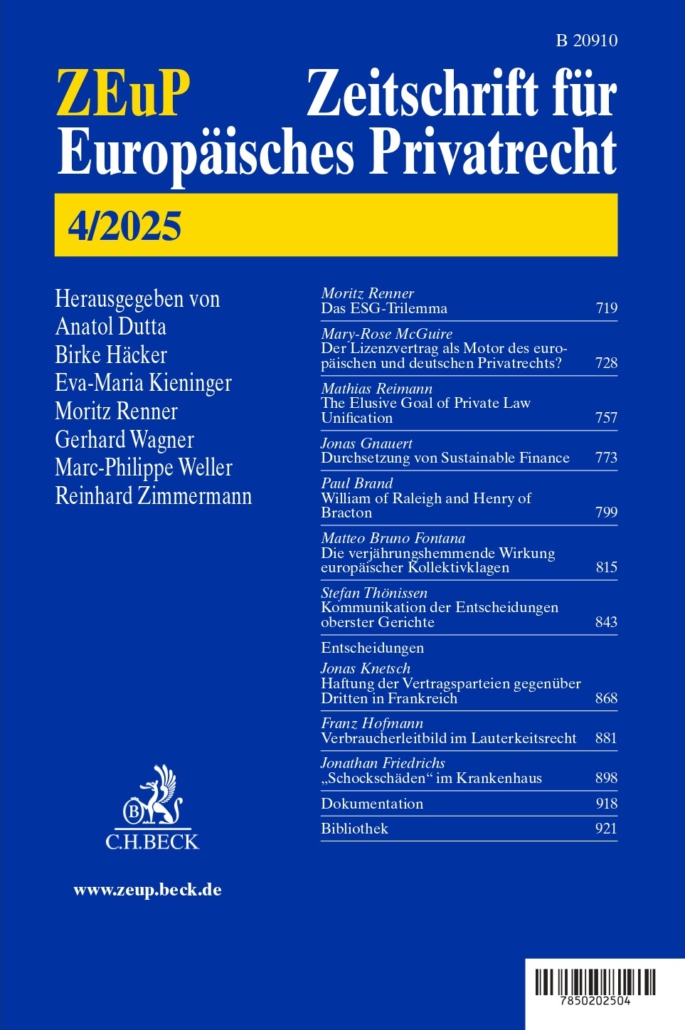
ZEuP – Zeitschrift für Europäisches Privatrecht 4/2025
A new issue of ZEuP – Zeitschrift für Europäisches Privatrecht is now available and includes contributions on EU private law, comparative law and legal history, legal unification, private international law, and individual European private law regimes. The full table of content can be accessed here: https://rsw.beck.de/zeitschriften/zeup.