


Views
Abu Dhabi Court of Cassation on Civil Family Law and Muslim Foreigners: Has the Tide Turned?
Written by Lena-Maria Möller,
College of Law, Qatar University
The recent introduction of a civil family law regime in the United Arab Emirates – the first of its kind in the region – has attracted considerable attention, both on this blog and beyond.[1] A key unresolved issue has been the law’s applicability in Abu Dhabi, particularly regarding access for Muslim foreigners to the emirate’s newly established Civil Family Court. Scholars and legal practitioners navigating this new framework have long observed a surprising discrepancy, if not an ideological tension, between the law’s drafters and those interpreting it, especially at the higher court level. Central to this divergence has been whether Abu Dhabi’s Law on Civil Marriage and Its Effects (Law No. 14/2021 of 7 November 2021, as subsequently amended) and its Procedural Regulation (Chairman Resolution No. 8/2022 of 1 February 2022) apply exclusively to non-Muslims or extend also to Muslim foreigners who are citizens of non-Muslim jurisdictions. A recent judgment by the Abu Dhabi Court of Cassation in late October affirmed jurisdiction over Muslim foreigners with dual French-Moroccan nationality, marking a potential shift in personal jurisdiction. This ruling may expand access to a legal framework devoid of religious underpinnings for many Muslim expatriates in the UAE.
Book review: H. Muir Watt’s The Law’s Ultimate Frontier: Towards an Ecological Jurisprudence – A Global Horizon in Private International Law (Hart)
(Written by E. Farnoux and S. Fulli-Lemaire, Professors at the University of Strasbourg)
 Horatia Muir Watt (Sciences Po) hardly needs an introduction to the readers of this blog. The book published last year and reviewed here constitutes the latest installment in her critical epistemological exploration of the field of private international law. More specifically, the book builds upon previously published fundamental reflections on the methods of private international law already initiated (or developed) in her previous general course (in French) at the Hague Academy of International Law (Discours sur les méthodes du droit international privé (des formes juridiques de l’inter-altérité)), as well as on the contemporary relevance of private international law (“Private International Law Beyond the Schism”). Numerous other works, naturally, also come to mind when reading this book (see among many others, ed. with L. Bíziková, A. Brandão de Oliveira, D. Fernandez Arroyo, Global Private International Law : adjudication without frontiers; Private International Law and Public law).
The publication of a book on the field that this blog deals with would be enough to justify it being flagged for the readers’ attention. We feel, however, that its relevance to our academic pursuits warrants more than a mere heads-up and, while it would be unreasonable (and risky) to try to summarize the content of this engrossing and complex book in a blog friendly format, we would like to make a few remarks intended to encourage the readers of this blog to engage with this innovative and surprising work.
Transforming legal borders: international judicial cooperation and technology in private international law – Part II
Written by Yasmín Aguada** [1]– Laura Martina Jeifetz ***[2]. Part I is available here
Abstract: Part II aims to delve deeper into the aspects addressed in the previously published Part I. International Judicial Cooperation (IJC) and advanced technologies redefine Private International Law (PIL) in a globalized world. The convergences between legal collaboration among countries and technological innovations have revolutionized how cross-border legal issues are approached and resolved. These tools streamline international legal processes, overcoming old obstacles and generating new challenges. This paper explores how this intersection reshapes the global legal landscape, analyzing its advantages, challenges, and prospects.
Keywords: private international law, international judicial cooperation, new technologies, videoconferencing, direct judicial communications, Smart contracts, and Blockchain.
News
Open Online Conference: “Cross-Border Enforcement of Child Support: Pros and Cons of the Different National Systems” on January 28th, 2026 3-5:30pm CET
The Child Support Forum in cooperation with the International Union of Judicial Officers is pleased to invite every interested stakeholders of the cross border child support recovery to an open conference on January 28th, 2026 from 3 to 5:30 pm (CET).
According to Art. 41 of Regulation (EC) No. 4/2009 and Art. 32 of the 2007 Child Support Convention, the enforcement procedure shall be governed by the law of the state of enforcement. But in practice, the prospects of successfully initiating cross-border enforcement proceedings are not always easy to assess. In order to enforce successfully, it is necessary to know the specifics of the legal system of the state of enforcement (the Requested state).
Key questions in this context are:
- What does the process of enforcement of child support looks like in different states?
- Are maintenance claims given a degree of priority?
- How do Central Authorities facilitate the ongoing enforcement of maintenance decisions?
- What are the conditions for children to be exempted from costs?
The meeting aims to review the international legal framework and provide an overview of the various national enforcement systems. Finally, the advantages and disadvantages of the different systems from a legal policy perspective shall be discussed.
The participation is free of charge but registration is required.
To register, click here.
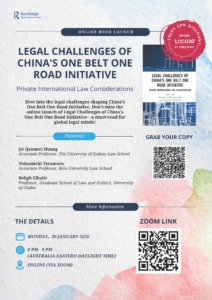
Online Book Launch – Legal Challenges of China’s One Belt One Road Initiative: Private International Law Considerations
Following the successful release of Legal Challenges of China’s One Belt One Road Initiative: Private International Law Considerations late last year, as previously announced on this blog, co-editors Dr Poomintr Sooksripaisarnkit (University of Tasmania) and Dr Sai Ramani Gariimella (South Asian University) are pleased to invite you to an upcoming online book launch.
This virtual event will feature insights from three distinguished contributors:
- Dr Jie (Jeanne) Huang (University of Sydney)
- Dr Nobumichi Teramura (Keio University Law School)
- Professor Beligh Elbalti (The University of Osaka)
Presentations will be followed by a moderated Q & A and discussion session.
This event is open to the public; please refer to the attached flyer to scan the QR Code for Zoom access.
Supreme Court of Canada to Hear Jurisdiction Appeal
Canada’s highest court does not grant leave to appeal in many cases involving private international law. In November 2025 it granted leave to appeal from NHK Spring Co., Ltd. v Cheung, 2024 BCCA 236, in which the British Columbia Court of Appeal agreed with the court below in holding that it had jurisdiction to hear a price fixing class action. The action is interesting because it involves what could be described as a “foreign” conspiracy that had effects within Canada.
The defendants are Japanese entities and the claim alleges that they conspired to fix the price of “suspension assemblies” which are a component of hard disk drives which are in turn a component of things like computers. The claim alleges that Canadians purchased products that contained these assemblies and because of the price fixing they paid more than they otherwise would have done.